


Nepal’s International Trade: A Decade of First-Month Trends in Imports, Exports and Trade Deficit (F.Y. 2073/74 - 2083/84)


.png)
Nepal is in a high-liquidity status, while the economy is moving at a slow pace. Now, in the first month of fiscal year 2083/84, trade data has been published by the Department of Customs. The first-month data of fiscal year 2083/84 is spreading a positive signal regarding trade. Here, we will evaluate the data of the first month of each fiscal year regarding international trade in Nepal for the 10 - year period from Fiscal Year (f.y.) 2073/74 to f.y. 2083/84.
Import
As Nepal is an import-based country, it imports most of its needs from other countries and is highly interdependent with other countries. Imports increased from Rs. 70.17 billion in f.y. 2073/74 to Rs. 187.44 billion in f.y. 2083/84. Although imports fluctuated considerably during the period, they reached a peak in the latest fiscal year. The sharp rise indicates Nepal’s continued dependence on foreign goods and products.
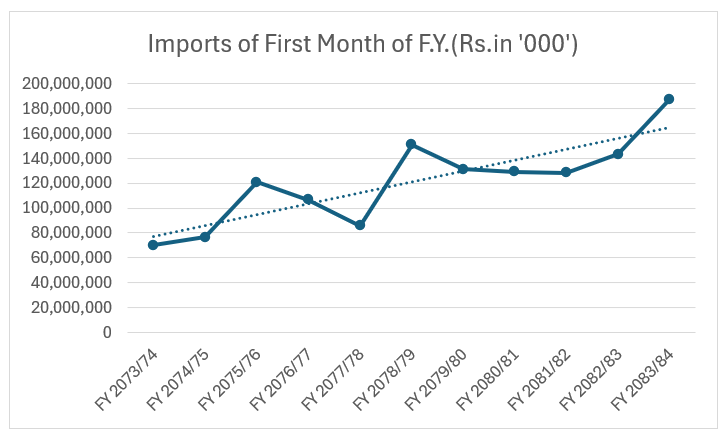
Imports are in an increasing trend. Nepal’s imports have shown a steadily increasing trend. As of 2073/74, the nation’s import volume was Rs. 70.16 billion. The import volume increased at an average growth rate of 13.66% annually. During the review period, the highest increase in imports was observed in the first month of 2078/79. In this year, imports increased by 75.66%, reaching Rs. 150.73 billion from Rs. 85.80 billion in the first month of 2077/78.
The second-highest increase was observed in 2075/76. In the first month of this fiscal year, imports increased by 57.18%, reaching Rs. 120.61 billion from Rs. 76.73 billion in f.y. 2074/75. Imports fell by 11.51%, narrowing to Rs. 106.72 billion in f.y. 2076/77. Again, imports declined by 19.60% in 2077/78, reaching Rs. 85.80 billion.
Exports
Based on the review period from the first month of F.Y. 2073/74 to the first month of 2083/84, the export amount was Rs. 6.95 billion in the first month of f.y. 2073/74. After ten years, exports for the first month reached Rs. 38.70 billion. The average growth rate stood at 24.54% annually.
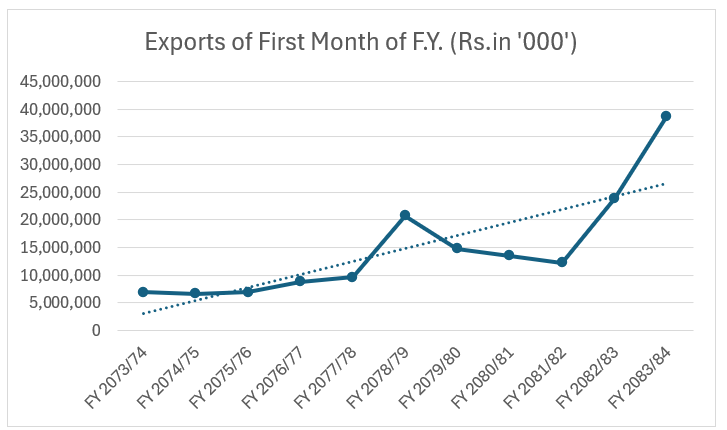
Nepal’s exports declined four times during the review period. The highest decline was observed in the first month of f.y. 2079/80, when exports declined by 28.68%, from Rs. 20.76 billion in f.y. 2078/79 to Rs. 14.80 billion in 2079/80. In the remaining three years, exports declined by less than 10%.
Trade Deficit
Nepal recorded a trade deficit throughout the entire period. The deficit increased from Rs. 63.21 billion in f.y. 2073/74 to Rs. 148.74 billion in 2083/84. The highest deficit was recorded in the latest fiscal year, showing that import growth continues to exceed export growth.
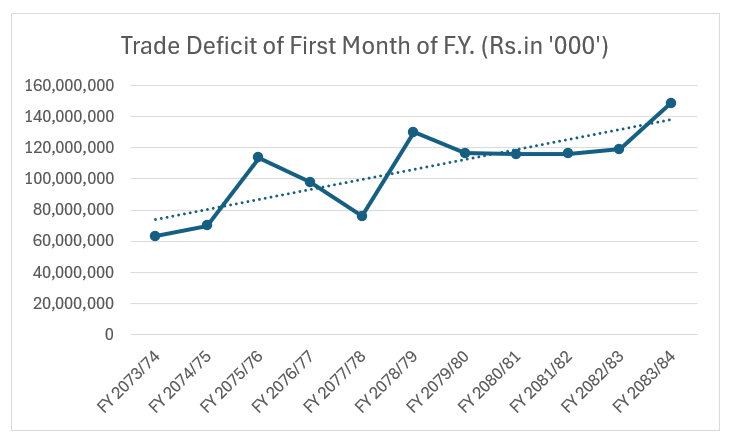
Trade deficit growth remained negative for four years. The highest negative growth was observed in the first month of f.y. 2077/78, at 22.17%. In the remaining years, negative growth remained below 10%. On average, the trade deficit grew by 12.43%.
Total Foreign Trade
Total foreign trade increased from Rs. 77.12 billion in f.y. 2073/74 to Rs. 226.15 billion in f.y. 2083/84. Despite fluctuations in the middle years, the overall trend is strongly upward. This reflects the growing integration of Nepal’s economy with international markets.
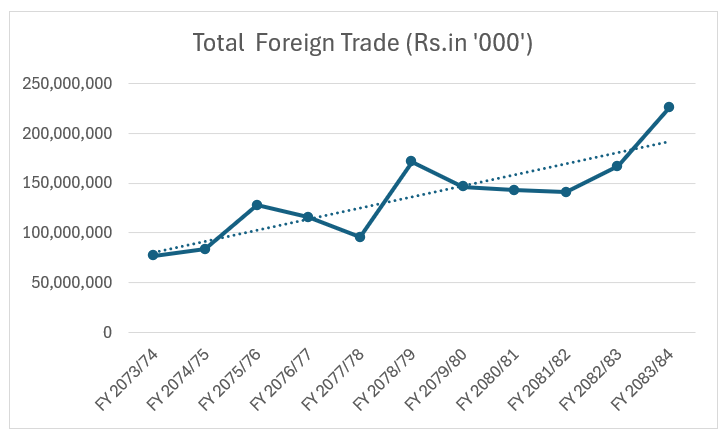
Nepal’s total foreign trade observed negative growth for five years during the review period. The highest negative growth was observed in the first month of f.y. 2077/78. During this period, trade declined by 17.42%, from Rs. 115.56 billion in f.y. 2076/77 to Rs. 95.42 billion. This decline was caused by the COVID-19 shock. On average, Nepal’s total foreign trade volume increased by 14.63% annually.
Imports/Exports Ratio
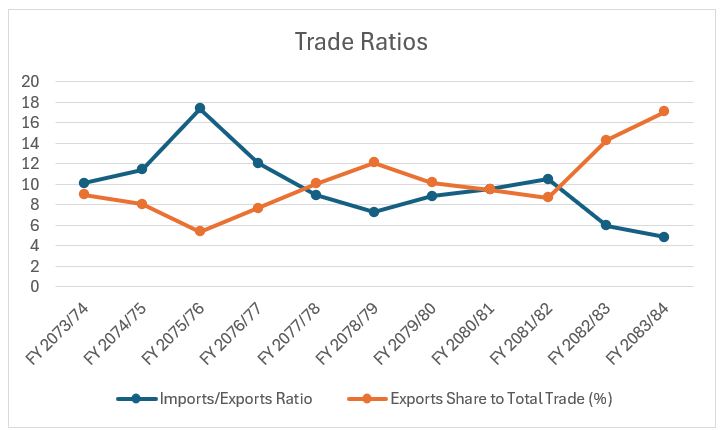
The imports to exports ratio was 10.1 in f.y. 2073/74 and reached a high of 17.4 in f.y. 2075/76. It subsequently declined to 4.84 in 2083/84. The declining ratio in recent years indicates that exports have grown faster relative to imports, although the gap remains substantial.
On average, the import/export ratio stood at 10.20 times based on the 10-year data. In the last two years, this ratio stood at around 5 times, indicating that export growth is supporting this ratio in a positive direction.
Exports Share of Total Trade
Exports accounted for only 9% of total trade in f.y. 2073/74 and declined to 5.4% in f.y. 2075/76. However, the share increased significantly afterward, reaching 17.11% in f.y. 2083/84. This indicates a gradual improvement in the contribution of exports to Nepal’s total foreign trade.
Imports Share of Total Trade
Imports dominated Nepal’s foreign trade throughout the period. Their share increased to 94.6% in F.Y. 2075/76 but gradually declined to 82.89% in f.y. 2083/84. The decline is a positive sign because it reflects the increasing share of exports, although imports still constitute the majority of total trade.
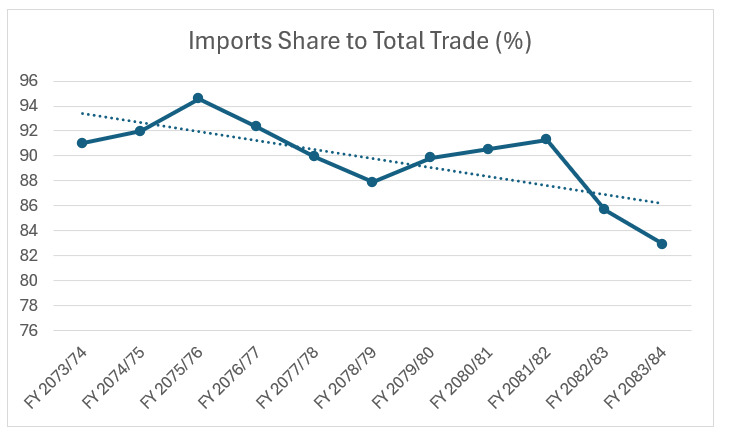
On average, this ratio stood at 90.50%. Meanwhile, in f.y. 2082/83, it stood at 85.67% and declined further to 82.89% in f.y. 2083/84, remaining lower than the average.
Conclusion
The analysis of first-month foreign trade data from f.y. 2073/74 to 2083/84 shows that Nepal’s foreign trade has expanded significantly. Total trade increased from Rs. 77.12 billion to Rs. 226.15 billion, mainly driven by rising imports. However, the country remained highly dependent on imports, resulting in a persistent trade deficit.
COVID-19 Shocks
The Government of Nepal (GoN) imposed a nationwide lockdown from March 24, 2020 (B.S. Chaitra 11, 2076). The intensity of the lockdown strengthened and weakened depending on the number of COVID-19 cases. Trade was significantly impacted by the lockdown.
The COVID-19 pandemic significantly affected trade, particularly in f.y. 2076/77 and 2077/78, when imports and total trade declined. Despite these disruptions, exports have shown strong long-term growth, increasing from Rs. 6.95 billion to Rs. 38.70 billion. The export share of total trade also improved from 9% to 17.11%, while the import-to-export ratio declined from 10.10 times to 4.84 times.
Policy Shocks
Sometimes, central banks impose restrictions on the import of goods and services, taking into consideration the status of foreign exchange reserves. Such restrictions can disrupt the smooth flow of international trade and create wider economic impacts.
Policy changes by the Government of India and other major trading partners can also significantly affect Nepal’s foreign trade.
Geopolitical and Regional Conflict Shocks
As an import-dependent country, Nepal’s international trade is highly exposed to global and regional developments. Various geopolitical tensions and regional conflicts can create significant shocks to Nepal’s trade by disrupting supply chains, increasing transportation costs, and affecting the availability and prices of imported goods.
Overall, the recent improvement in exports provides a positive signal for Nepal’s external trade. However, reducing the trade deficit and import dependence remains a major challenge. Sustained export growth, diversification of products and markets, and stronger domestic production are essential for achieving a more balanced trade structure.

