


Economic Status Paper 2083 Unveiled: Government Calls for Deep Structural Transformation

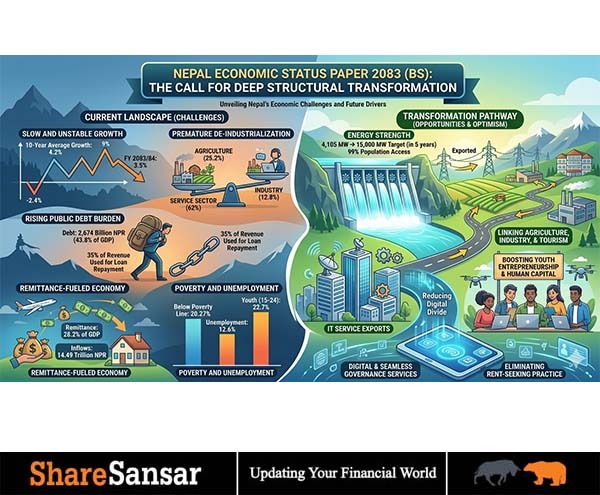
The Government of Nepal has released the Economic Status Paper 2083 (Swat Patra 2083), highlighting major structural challenges in the economy and calling for a shift toward sustainable economic transformation.
Slow and Unstable Economic Growth
According to the report explained in point 8, Nepal’s average economic growth over the past decade has remained at around 4.2 percent. In the review time horizon of decade, growth trendline touch in negative growth 2.4% to highest peak of growth rate was 9%. Although growth reached 4.61 percent in FY 2081/82, it is projected to decline to 3.5 percent in the current fiscal year. Indicators seems dissatisfying comparing with neighbor countries. The economy is described as structurally imbalanced, with declining agricultural contribution and rising dominance of the service sector.
Premature de-industrialization
The economy is shifting toward services without proper industrialization (premature de-industrialization). In comparison on f.y. 2072/73 to f.y. 2081/82 Agriculture’s share has declined from 28.4% to 25.2% services increased 57.5% to 62%, and industry weakened 14.1% to 12.8%. This structural shift seems challenging t0 develop value creation-based economy.
Weak Revenue Mobilization
Revenue growth has slowed in recent years. Revenue growth was in 14.9% p.a. before covid – 19 (f.y. 2076/77) but growth rate has been dropping 8.7% p.a. in five years of post-covid – 19. Covid – 19 seemed negative shocked for revenue. Revenue performance has deteriorated, with the revenue-to-GDP ratio declining from 21.5 percent to 19.3 percent. Revenue collection has reached only about 87.6 percent of targets. Around 45 percent of revenue depends on imports, and the informal economy estimated at 40 percent of GDP continues to narrow the tax base.
Rising Public Debt Burden
Public debt has increased sharply from 22.5 percent (in Amount Rs. 544 billion) of GDP in 2072 to 43.8 percent (In Amount: 2,674 billion) currently. By Chaitra 2082, total public debt reached NPR 28.78 trillion. A significant portion of the budget is now used for debt servicing, with about 35 percent of total revenue spent on loan repayment, creating resource constrain for development.
Inflation and Exchange Rate
Inflation remaining in safe zone give stability in public stress in inflation. In report declining demand after covid – 19 has give stability in inflation rate. Which was 4.1% in last fiscal year and stayed in 2.13% in last eight month of current fiscal year. Inflation rate yet to be watch as sequential effect of middle east war.
Exchange rate, Nepalese rupees with USD keep depreciated. This isn’t because of Nepalese economic indicators. As Nepalese rupees is pegged with India currency. IC keeps depreciating. In B.S. 2049 Magh, Nepalese Rs. 49.80 can buy 1 USD and As of Chaitra 13, 2082 Rs. 150.67 need to buy 1 USD. As import based economy, it will affect import and trade of Nepal. As import is 45% revenue contributor for nation.
Remittance-fueled Economy
Remittance remains the backbone of Nepal’s economy, contributing about 28.2 percent of GDP. By Chaitra 2082, remittance inflows reached NPR 14.49 trillion. However, reliance on remittance and outward migration poses long-term risks.
Financial Sector Concerns
Despite adequate liquidity in banks, loan demand remains weak. Another side, increasing loan in private sectors hasn’t contributing for good employment generating areas. Non-performing loans (NPL) have risen to 5.42 percent. The cooperative sector crisis has also put billions of rupees at risk, raising concerns about overall financial sector stability.
Energy and Infrastructure: A Positive Outlook
The report identifies the energy sector as a major strength. Electricity production has significantly increased from 697 MW on end of Asadh 2068, to over 4,105 MW, on end of Falgun 2082, with access expanded to 99 percent of the population. Though transmission and demand issues persist. The country has also started exporting electricity. Road infrastructure has expanded significantly, though quality and maintenance remain issues.
Poverty and Unemployment Challenges
Based on report, about 20.27 percent of the population lives below the poverty line, with higher poverty rates in rural areas. Overall unemployment stands at 12.6 percent. Gender wise, Female and male unemployment stand at 13.1% and 10.30% respectively. While youth unemployment (ages 15–24) is significantly higher at 22.7 percent. This has driven large-scale migration for foreign employment. Out of employed people 64.9% of them take daily basis wage, which indicate huge people are out of employment benefits schemes.
Optimism: Economic Transformation
The report outlines key drivers for transformation, including:
- Expanding electricity production to 15,000 MW within five years
- Linking agriculture with industry and tourism
- Promoting Information and Technology service exports and reducing the digital divide
- Developing year-round tourism infrastructure
- Eliminating rent-seeking practices and promoting competitive markets
- Increase entrepreneurship in youth
- Establishing digital and seamless government services
- Building human capital for nation development

