Nabil, Prabhu Lead Deposit Rates as Average Bank Interest Rates Decline in Bhadra

Sun, Aug 16, 2026 11:51 AM on Interest Rates, Latest,

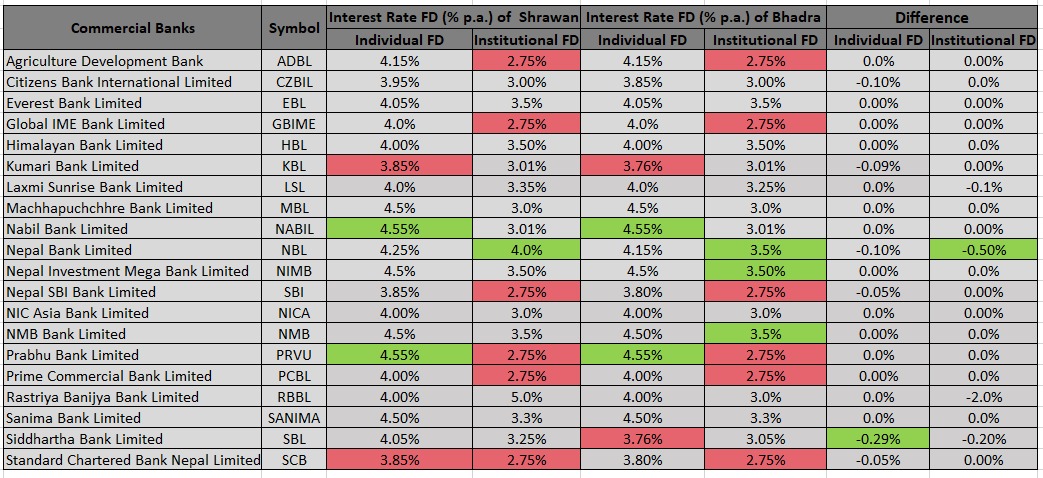
Nepal’s 20 commercial banks have published their new interest rates for the month of Bhadra, with the average deposit rates declining further compared to Shrawan amid continued high liquidity in the banking system.
The average maximum interest rate on individual deposits has declined by 0.0315 percentage points to 4.136% in Bhadra from 4.1675% in Shrawan. Similarly, the average interest rate offered on institutional deposits has fallen to 3.081% from 3.116% in the previous month.
Five commercial banks have reduced their deposit interest rates for Bhadra. Siddhartha Bank has made the largest reduction, cutting its individual deposit rate by 0.29 percentage points and its institutional deposit rate by 0.20 percentage points. The bank’s new rates stand at 3.76% for individual deposits and 3.05% for institutional deposits.
Nepal Bank has reduced its individual deposit rate by 0.10 percentage points to 4.15% and its institutional deposit rate by 0.50 percentage points to 3.50%.
Similarly, Citizens Bank has set its individual deposit rate at 3.85%, while Kumari Bank has set it at 3.76%. Standard Chartered Bank has reduced its rate to 3.80%.
The remaining 15 commercial banks have maintained the interest rates they offered in Shrawan.
Nabil Bank and Prabhu Bank continue to offer the highest individual deposit interest rate among the commercial banks, at 4.55%.
Nepal Investment Mega Bank, NMB Bank, Sanima Bank, Machhapuchchhre Bank, Rastriya Banijya Bank, and Global IME Bank are among the institutions that have retained their previous rates for Bhadra.
The continued decline in deposit rates comes as banks face excess liquidity and relatively weak demand for credit. With funds continuing to accumulate in the banking system, banks are maintaining a strategy of reducing the cost of deposits while keeping interest rates relatively low.
The trend indicates that liquidity conditions in Nepal’s banking sector remain comfortable, with subdued credit demand continuing to put downward pressure on deposit rates.