

How Did We Perform As a Nation in First Month of Fiscal Year 2083/84? A Quick Macroeconomic Summary
Fri, Sep 18, 2026 9:13 PM on Highlight News, Economy, National,
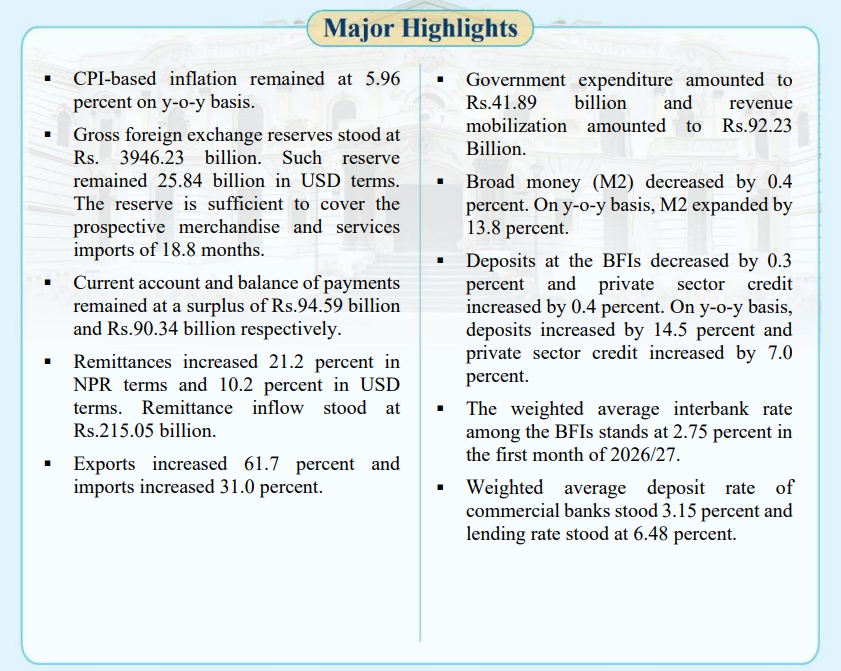
Nepal Rastra Bank, the central bank of Nepal, has unveiled the current macroeconomic and financial situation of Nepal based on one-month data (Ending Mid-August) of FY 2026/27.
Overall
Nepal Rastra Bank estimated that inflation remained at 5.96 percent on a year-over-year basis. The gross foreign exchange reserves stood at 25.84 billion in USD terms, whereas total imports and exports increased 61.7 percent, and imports increased 31.0 percent.
NEPSE index stood at 2,643.83 in mid-August 2025, compared to 2788.37 in mid-August 2025.
Inflation
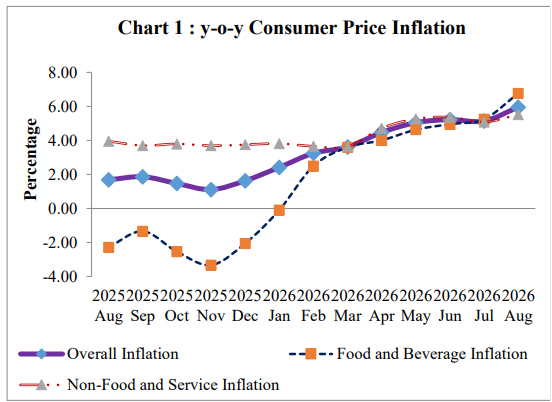
The y-o-y consumer price inflation stood at 5.96 percent in mid-August 2026 compared to 1.68 percent a year ago.
The Year-on-year consumer price inflation rose to 5.96 percent in mid-August 2026, up from 1.68 percent recorded a year earlier. Food and beverages inflation reached 6.77 percent, while non-food and services inflation stood at 5.52 percent during the review period.
Import and Export
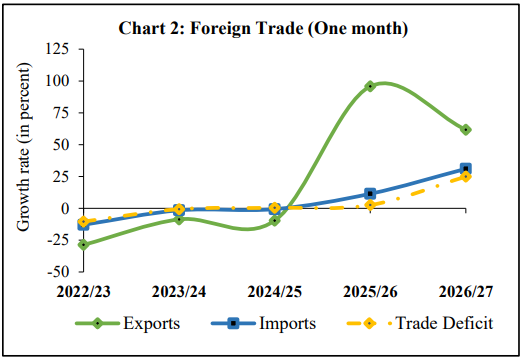
During the first month of 2026/27, merchandise exports increased by 61.7 percent to Rs. 38.70 billion, compared with 95.7 percent growth in the same period of the previous year. Destination-wise, exports to India, China, and other countries increased by 71.0 percent, 287.8 percent, and 18.1 percent, respectively. Exports of soaybean oil, palm oil, polyester yarn and thread, jute goods, and particle board, among others, increased. In contrast, exports of Ayurvedic medicine, tanned skin, rosin, herbs, and Nepali paper and paper products, among others, declined during the review period.
During the first month of 2026/27, merchandise imports rose by 31.0 percent to Rs. 187.44 billion, compared to a growth of 11.4 percent a year earlier. Imports from India, China, and other countries increased by 22.6 percent, 13.4 percent, and 69.0 percent, respectively. Imports of petroleum products, chemical fertilizer, edible oil, oilseeds, and crude soyabean oil, among others, increased, whereas imports of rice/paddy, gold, bitumen, coal, and medical equipment and tools, among others, declined during the review period.
The total trade deficit increased by 24.9 percent to Rs. 148.74 billion during the first month of 2026/27, compared to a 2.5 percent increase in the corresponding period of the previous year. Meanwhile, the export-import ratio improved to 20.6 percent during the review period from 16.7 percent in the corresponding period of the previous year.
Services and Remittance
Net services income recorded a deficit of Rs. 10.82 billion during the review period, compared to a deficit of Rs. 13.24 billion in the corresponding period of the previous year.
Remittance inflows increased by 21.2 percent to Rs. 215.05 billion during the first month of 2026/27, compared to a 29.9 percent increase recorded in the same period of the previous year. In US dollar terms, remittance inflows rose by 10.2 percent to USD 1.40 billion during the review period, compared to a 25.0 percent increase in the corresponding period of the previous year.
Inter-bank Transaction
During the review period, interbank transactions of BFIs stood at Rs. 127.28 billion on a turnover basis. Of this, Rs. 120.50 billion represented transactions among commercial banks, while Rs. 6.78 billion involved other financial institutions, excluding transactions among commercial banks. In the corresponding period of the previous year, total interbank transactions amounted to Rs. 94.94 billion, including Rs. 87.49 billion among commercial banks and Rs. 7.45 billion among other financial institutions.
Price of Oil and Gold
In the international market, the price of Brent crude oil rose by 36.7 percent to USD 92.02 per barrel in mid-August 2026, up from USD 67.30 per barrel a year earlier. Similarly, the price of gold increased by 31.6 percent to USD 4,390.70 per ounce during the same period, compared to USD 3,335.50 per ounce a year ago.
Foreign Exchange Reserves and Adequacy Indicator
Based on merchandise imports during the first month of 2026/27, the banking sector’s foreign exchange reserves are sufficient to cover 21.8 months of prospective merchandise imports and 18.8 months of merchandise and services imports. As of mid-August 2026, the reserves-to-GDP, reserves-to-imports, and reserves-to-M2 ratios stood at 59.8 percent, 157.0 percent, and 44.5 percent, respectively. In comparison, these ratios stood at 59.1 percent, 163.4 percent, and 43.8 percent, respectively, in mid-July 2026.
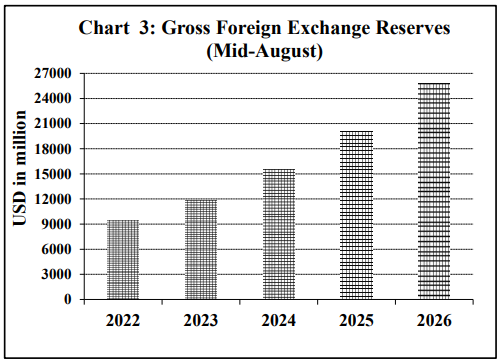
Gross foreign exchange reserves increased by 1.2 percent to Rs. 3,946.23 billion in mid-August 2026, up from Rs. 3,897.67 billion in mid-July 2026. In US dollar terms, gross foreign exchange reserves rose by 2.1 percent to USD 25.84 billion in mid-August 2026 from USD 25.31 billion a month earlier.
Of the total foreign exchange reserves, reserves held by Nepal Rastra Bank increased by 1.3 percent to Rs. 3,517.99 billion in mid-August 2026 from Rs. 3,473.19 billion in mid-July 2026. Similarly, reserves held by BFIs, excluding NRB, rose by 0.9 percent to Rs. 428.22 billion from Rs. 424.48 billion during the same period. The share of Indian currency in total foreign exchange reserves stood at 21.8 percent in mid-August 2026.
Exchange Rate
The Nepalese rupee appreciated by 0.9 percent against the US dollar in mid-August 2026 compared to mid-July 2026, whereas it had depreciated by 2.0 percent during the same period of the previous year. The buying exchange rate of the US dollar stood at Rs. 152.39 in mid-August 2026, compared to Rs. 153.72 in mid-July 2026.
Nepal Government Expenditure and Revenue
According to the Ministry of Finance and Financial Comptroller General Office (FCGO), the Government’s total expenditure stood at Rs. 41.89 billion during the first month of 2026/27. Of the total, recurrent expenditure amounted to Rs. 21.40 billion, while capital expenditure and financial expenditure stood at Rs. 1.33 billion and Rs. 19.15 billion, respectively. During the review period, the Government mobilized total revenue of Rs. 92.23 billion, including the amount to be transferred to provincial and local governments. Of this, tax revenue amounted to Rs. 85.19 billion, while non-tax revenue stood at Rs. 7.03 billion.
Cash Balance of Government
The cash balance in various Government of Nepal (GoN) accounts maintained at Nepal Rastra Bank stood at Rs. 361.81 billion in mid-August 2026, including the accounts of provincial and local governments. The balance had stood at Rs. 277.46 billion in mid-July 2026.
Banking
Domestic credit declined by 1.2 percent during the review period, compared to a 1.6 percent decrease in the corresponding period of the previous year. On a year-on-year basis, however, domestic credit increased by 2.5 percent as of mid-August 2026.
The monetary sector’s net claims on the government decreased by 13 percent during the review period, compared to a 10.1 percent decline in the corresponding period of the previous year. On a year-on-year basis, such claims decreased by 27.5 percent as of mid-August 2026.
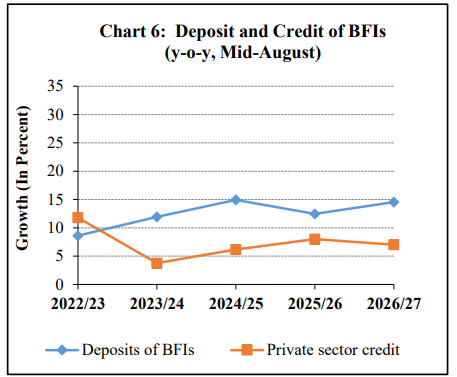
Deposits at BFIs decreased by Rs. 20.71 billion (0.3 percent) to Rs. 8,256.21 billion during the review period, compared to a decline of Rs. 55.79 billion (0.8 percent) in the corresponding period of the previous year. On a year-on-year basis, deposits at BFIs increased by 14.5 percent as of mid-August 2026.
Private sector credit from BFIs increased by Rs. 23.58 billion (0.4 percent) to Rs. 5,880.64 billion during the review period, compared to a decrease of Rs. 2.93 billion (0.1 percent) in the corresponding period of the previous year. On a year-on-year basis, credit to the private sector from BFIs increased by 7.0 percent as of mid-August 2026.
Interest Rates
The average base rates of commercial banks, development banks, and finance companies stood at 4.72 percent, 6.14 percent, and 6.95 percent, respectively, during the first month of 2026/27. In the corresponding month of the previous year, the average base rates of commercial banks, development banks, and finance companies stood at 5.78 percent, 7.28 percent, and 8.87 percent, respectively.
Balance of Payments
The Balance of Payments (BOP) remained in surplus at Rs. 90.34 billion during the review period, compared to a surplus of Rs. 89.30 billion in the previous year. In US dollar terms, the BOP recorded a surplus of USD 589.54 million during the review period, compared to a surplus of USD 641.17 million in the corresponding period of the previous year.

