

The Million Rupee Receipt: How a Simple Lottery Could Hand Nepal’s Government Billions in Missing Taxes
Picture yourself stepping into a bustling restaurant in New Road, Kathmandu, having a tasty plate of momo and a drink, and then paying the Rs. 300.00 bill by swiftly scanning a QR code with your phone.
More often than not, the story ends right there. You eat, you pay, and you leave. Unless you specifically demand an official tax invoice from the business owner, that purchase might never enter their legitimate ledgers. Unrecorded sales are uncollected taxes – a huge, quiet leak in Nepal’s coffers.
Now, in a bid to stop these leaks, the Ministry of Finance and the Inland Revenue Department (IRD) are turning to psychology with a dash of luck. Under the Taxpayer Incentive Gift Program, that everyday retail receipt has transformed from a mere piece of paper or an SMS confirmation into an entry into a lottery with significant cash prizes.
By offering daily rewards of Rs. 133,034 and a weekly jackpot of Rs. 1,000,000, the government aims to turn a million ordinary consumers into an active, self-policing network of tax enforcers.
1. The Behavioral Nudge: Turning Consumers into Tax Inspectors
Tax administration has traditionally been a grueling process. Revenue authorities expend millions of rupees on auditing businesses, examining account books, and trying to catch dishonest sellers who keep "double books" - one official ledger for the tax department and a much richer one for themselves.
The bill lottery fundamentally changes this dynamic by adjusting consumer incentives.
Traditional Model: Business owner hides the sale; Consumer has no reason to care about a receipt. The tax is lost forever.
Incentivized Model: Customer asks for the receipt. Business owner records the real sale (VAT is applicable and captured). The tax is collected.
Instead of Stationing a tax inspector in every shop, street food stall, and store, the Government has provided you with a financially rewarding motivation to demand a proper VAT invoice every time you pay for a good or service.
When you confidently say “Please give me my VAT receipt,” it’s not just because you like to be thorough; you’re actually entering a contest where you could win up to Rs 1 million! This simple change in consumer behavior makes it much harder for businesses to operate in the shadow economy.
2. Who can participate and how does it work?
The best part about the lottery system is its sheer simplicity. You don’t have to purchase separate lottery tickets; your regular consumer purchases will act as entries into the program. However, there are some key parameters:
Entry Requirements:
i. The minimum value of a qualifying purchase (for personal consumption) is typically around Rs. 100.
ii. A valid business with a registered Permanent Account Number (PAN) or Value Added Tax (VAT) number must issue the receipt.
iii. The purchase must be for personal consumption; commercial and business-to-business (B2B) transactions are excluded.
iv. Public utility bills such as electricity, telephone, internet, and water charges, along with airline tickets and vehicle purchases, are not eligible for the lottery.
v. Each transaction/bill payment can only be used once as an entry.
Transaction Type Amount qualifies for lottery? Reason
a. Groceries Rs. 80 No. Less than the minimum threshold.
b. Coffee at a shop Rs. 250 Yes. Purchase of a personal item from a registered business.
c. Mobile Phone purchase Rs. 45,000 Yes. Consumer electronics purchase, with proper bill and PAN.
d. Utility bill (electricity) Rs. 3,200 No. Public utilities are excluded.
e. Wholesale stock purchase Rs. 150,000 No. This is a B2B transaction.
3. Breakdown of prizes and the 25% tax.
The lottery draws and prizes are divided into two categories to keep the excitement high:
a. Daily Drawings: One winner each day receives a prize of Rs. 133,034.
b. Fortnightly Bumper Drawings: Two lucky winners each month take home a cool Rs. 1,000,000.
It’s important to remember that these are gross prize amounts. Under Nepal’s income tax laws, winnings are considered a type of windfall gain and are subject to a flat 25% tax deducted at source. Here’s how that plays out for a winner:
|
Particulars |
Daily Winner Prize |
Bumper Winner Prize |
|
Gross Prize |
Rs. 133,034.00 |
Rs. 1,000,000.00 |
|
Deduction @ 25% |
Rs. 33,258.50 |
Rs. 250,000.00 |
|
Net Payout |
Rs. 99,775.50 |
Rs. 750,000.00 |
4. Why This Model is a Win-Win for the Government.
The idea of doling out such large sums of cash daily and fortnightly might seem like a steep expenditure. However, from a fiscal perspective, it’s remarkably cost-effective.
Annual Programme Budget:
a. For daily draw (365 days x Rs 133,034) = Rs 48,557,410
b. For bumper draw (24 times a year x Rs 1,000,000) = Rs 24,000,000
c. Total prize money allocated per year: approximately Rs 72,557,410 (about 7.26 Crore)
This figure doesn't account for administrative overheads like awareness campaigns, website maintenance, and verification technology, which could easily add another Rs 5 to 10 crore, bringing the total yearly cost to somewhere between Rs 12 to 17 crore.
Now, compare that to Nepal’s VAT collection target, which is projected to be over Rs 400 billion. Even with all administrative expenses, the entire lottery programme consumes less than 0.02% of Nepal's annual VAT revenue.
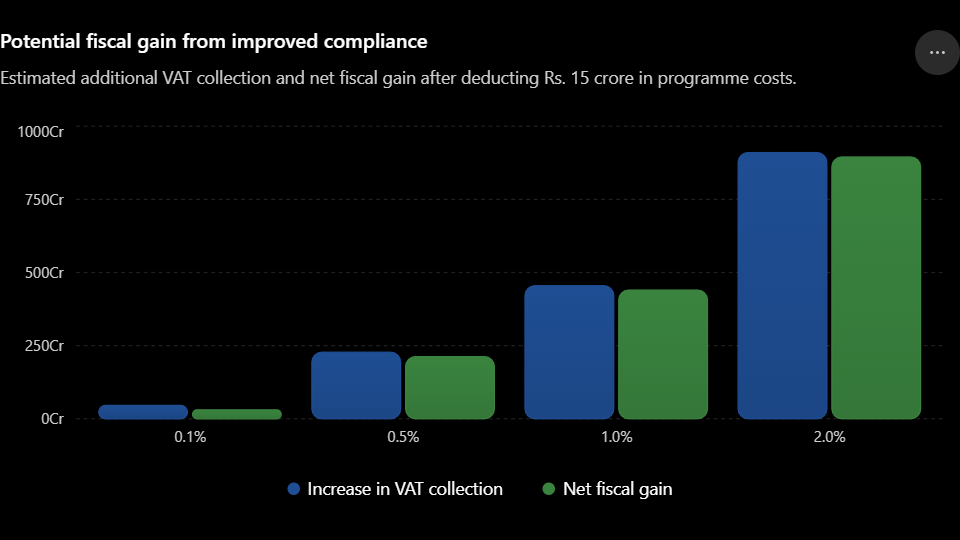
To simply break even on the program’s costs, the government needs to capture just Rs 115 Crore in previously unreported taxable transactions (at 13% VAT). Given that a vast amount of retail transactions happen informally, reaching this breakeven point is an incredibly low bar. If the program increases compliance by even a small margin, the financial returns will skyrocket.
|
Percentage Increase in Compliance |
Increase in VAT Collection |
Net Fiscal Gain* |
|
0.1% |
Rs. 45.5 Crore |
Rs. 30.5 Crore |
|
0.5% |
Rs. 227.5 Crore |
Rs. 212.5 Crore |
|
1.0% |
Rs. 455 Crore |
Rs. 440 Crore |
|
2.0% |
Rs. 910 Crore |
Rs. 895 Crore |
* Net Fiscal Gain = Increase in VAT Collection − Rs. 15 Crore estimated total programme cost.
Potential fiscal gain from improved compliance
Estimated additional VAT collection and net fiscal gain after deducting Rs. 15 crore in programme costs.
5. The Domino Effect: A boon to Corporate Income Tax
The benefits of capturing every retail transaction don’t just end with Value Added Tax. Once a purchase is recorded and a proper receipt is issued, it naturally enters the formal financial system.
This means that those sales cannot be conveniently overlooked when the business owner files their annual corporate income tax return. The trickle-down effect of ensuring proper VAT reporting creates an audit trail for other taxes as well:
i. Mandatory VAT issuance prompts honest reporting for corporate income tax at the year-end.
ii. It also encourages better compliance for Withholding Tax (TDS) and Payroll Taxes.
A conservative estimate suggests that for every Rs 100 billion added to the formal tax net through this initiative, the government not only benefits from an additional Rs 50 to 80 billion in VAT but also from roughly Rs 2.5 billion in corporate income tax.
6. Digital Infrastructure Links QR Codes to IRD Software.
The real success of this programme hinges on Nepal's robust digital payment system and increasing QR code penetration. Commercial banks and Payment Service Providers (PSPs) will be tightly integrated with the Inland Revenue Department’s central database.
When a consumer makes a payment via a QR code at a registered establishment, the payment system will communicate with the IRD’s server to verify that the transaction indeed occurred with a legitimate business and was appropriately recorded. This automation significantly reduces the potential for fraudulent submissions and manual errors.
Furthermore, the vast amount of data generated will offer the IRD invaluable insights into purchasing trends, sector-wise sales volumes, and regional compliance patterns, enabling smarter and more targeted tax administration strategies.
7. How Winners Claim Their Prize
If your transaction is selected during a daily or fortnightly draw, the process for claiming your money is strictly defined:
- Notification: Winners are notified directly via SMS to their registered mobile number or via email, with official announcements published on the IRD website.
- 15-Day Claim Window: Winners must submit their claim within 15 calendar days of the announcement.
- Required Documentation:
- Original purchase invoice/receipt
- Official identification (Citizenship card or Passport)
- Personal Permanent Account Number (PAN)
- Bank account details for direct electronic transfer
- Verification: The relevant Inland Revenue Office verifies the submitted documents within 10 days before releasing the funds directly into the winner's bank account.
- The Unclaimed Clause: If a winner fails to claim their prize within the 15-day window, the prize money is not retained by the IRD—it is automatically transferred to the Prime Minister's Disaster Relief Fund.
A Win-Win for the Public Purse
The Taxpayer Incentive Gift Programme is more than a novelty giveaway. It is an efficient, low-cost policy mechanism that leverages consumer self-interest to solve a structural enforcement problem.
For the government, spending a few crore rupees on prizes to capture hundreds of crore rupees in missing tax is one of the highest-yield investments available in public finance. For everyday citizens, the takeaway is simple: the next time you pay for groceries, dinner, or clothes, ask for your official tax bill. That small piece of paper might just be worth a million rupees.
Article By: Aashish Bhattarai

