


NEPSE Slips by Around 300 Points During Dr. Swarnim Wagle's First 100 Days as Finance Minister

Wed, Jul 8, 2026 1:56 PM on Economy, NEPSE News, Latest, Stock Market,
.png)
Nepal successfully completed its parliamentary elections in 2082 BS, with the Rastriya Swatantra Party (RSP) emerging as the largest party by securing nearly a two-thirds majority in the House of Representatives. The party subsequently formed a strong government, with Mr. Balendra Shah appointed as Prime Minister and Dr. Swarnim Wagle appointed as Finance Minister on March 27, 2026 (Chaitra 13, 2082).
Since March 27, 2026, fell on a Friday when the Nepal Stock Exchange (NEPSE) remained closed, the last trading session before the new government took office was on March 26, 2026. On that day, the NEPSE Index closed at 2,950.16, gaining 14.21 points.
When the market reopened on March 29 (Sunday), the NEPSE Index declined sharply by 71.05 points (2.40%). The downward trend continued on the following trading day, March 30, when the index fell by another 47.71 points (1.65%). Since then, the market has largely maintained a declining trend.
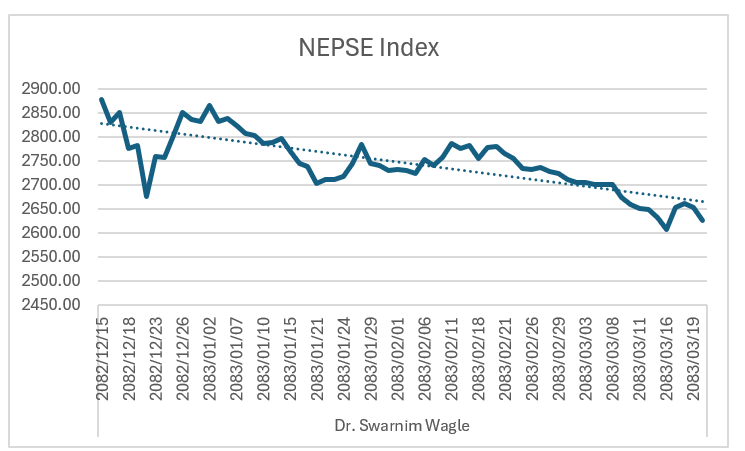
On July 7, 2026 (Asadh 23, 2083), Dr. Swarnim Wagle completed 100 days in office as Finance Minister. By that date, the NEPSE Index had fallen to 2,651.68, representing a decline of 298.48 points, or 10.12%, compared with its level before the new government assumed office.
Despite the formation of a majority government with new leadership and interest rates remaining at historically low levels, the stock market has not responded as economic theory would typically suggest. Instead, the NEPSE has exhibited weak and unexpected performance.
This trend indicates that investors remain uncertain about the country's future economic direction. Market participants appear to be waiting for stronger policy initiatives, structural reforms, and a more investment-friendly environment before regaining confidence in the stock market.

