

Nepal Government Expenditure Trend Analysis: A Fiscal Review from FY 2061/62 to FY 2083/84 Overview
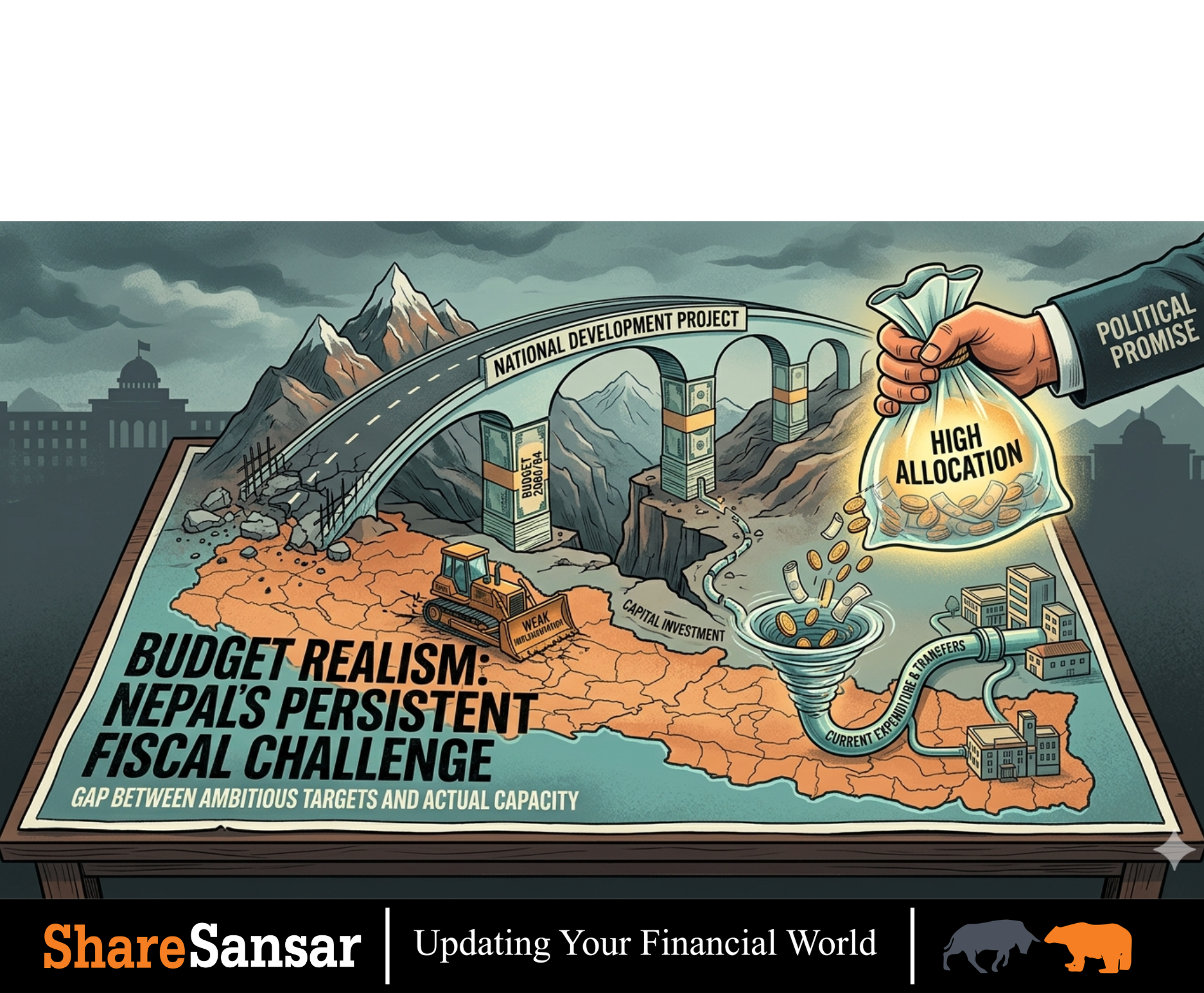
Following the Gen-Z-led protests against corruption, political non-accountability, and governance failure, Nepal entered a new political phase. In the 2082 election, the three traditional major parties were largely rejected by voters, while the Rastriya Swatantra Party (RSP) secured a majority mandate. After forming the government, the RSP presented its first fiscal budget for FY 2083/84.
As first fiscal budget presented by RSP cabinet, evaluating the Government of Nepal’s (GoN) fiscal expenditure data over the past two decades and connecting onward. Data shows a massive expansion in the size of the national budget. However, despite the continuous growth in allocated expenditure, spending efficiency particularly in capital expenditure remains structurally weak. The data reveals a persistent imbalance between recurrent and development spending, highlighting concerns regarding fiscal discipline, implementation capacity, and long-term economic productivity.
The dataset covers fiscal years from 2061/62 to 2083/84 and includes trends in total expenditure, current expenditure, capital expenditure, financial transfers, and financial expenditure.
Rapid Expansion of Government Spending
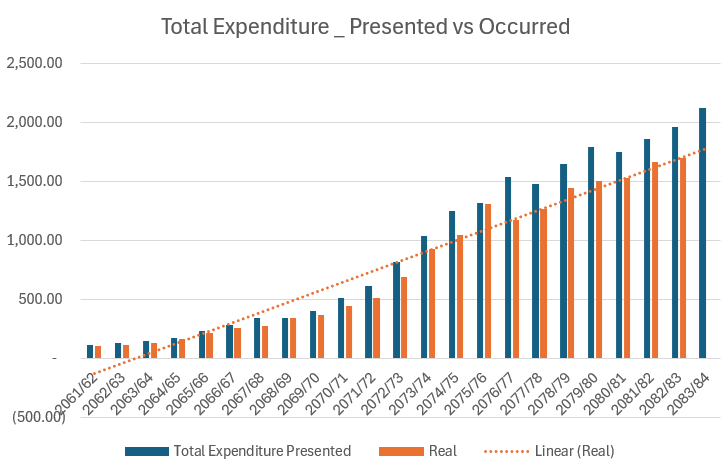
Nepal’s total presented expenditure increased from NPR 111.69 billion in FY 2061/62 to NPR 2,124.34 billion in FY 2083/84. This represents nearly a 19-fold increase in government spending within two decades. Actual expenditure also grew significantly, rising from NPR 100.94 billion to NPR 1,696.33 billion by FY 2082/83. The data indicates that (GoN) has aggressively expanded fiscal operations, particularly after federal restructuring and increasing social protection obligations.
However, expenditure growth has not always translated into efficient budget execution. The average expenditure achievement rate during the study period stands at only 88 percent, meaning around 12 percent of the annual budget remains unspent on average. This suggests that budget expansion has outpaced implementation capacity.
Current Expenditure Continues to Dominate Fiscal Structure
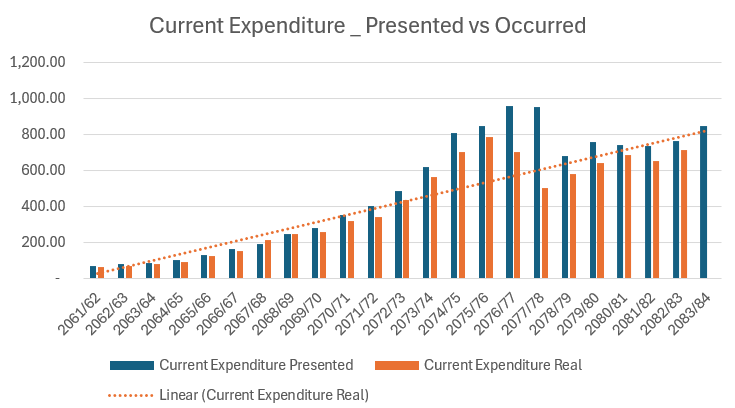
Current expenditure has consistently remained the largest component of government spending. It increased from NPR 67.61 billion in FY 2061/62 to NPR 846.31 billion in FY 2083/84. The execution rate of current expenditure remains relatively high, averaging around 90 percent throughout the study period. In several years, current expenditure utilization exceeded 95 percent.
This trend indicates that recurrent obligations such as:
- General Public Service Expenditure
- Social Security Payment
- Regular Government Services
However, the continued dominance of recurrent expenditure raises serious structural concerns. A growing share of public resources is being absorbed by consumption-oriented spending rather than productive investment.
The data shows that while the government can efficiently spend on administration and mandatory obligations, it struggles to convert budget allocations into productive capital assets.
Persistent Weakness in Capital Expenditure
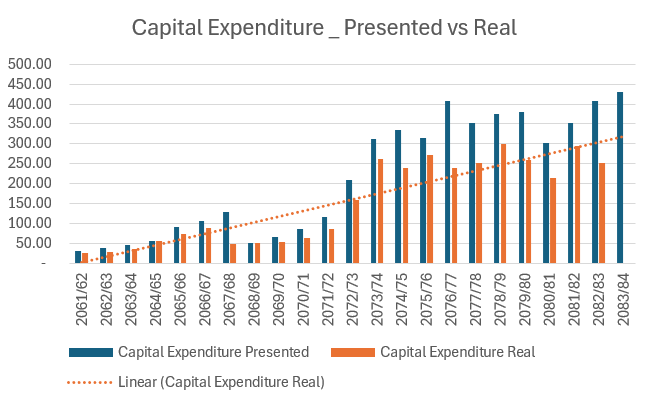
Capital expenditure remains the weakest area of Nepal’s fiscal management system. Although presented capital expenditure increased from NPR 31.58 billion in FY 2061/62 to NPR 431.11 billion in FY 2083/84, actual implementation has remained consistently poor.
The average capital expenditure achievement rate during the study period is only 76 percent, significantly lower than current expenditure performance. Fiscal year 2067/68, 2076/77 and 2082/83 are achieved only 37, 59 and 62 percent achievement only.
Comparing occurred expenditure vs. occurred capital expenditure. This shows that development projects related to capital generating in future isn’t getting movement. This reflects deep-rooted structural issues as well as policy maker perspective towards future development. Comparing the Even in years with larger development budgets, spending efficiency deteriorated rather than improved. Here is the trendline;
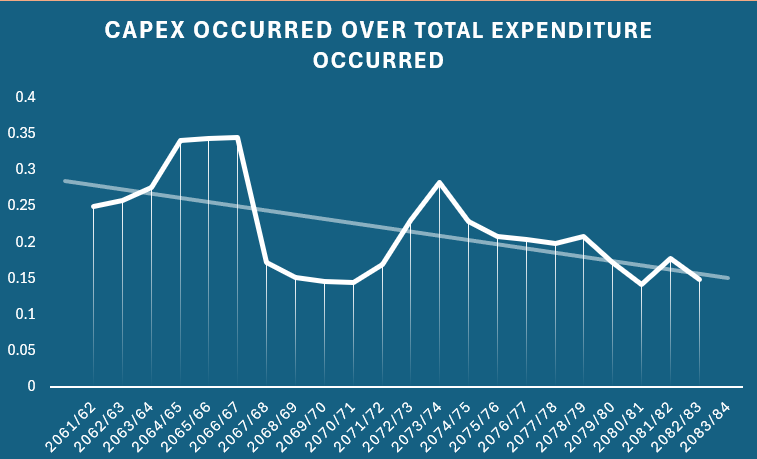
The data strongly suggests that Nepal’s fiscal system prioritizes budget announcement over implementation readiness. As a result, infrastructure projects experience chronic delays, cost overruns, and low economic returns.
Federalism Has Significantly Increased Financial Transfers
A major structural shift appears after the implementation of federalism. Financial transfer expenditure, which mainly represents transfers to provincial and local governments, rose sharply from NPR 102.45 billion in FY 2075/76 to NPR 424.28 billion in FY 2083/84.
This indicates a significant decentralization of fiscal resources under Nepal’s federal governance model. While increased transfers strengthen subnational governments financially, the data also raises important questions regarding:
The rapid rise in fiscal transfers without corresponding improvements in capital expenditure outcomes suggests that decentralization alone has not solved implementation challenges.
Rising Financial Expenditure Signals Growing Debt Burden
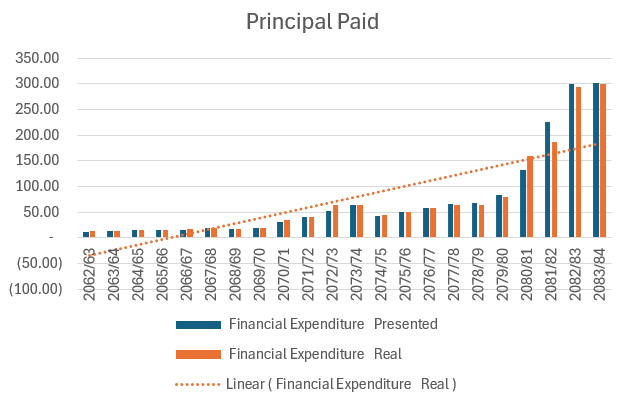
Financial expenditure has increased sharply over time. It grew from NPR 12.50 billion in FY 2062/63 to NPR 302.48 billion in FY 2083/84. Particularly after FY 2078/79, financial expenditure accelerated rapidly. Indicating; increasing domestic and external debt servicing, higher interest obligations, and expanding fiscal deficits.
In FY 2080/81, actual financial expenditure reached NPR 159.32 billion, one of the highest levels recorded in review period. The growing share of financial expenditure is concerning because it reduces fiscal space for development investment. If debt servicing continues rising faster than productive capital formation, fiscal sustainability risks may intensify in the coming years.
Budget Realism Remains a Core Fiscal Challenge
In the review period, its clearly shows that Nepal’s annual budgets are often overly ambitious. Large gaps between presented and actual expenditure indicate weak budget realism. Several years recorded substantial underspending despite high allocations. Fiscal year wise; 2071/72, 2074/75 and 2076/77 achieved lower expenditures below the average of two decades. In this year government achieved 83, 84 and 76 of total expenditures respectively.
This pattern suggests that budget formulation is frequently driven by political ambition rather than implementation capacity. Overestimation of spending capacity weakens fiscal credibility and distorts development planning.
Conclusion
Nepal Government’s fiscal expenditure trend reflects a state that has expanded rapidly in size but not proportionally in implementation effectiveness. While total expenditure has increased dramatically over the last two decades, the quality and efficiency of public spending remain key concerns. The government has demonstrated relatively strong performance in executing current expenditure but continues to struggle in delivering development-oriented capital expenditure.
In previous days’ budget highlights, a critical fiscal imbalance: GoN seems increasingly effective at spending on administration and transfers, but less effective at converting public resources into productive infrastructure and long-term economic assets. Announcing, higher budget allocations alone are unlikely to produce stronger development outcomes.
Looking back, previous governments often blamed each other and political instability, particularly frequent changes in government cabinets, as major reasons for their inability to deliver strong performance and achieve development targets. Now, with the Rastriya Swatantra Party (RSP) securing a majority government and forming its own ministerial team, public expectations have risen significantly following the announcement of the FY 2083/84 budget. The key question now is whether the government will be able to achieve the targets set by its own administration, or whether its performance will remain around or even below the historical average.
People remain optimistic, but ultimately, implementation and fiscal outcomes over time will determine the reality.

