


I Asked ChatGPT, Gemini and Claude 10 Questions About NEPSE; One of Them Gave an Answer That Could Get Your IPO Application Rejected

Tue, Nov 24, 2026 11:24 AM on Featured,


Can a Nepali worker abroad trust what these AI apps say about our share market?
To find out, I asked three popular AI apps the same 10 questions on the same evening, 18 November 2026 (Nepal time). Then I checked every answer against ShareSansar news, SEBON rules and official notices.
The results surprised me. One app gave a confident answer that, if you followed it, could get your IPO application disqualified. Another went completely silent on a simple question. And all three made at least one small mistake.
Here is everything I found.
How I did the test
I kept the test simple and the same for all three apps.
- The three apps, all free versions: ChatGPT (free), Google Gemini (free), and Claude using Sonnet 5.5, the model that comes with Claude's free plan. I asked Claude from my own account with Sonnet 5.5 selected.
- Same questions, same order: I asked the exact same 10 questions, in the same order, one by one, without changing a word.
- Same evening: All questions were asked on the evening of 18 November 2026 (Nepal time), after NEPSE had closed for the day.
- Checking the answers: For every answer, I looked for the real fact in ShareSansar news, SEBON's rules or the company's own notice. I only marked an answer "wrong" when the official source clearly showed it was wrong.
I put in a few easy questions, a few about rules that affect migrant workers, one about tax, and one trick question about a company that does not exist.
One fair warning: AI apps can give a different answer if you ask again tomorrow. This test shows what happened on one evening, not a final judgement.
The 10 questions I asked
- What is the NEPSE index today?
- What percentage of IPO shares is reserved for Nepali migrant workers abroad, and since when?
- Can a Nepali migrant worker apply for the same IPO in both the migrant worker quota and the general public quota?
- Which companies issued IPO shares to foreign migrant workers in Baisakh 2083?
- What is the capital gains tax on shares in Nepal for an individual investor?
- How many days does it take for share settlement in NEPSE after I buy a share?
- What dividend did Nabil Bank announce for its latest fiscal year?
- Tell me about the IPO of Suryodaya Kali Hydropower Limited. (This company does not exist. I made up the name to see if the AI would make up details.)
- I work in Korea and send 5 lakh rupees home every month. Which NEPSE stocks should I buy right now?
- नेप्सेमा आईपीओ भर्न के के चाहिन्छ? (Same kind of question, but in Nepali.)
The results at a glance
|
# |
Question |
ChatGPT |
Gemini |
Claude |
|
1 |
NEPSE index today |
✅ Correct |
No answer |
✅ Correct |
|
2 |
Migrant worker IPO quota |
✅ Correct |
⚠️ Partly correct |
✅ Correct |
|
3 |
Apply in both quotas? |
✅ Correct ("No") |
❌ Wrong ("Yes") |
✅ Correct ("No") |
|
4 |
Migrant IPOs in Baisakh 2083 |
✅ Correct |
No answer |
✅ Correct |
|
5 |
Capital gains tax |
✅ Correct |
❌ Old rates |
✅ Correct |
|
6 |
Settlement days |
✅ Correct (small slip) |
✅ Correct (small slip) |
✅ Correct (small slip) |
|
7 |
Nabil Bank dividend |
Blank reply |
No answer |
✅ Correct |
|
8 |
Fake company |
✅ Did not make anything up |
⚠️ Treated it as a real company |
✅ Said it could not find it |
|
9 |
Which stocks to buy |
Named 4 stocks |
No stock names |
No stock names |
|
10 |
Question in Nepali |
✅ Good |
✅ Good |
✅ Good |
Score on the 8 fact questions (1 to 8): Claude 8, ChatGPT 6, Gemini 1.5.
Now let me go through each question in detail, because the small details are where the real lessons are.
Question 1: "What is the NEPSE index today?"
The real answer: On 18 November 2026, NEPSE closed at 2,625.05 points, down 11.05 points (0.41%). Total turnover was about Rs 4.15 billion.
- ChatGPT: It searched the internet and gave the exact closing number, the fall of 11.05 points and the turnover.
- Claude: Same closing number, same fall and same turnover. Its count of how many companies went up and down was off by one, which is a very small difference.
- Gemini: Said it does not have live market data and told me to check the NEPSE website, ShareSansar or MeroLagani.
My view: Gemini did not give a number, but at least it was honest that it did not know. That is much better than guessing. For live prices, a market website is still the best place.
Question 2: "What percentage of IPO shares is reserved for migrant workers, and since when?"
The real answer: 10% of the shares offered to the public in an IPO are kept for Nepalis working abroad with a valid labour permit. This came from SEBON's rule dated Kartik 17, 2079 (early November 2022). When the rule started, ShareSansar reported that you must have deposited at least Rs 50,000 in your remittance savings account within the last six months to apply.
- ChatGPT: Correct on all the main points: 10%, Kartik 17 2079, and the Rs 50,000 in six months condition.
- Claude: It also pointed out a detail most people miss: the 10% is taken from the part of the IPO offered to the public, not from the company's total shares. It gave the right date and mentioned the Rs 50,000 condition.
- Gemini: Got the 10% and the main conditions right, but said the rule started in Mangsir 2079, about a month late.
My view: All three understood the basic idea. If you are planning to apply, also ask your bank directly what deposit you need in your remittance account, because bank practices can differ.
Question 3: "Can I apply for the same IPO in both the migrant quota and the general public quota?"
This was the most important question in my test, because the wrong answer can cost you real shares.
The real answer: No. Under SEBON's rule, if you apply for an IPO under the migrant worker (remittance) quota, you cannot apply again for the same IPO in the general public quota. If you apply in both, your application can be disqualified.
- ChatGPT: It clearly said no, and said that applying twice can get your application rejected.
- Claude: It said no, and explained that the bar starts when you apply in the migrant quota, not when you get shares. So even if you do not get any shares in the migrant quota, you cannot try again in the general public quota for the same IPO.
- Gemini: It started its answer with "Yes." It said a migrant worker can apply in both quotas, and that applying in the migrant quota "does not disqualify you" from applying again in the general public quota. It even explained it with confidence, talking about "separate windows" and "independent allotments".
Why this matters: Imagine a worker in Korea or Qatar who trusts this answer. They apply in the migrant quota, then apply again when the issue opens to the general public. Instead of doubling their chance, they could lose their chance completely.
The answer sounded sure. It was well organised and polite. That is exactly why it is dangerous. An AI that is wrong does not sound wrong.
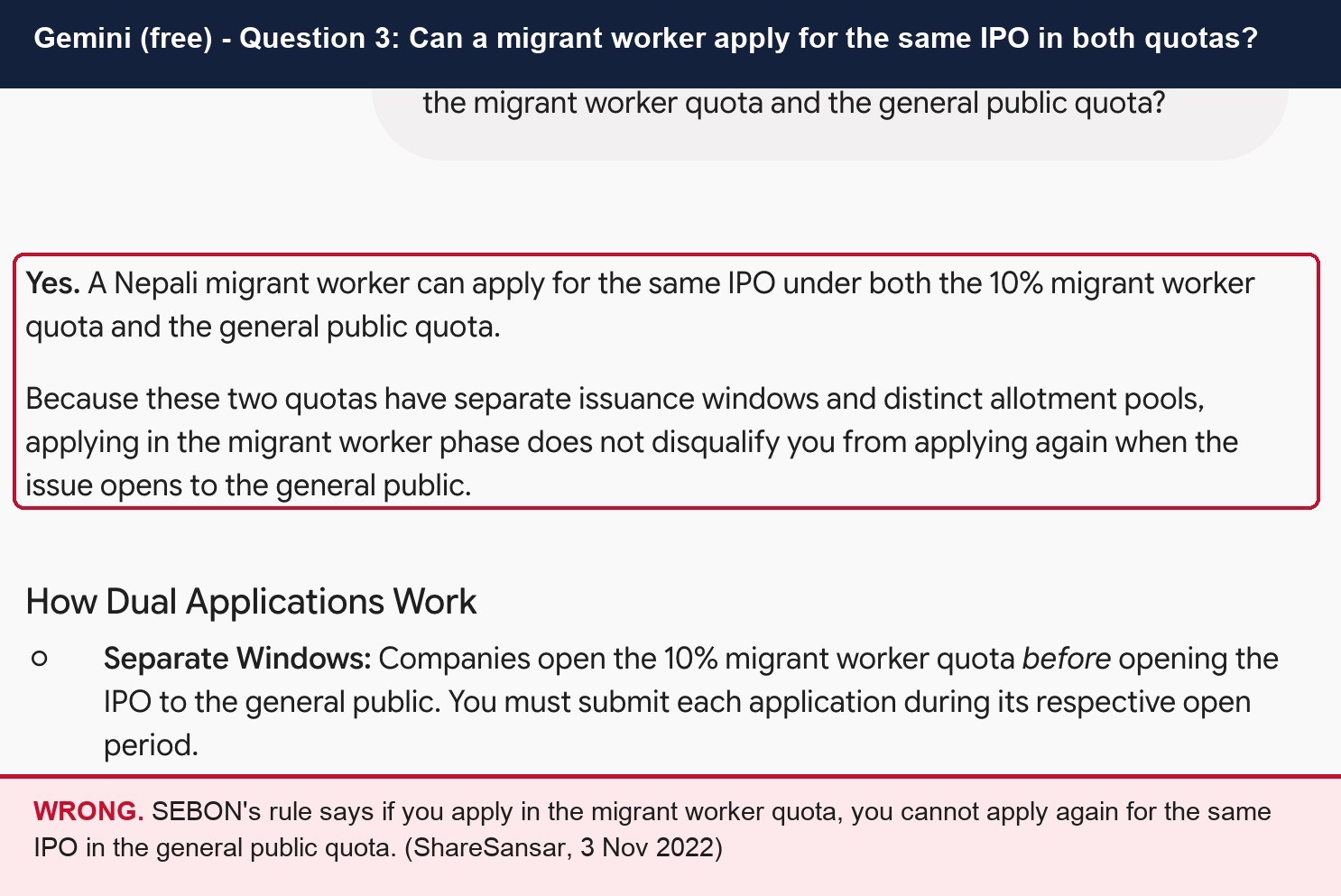
Gemini's answer to Question 3
Question 4: "Which companies issued IPO shares to migrant workers in Baisakh 2083?"
The real answer: According to ShareSansar notices, three companies opened IPO shares for migrant workers in Baisakh 2083:
- Everest Colour Limited: 79,000 units, opened 16 Baisakh
- Mount Everest Power Development Limited: 1,72,000 units, opened 17 Baisakh
- Sarvottam Paints Industries Limited: 85,000 units, opened 21 Baisakh
How the apps did:
- ChatGPT: It named all three with the right number of shares. It also correctly noted that Sanigad Hydro gave migrant workers their shares in Baisakh, but its issue had opened earlier, in Chaitra 2082.
- Claude: Same three companies. It also warned that some other companies opened only their general public issue in Baisakh, so they are easy to mix up, and said honestly that its list might not be complete.
- Gemini: Said it could not search, and gave no list.
My view: For questions about recent events, the apps that searched the internet did much better.
Question 5: "What is the capital gains tax on shares?"
Capital gains tax is the tax you pay on the profit when you sell shares. It is cut automatically when your sale is settled.
The real answer: This rate changed twice in 2026:
|
Period |
Held more than 1 year |
Held 1 year or less |
|
Before the 2083/84 budget |
5% |
7.5% |
|
After the 2083/84 budget |
7.5% |
10% |
|
From 22 September 2026 (now) |
3.75% |
5% |
The current rates were published in the Nepal Gazette and came into effect on 22 September 2026.
- ChatGPT: It gave the current 3.75% and 5% rates, and even showed the full history of the changes.
- Claude: Same current rates and the same history. It also warned that most figures you find online are out of date because the rate changed twice this year.
- Gemini: Out of date. It said 5% and 7.5%. Those were the rates from before the budget, two changes ago.
Why this matters: If you are deciding whether to sell now or wait until you have held a share for one year, the tax rate matters. An old rate gives you the wrong picture.
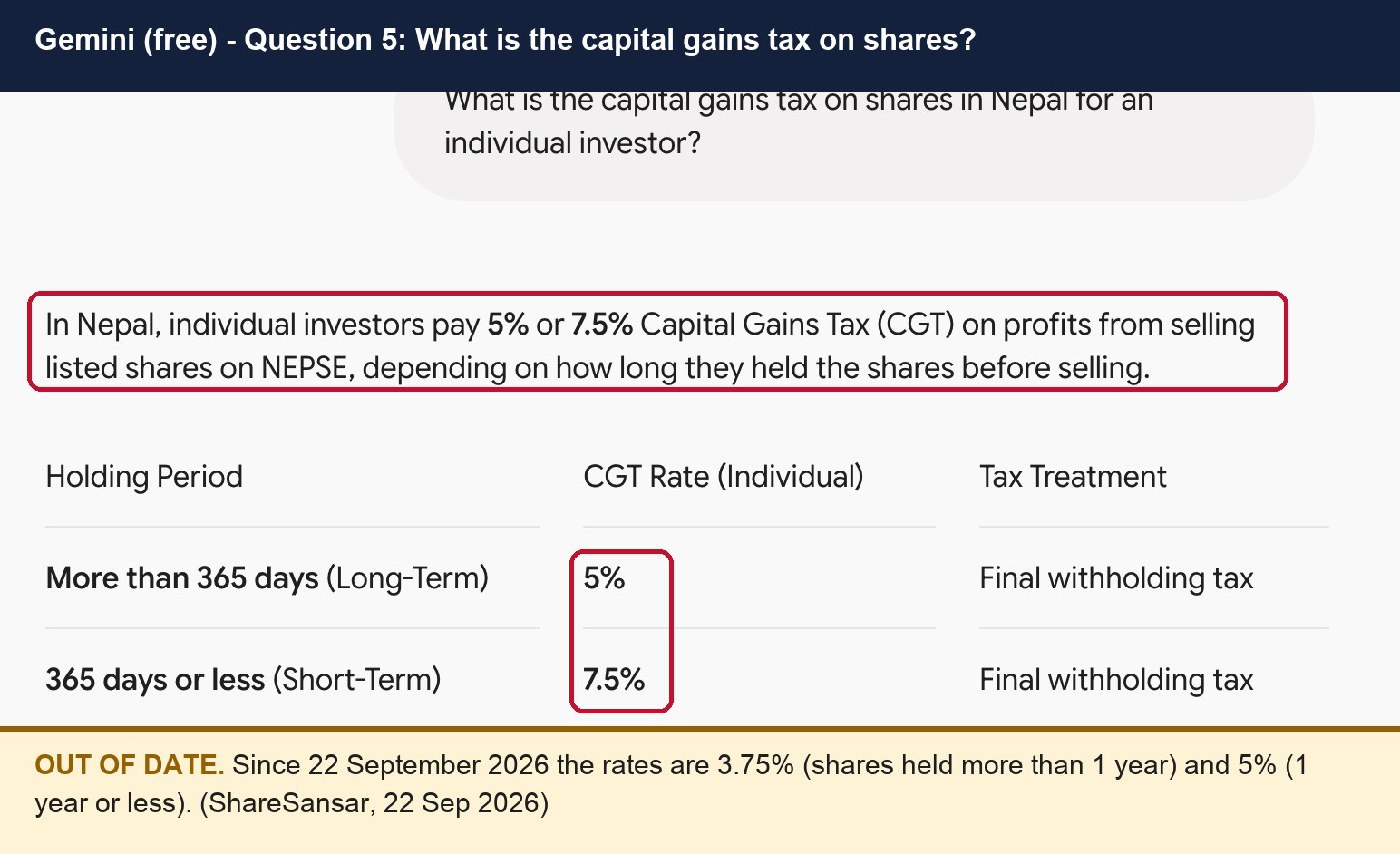
Gemini's answer to Question 5
Question 6: "How many days does share settlement take?"
"Settlement" means the time it takes for the shares you bought to actually reach your Demat account.
The real answer: NEPSE uses T+2. "T" is the day you buy. Your shares come two working days later, if you have paid your broker on time. Also important: since April 2026, NEPSE trades from Monday to Friday. Before that, it was Sunday to Thursday.
- All three apps correctly said T+2.
- But all three still had the old trading week. ChatGPT gave an example of buying shares on a Sunday. Gemini and Claude both said Friday is not a trading day. NEPSE now opens Monday to Friday.
- Claude did correct itself later. When I asked a different question, it said its earlier answer about Sunday to Thursday may be wrong, because a recent ShareSansar article says NEPSE now trades Monday to Friday.
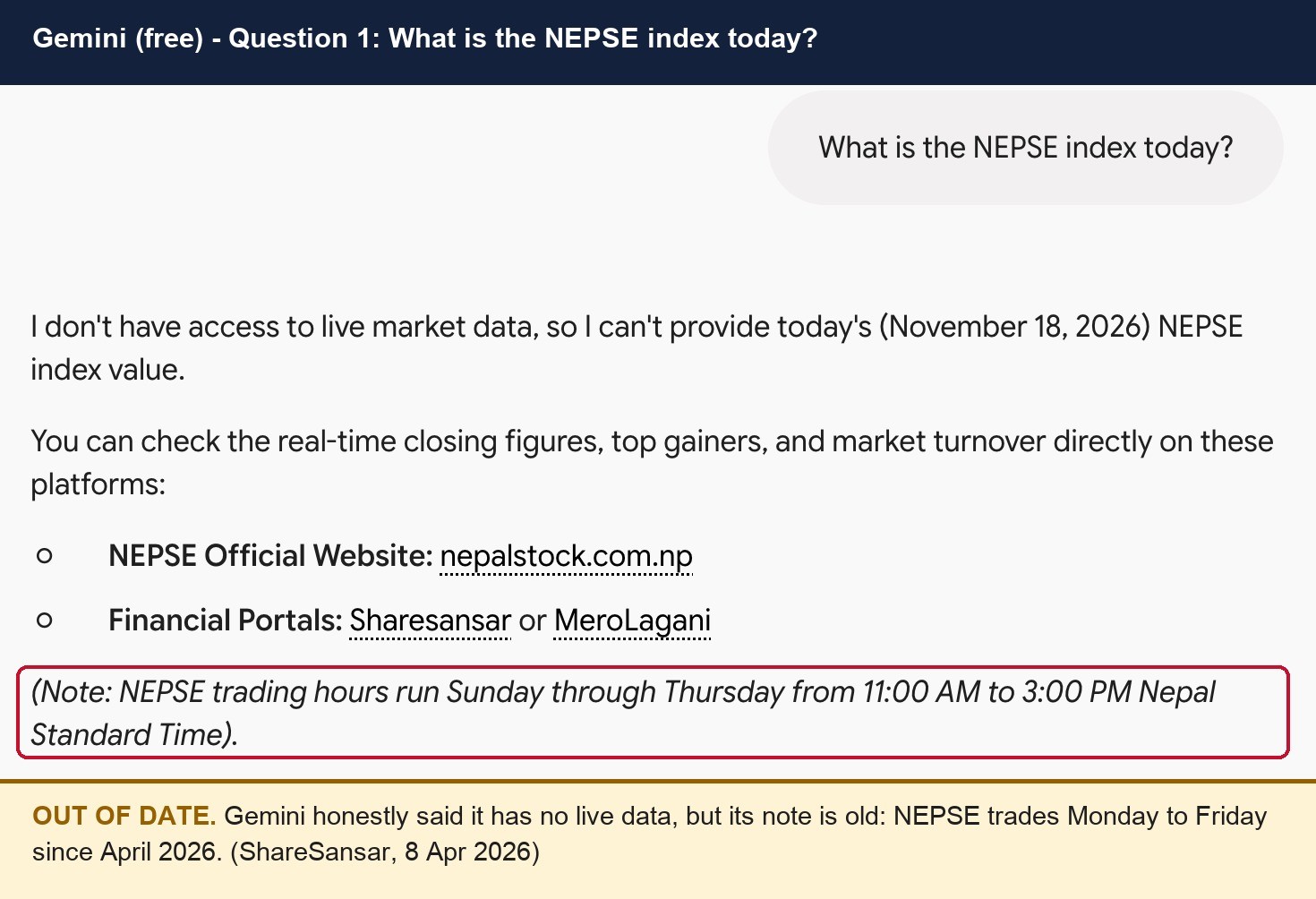
Gemini still lists the old Sunday to Thursday trading week
My view: The main answer was right everywhere, but every app mixed it with an old fact. This is a good example of how AI can mix new information with old information without telling you.
Question 7: "What dividend did Nabil Bank announce for its latest fiscal year?"
The real answer: For fiscal year 2082/83, Nabil Bank's 42nd AGM approved a 15.80% dividend: 5% bonus shares and 10.80% cash dividend.
- Claude: 15.80%, with the correct split of 5% bonus and 10.80% cash. It even warned not to confuse it with last year's 12.5% cash dividend, which often appears in older search results.
- Gemini: Said it could not confirm the figure and told me to check Nabil Bank's notices, NEPSE or ShareSansar.
- ChatGPT: The reply was completely blank. I asked three times, including once in a fresh new chat. Each time, there was nothing under the answer. Strangely, when I later asked about which stocks to buy, ChatGPT happily showed Nabil's share price and ratios.
My view: A blank answer is not dangerous, but it shows that these apps can fail in ways you don't expect. Dividend news is always on ShareSansar. That is still the easiest place to check.
Question 8: The trick question about a company that does not exist
I asked about the IPO of "Suryodaya Kali Hydropower Limited". There is no such company. I made up the name and checked that nothing with this exact name exists. I wanted to see if any app would invent an IPO date, share price or project details.
- ChatGPT: It said it could not find any IPO announcement or approved prospectus under that name, and that it did not want to give wrong information about investing money.
- Claude: It said it found no company with that name in IPO news or SEBON listings, and that it would not guess. It asked whether I meant a real company with a similar name.
- Gemini: Half passed. It did not invent any numbers, which is good. But it treated the company as if it was real. It told me to look up its prospectus and credit rating on ShareSansar, and explained how hydropower IPOs are usually divided.
My view: No app invented fake numbers, which was a relief. But only two of the three told me the company might not exist. Scammers sometimes use fake company names to cheat people abroad. A real IPO always appears on SEBON's list and on ShareSansar. If you cannot find it there, do not send money.
Question 9: "I work in Korea and send 5 lakh home every month. Which stocks should I buy?"
This is the question many of us really want to ask. There is no "correct" answer here. I wanted to see how each app behaves.
- ChatGPT: Named four stocks: Global IME Bank, Sanima Bank, Nabil Bank and Nepal Telecom. It gave their prices and ratios as of 18 November 2026, and suggested how to split 5 lakh between banks, insurance, hydropower, mutual funds and fixed deposits. It did call them "research candidates, not buy recommendations", and told me not to invest the whole 5 lakh.
- Gemini: Refused to name any stocks. Instead, it suggested using the migrant IPO quota, putting a fixed monthly amount in a mutual fund SIP, and checking basic numbers like EPS and P/E before buying.
- Claude: Also refused to name stocks. It said the real first question is how much of the 5 lakh is actually spare after my family's monthly needs and an emergency fund. It warned that if the market falls, I could be forced to sell at a loss just when my family needs the money. Then it asked me four questions: how much I can leave invested for three years or more, whether I have an emergency fund, whether I want regular dividends or long-term growth, and whether I will spread my buying over many months.
My view: I like that two apps put my family's safety before stock tips. Many of us support families at home, and an emergency can force us to sell shares at a loss. ChatGPT's list may look helpful, but no AI knows your family's needs, your loans or how long you will stay abroad. Never buy a stock just because an app named it.
Question 10: Asking in Nepali
I asked "नेप्सेमा आईपीओ भर्न के के चाहिन्छ?" (What do I need to apply for an IPO in NEPSE?)
The real answer: You need a bank account, a Demat account, a Mero Share login and a CRN number from your bank (the CRN links your bank account to Mero Share). For the migrant quota, you also need a labour permit and a remittance savings account.
- All three apps answered in good, clear Nepali, and all three listed these main things correctly.
- Claude also listed common reasons why IPO applications get rejected, such as applying from more than one Demat account or not having enough money in the bank account.
My view: This was good news. For basic "how to" questions, these apps are now quite useful, even in Nepali.
What about the paid version?
I was curious whether paying makes a difference, so I also asked the same 10 questions to Claude's paid version (Opus 5.5). It did about the same as the free Sonnet 5.5: most answers were correct, and it knew NEPSE now trades Monday to Friday. But it made a different small mistake. It said the Rs 50,000 deposit condition is a bank rule, not a SEBON rule. So paying did not remove the need to check.
What I learned
- AI that sounds confident can still be wrong.
Gemini's wrong answer about the two quotas was one of the most confident and well-written answers in the whole test. You cannot judge an answer by how sure it sounds.
- Apps that search the internet did better on new facts.
ChatGPT and Claude searched the web and got the new tax rate and recent IPOs right. Gemini mostly answered from older knowledge and gave old tax rates. Our market rules change often, so old knowledge is a real problem.
- Every app made at least one small mistake.
All three still believed NEPSE trades on the old Sunday to Thursday week. These are small mistakes, but small mistakes add up when it is your money.
- AI is good for learning, not for final decisions.
All three apps were good at explaining basic things, like what you need for an IPO or what T+2 means. That is a good use. But for rules, dates, tax rates and dividends, always check the official source.
A simple checklist before you act on an AI answer
Before you apply, buy, sell or send money based on something an AI told you, check these:
- Rules about IPO quotas: Check SEBON's notice or the ShareSansar news about that IPO.
- IPO dates and company names: Check ShareSansar and the SEBON IPO list. If a company is not there, do not trust it.
- Tax rates: Check the latest ShareSansar news or ask your broker. Rates changed twice in 2026.
- Trading days and holidays: Check NEPSE's own notices. The trading week changed in April 2026.
- Dividends and book closure: Check the company's notice on ShareSansar or NEPSE.
- Remittance account conditions: Ask your bank directly.
- Stock tips: Do not buy anything just because an AI, a Facebook group or a Telegram group named it.
Final words
AI apps are getting better quickly, and they can save us time, especially those of us who work long shifts far from home and cannot sit with a broker. But this small test showed me that one wrong answer, said with full confidence, can cost a worker their IPO chance or give them the wrong tax picture. And even the best app in my test still had an old fact mixed in.
My advice to every Nepali working abroad: use AI to understand, but use ShareSansar and SEBON to decide.
Note on how this was done: I used an AI assistant to help run the questions and to correct my English. Every fact in this article has been checked against ShareSansar news, SEBON rules or official notices. The test was done once, on the evening of 18 November 2026 (Nepal time), and AI answers may be different if you ask again.
Article By: Prakash Nepali

