


Decoding Development Bank Q1 Report: Know Top Performers Across 5 Key Financial Parameters

Tue, Nov 3, 2026 4:23 PM on Financial Analysis, Highlight News, Stock Market, National,

Currently, there are 17 Class B development banks operating in Nepal, all of which are listed on the Nepal Stock Exchange (NEPSE). We have analysed the 16 development banks based on Net profit, Earning Per Share (EPS), Price to Earning Ratio (P/E), Distributable Profit Per Share (DPS) and Non-Performing loan based on the Q1 unaudited report of F.Y. 2083/84.
Note: Karnali Development Bank Reports are not available
Net Profit:
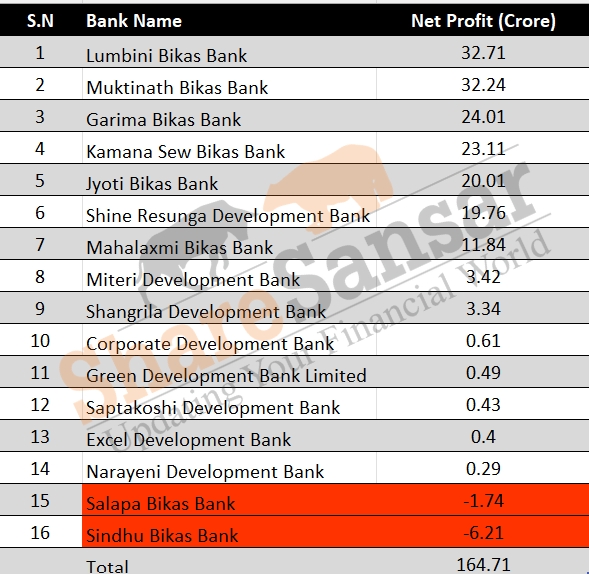
The net profit report of development banks listed in NEPSE for the fiscal year 2083/84, the total industry net profit stands at 164.71 Crore.
Among the banks Lumbini Bikas Bank holds the highest net profit in the industry with 32.71 Crore. Following closely behind are Muktinath Bikas Bank with 32.24 Crore and Garima Bikas Bank with 24.01 Crore, making them the top three most profitable development banks for the quarter.
On the other end of the spectrum, the banks with the lowest net profits include institutions experiencing negative earnings. Among the lowest performers, Sindhu Bikas Bank recorded the lowest net profit with a loss of -6.21 Crore, preceded by Salapa Bikas Bank with a net loss of -1.74 Crore.
Additionally, among the banks reporting positive figures at the lower tier, Narayeni Development Bank registered the lowest positive net profit at 0.29 Crore, followed by Excel Development Bank 0.40 Crore and Saptakoshi Development Bank 0.43 Crore.
Earning Per Shares:
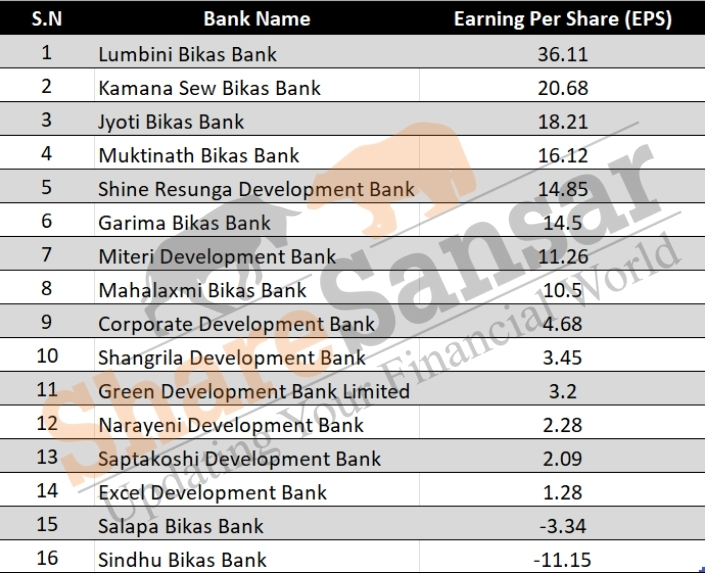
Lumbini Bikas Bank dominates the sector with an outstanding EPS of Rs 36.11, demonstrating exceptional capital efficiency and high profitability per share relative to its equity base. Kamana Sewa Bikas Bank Rs 20.68 and Jyoti Bikas Bank Rs 18.21 secure the second and third positions respectively, forming a robust top tier of high earning institutions.
Conversely, lower tier institutions display weak earnings capacity, with Excel Development Bank generating the lowest positive earnings at Rs 1.28 per share. The bottom of the list highlights severe bottom line drag, as Salapa Bikas Bank reports an EPS of Rs -3.34 and Sindhu Bikas Bank underperforms the entire industry with a sharp negative EPS of Rs -11.15, reflecting acute profitability pressure and capital erosion.
Note: Preference Share Dividend is adjusted while calculating EPS of Kamana Sewa Bikas Bank (KSBBL).
Price to Earning Ratio:
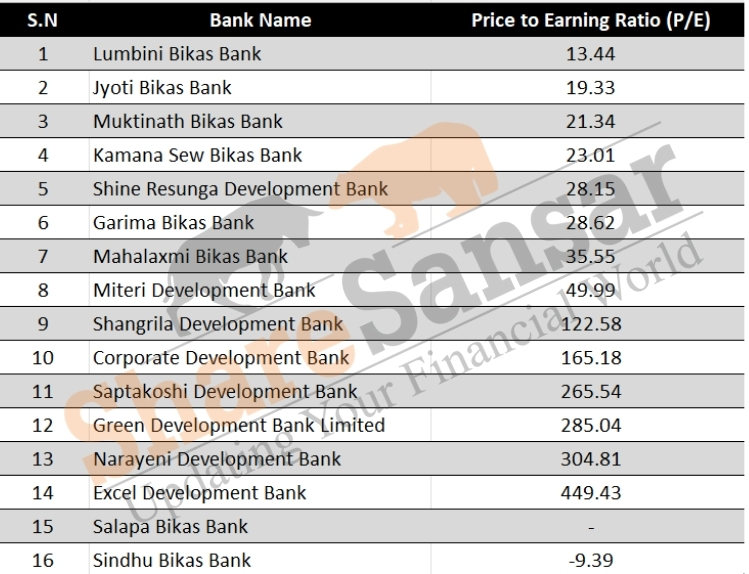
Lumbini Bikas Bank boasts the most attractive valuation profile in the sector with the lowest Price-to-Earnings (P/E) ratio of 13.44x, indicating high earning support relative to its market price. It is followed by Jyoti Bikas Bank 19.33x and Muktinath Bikas Bank 21.34x, completing the top three value picks traded at reasonable valuation multiples. Meanwhile, high-tier fundamental performers like Kamana Sewa Bikas Bank 23.01x, Shine Resunga Development Bank 28.15x, and Garima Bikas Bank 28.62x remain fairly priced under the 30x threshold.
On the opposite end, micro cap and low earnings banks exhibit extreme market overvaluation due to severely suppressed net earnings. Excel Development Bank records a steep P/E ratio of 449.43x, preceded by Narayeni Development Bank 304.81x, reflecting speculative pricing relative to actual earnings capacity, while Sindhu Bikas Bank stands at -9.39x due to its negative net earnings.
Distributable Profit Per Share:
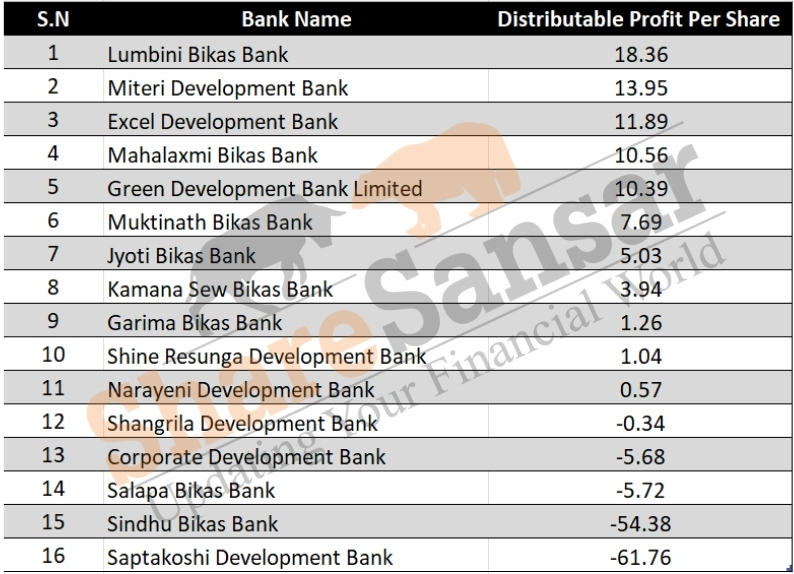
Lumbini Bikas Bank leads the sector in dividend capacity with the highest Distributable Profit Per Share at Rs 18.36, underscoring its strong retained earnings and superior dividend payout potential. Miteri Development Bank Rs 13.95 and Excel Development Bank Rs 11.89 take the second and third spots.
Conversely, nearly a third of the sector faces negative distributable figures, severely restricting their immediate capacity to distribute dividends to shareholders. Shangrila Development Bank records a minor shortfall of Rs -0.34, while regulatory adjustments and accumulated losses weigh heavily on Corporate Development Bank Rs -5.68 and Salapa Bikas Bank Rs -5.72. The most severe capital drags are seen at the tail end, where Sindhu Bikas Bank Rs -54.38 and Saptakoshi Development Bank Rs -61.76 post substantial negative balances, pointing to acute reserve deficits and long term earnings cleanup requirements.
Non-Performing Loan:
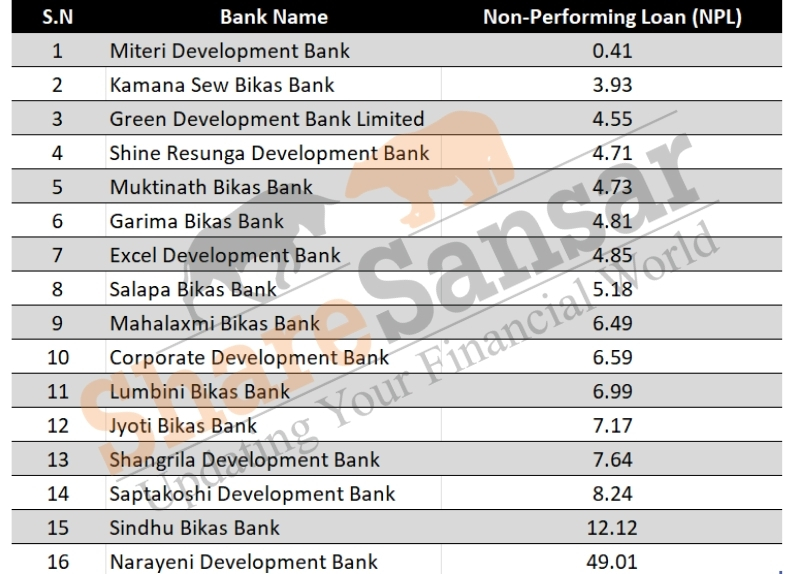
Miteri Development Bank sets the benchmark for asset quality across the sector, maintaining an exceptionally fresh Non-Performing loan ratio of 0.41%. It is followed by Kamana Sewa Bikas Bank 3.93% and Green Development Bank Limited 4.55%, which round out the top three institutions with the healthiest loan portfolios.
Conversely, asset quality deterioration poses a significant challenge across the mid-to-lower tiers of the sector, with institutions like Mahalaxmi Bikas Bank 6.49%, Lumbini Bikas Bank 6.99%, Jyoti Bikas Bank 7.17%, Shangrila Development Bank 7.64%, and Saptakoshi Development Bank 8.24% reflecting elevated default stress.
The severity of asset impairment peaks at the bottom of the list, where Sindhu Bikas Bank reports an NPL of 12.12%, and Narayeni Development Bank experiences an acute portfolio distress with a staggering NPL ratio of 49.01%, signalling severe recovery issues and heavy provisioning demands.
Conclusion:
Conclusion:
An aggregate evaluation of development banks listed in NEPSE across five key parameters Net Profit, Earnings Per Share (EPS), Price-to-Earnings (P/E) Ratio, Distributable Profit Per Share, and Non-Performing Loan (NPL) highlights distinct leaders and laggards in the industry.
- Top Performing Banks: Lumbini Bikas Bank emerges as the standout leader of the sector, capturing the highest net profit Rs 32.71 Crore, the highest EPS Rs 36.11, the lowest and most attractive P/E ratio 13.44x, and the highest distributable profit per share Rs 18.36, though its NPL sits at an elevated 6.99%. Muktinath Bikas Bank and Kamana Sewa Bikas Bank also rank among the top tier, demonstrating robust profitability, solid EPS figures, and reasonable asset quality. Meanwhile, Miteri Development Bank commands the best asset health in the sector with a pristine NPL of just 0.41%, paired with a strong distributable profit of Rs 13.95 per share.
- Least Performing Banks: On the opposite end, Sindhu Bikas Bank and Narayeni Development Bank anchor the bottom of the industry. Sindhu Bikas Bank suffers from the deepest net loss -Rs 6.21 Crore, a negative EPS of -Rs 11.15, a severe distributable loss Rs -54.38 per share, and a high NPL of 12.12%. Narayeni Development Bank faces an alarming asset quality crisis with an extreme NPL ratio of 49.01%, alongside severe valuation distortions P/E of 304.81x. Saptakoshi Development Bank and Salapa Bikas Bank also show severe bottom line distress, characterized by negative earnings and heavy capital erosion.
Conclusion The Q1 financial reports reveal a stark bifurcation within the development banking sector. Top tier institutions like Lumbini and Muktinath successfully leverage scale to generate robust profitability and high dividend capacity, while mid tier players maintain stable operational metrics. However, a significant tail of smaller banks struggles with acute asset quality deterioration, mounting non-performing loans, and negative reserves signalling an urgent need for aggressive provisioning and balance sheet cleanup to restore investor confidence.

