


Stock Market-Election Connection: Will Polls Push Market Up?

Sun, Feb 22, 2026 11:52 AM on Stock Market, National, Exclusive,


With the March 5 elections around the corner, speculation is mounting over whether the polls could trigger a fresh rally in the stock market.
Historically, elections in Nepal acted as a "psychological trigger" for the market—often leading to short-term bullish trends as investors anticipate policy stability and fresh economic boosts.
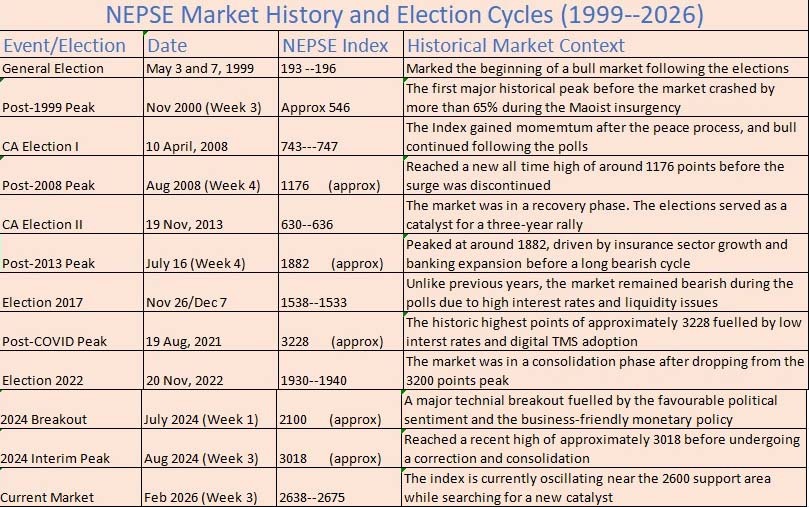
As of the third week of February 2026, the market is oscillating between 2638 and 2675 points after recently touching the peak of approximately 3018 points in the third week of August 2024.
Market participants are divided on whether the upcoming elections will trigger a sustainable bull run or a merely short-lived spike.
Some experts believed that the polls will be a catalyst for a long-term bull run.
Others argue that strong economic growth, adequate liquidity, and low interest rate serve as true fundamentals required for a sustainable market expansion.
A look at history
Since the Nepal Stock Exchange officially started trading on January 13, 1994 (29 Poush, 2050), six general elections were held so far in Nepal. Historical data shows that polls have often coincided with significant market movements.
The 1999 elections were organised in two phases (May 3 and 7). According to the weekly SSPro chart, an web-based analytical tool developed by ShareSansar (a financial news portal) to help stock market investors, in the first week of May, 1999, the market was in the 190s range before peaking at approximately 546 points in the third week of November 2000.
On April 10, 2008, Constituent Assembly Election I took place when the index stood between 743 to 747 points. The bull run continued for another five months, and peaked at around 1176 points in the fourth week of August, 2008 before entering a prolonged downtrend amid the global financial crisis and domestic liquidity issues.
Constituent Assembly II took place on November 19, 2013. In the third week of November, the index was between 630 and 636 points. The bull run continued and peaked at approximately 1882 points in the fourth week of July 2016 before entering a downtrend.
The 2017 federal and provincial polls were organised in two phases, on November 26 and December 7 amid a bearish phase. Amid the 1538-1533 points, the market broke major resistance levels and entered a bull run in the first week of November 2020.
The 2022 federal and provincial elections were organized on November 20 when the market was consolidating 1930 to 1940 points after hitting its historical peak of approximately 3228 points on August 19, 2021.
Later, the market broke major resistance levels and gained upward momentum in the first week of July 2024, supported by favourable political sentiment and accommodative monetary policy.
Political events and market psychology
Major political events have also influenced investor confidence.
In 1999, the Nepali Congress (NC) won a majority. Despite the Maoist insurgency being at its peak, the NEPSE index continued to follow an upward trend with investors cheered the prospect of a stable, single-party government.
In 2008, post-conflict optimism and the Maoists joining mainstream politics initially fuelled a massive bull run. The index peaked at around 1179 points in the fourth week of August, 2008 before entering a bearish phase.
In 2013, the victory of the perceived pro-market parties (NC and CPN-UML) caused a long-term rally. The bull continued and soared to peak at approximately 1881 points in the fourth week of July 2016 before entering a bearish trend.
In 2017, the "Left Alliance" (UML and Maoist) victory initially created high expectations for a stable 5-year term. However, the market later turned bearish as interest rates went up and political crisis began.
In 2022, the market was in a consolidation phase after hitting its historical peak of approximately 3228 points on August 19, 2021. The index was between 1930 to 1940 points before breaking out the major resistances and taking upward move in the first week of July 2024.
Major national events that influenced market sentiment
The Royal Massacre (2001): It caused a significant dent in investor confidence, leading to a prolonged bearish period amid the peak of the Maoist insurgency.
Comprehensive Peace Accord (2006): Marked as one of the biggest "green signals" in NEPSE history. The end of the 10-year civil war revitalized the market.
Promulgation of Constitution (2015): Despite the subsequent "blockade," the constitutional certainty provided a long-term psychological confidence for the market, leading to the 2016 bull peak.
The "Gen Z Movement" (2025): Large-scale demonstrations in late 2025 led to the dissolution of the previous parliament. This event initially caused a dip, but the announcement of the March 5, 2026 elections has since turned sentiment positive.
History of Bull and Bear Cycle
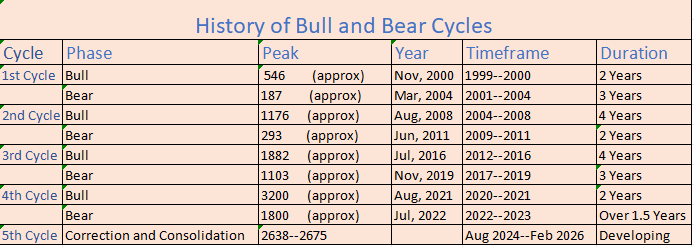
Nepal’s stock market has so far witnessed four major bull and bear cycles with the NEPSE index currently moving in the 2638-2675 range. The first bull cycle lasted for two years beginning in 1999 followed by the bear phase that extended for three years (2001--2004).
The second bull continued for four years (2004--2008) and bear lasted for two years (2009--2011).
In the third bull cycle, the bull market ran for four years (2012--2016) followed by a three-year bear market (2017--2019).
The fourth bull cycle lasted for two years (2020--2021) while the bear market ran for over one and a half years (2022--2023).
While the market is currently in the 2638--2675 range, market participants are closely watching whether a bull market is upcoming.
Chartered accountant and stock market analyst Manish Aryal said elections serve as catalysts rather than primary drivers.
“Market moves in anticipation. Major incidents like polls increase investor confidence, but the market ultimately follows its own path,” he said.
Fundamentals like good economic growth, excess liquidity, and low interest rates are needed for the sustainable growth of the stock market, he said, adding, “Robust economic growth supports the market.”
He however noted that elections can temporarily boost economic activities through increased spending, leading to the market momentum.
According to him, bull and bear cycle occurs every three to four years alternatively. Alongside excess liquidity and low interest rate, the unlocking of promoter shares after three years can also contribute to influence market trends.
He expressed cautious optimism that if a stable government emerges after the March 5 elections, it could boost investor confidence. “Stable policies and a stable economy could positively impact the stock market,” he said, adding that otherwise, the market continues seeking opportunities to gain momentum.
He noted that recent regulatory changes, including the approval of the margin trading directive, 2082, are expected to inject approximately Rs 5 billion into the market. “This could support brokerage landing at a time when banks and financial institutions are facing excess liquidity.”
Economic setback
Nepal’s economic growth has been on a shock-and-recovery mode over the past five years following the COVID-19 pandemic and subsequent economic slowdown.
Over these period, Nepal’s average growth rate stands at approximately 4.14 %. The government has revised economic growth forecast to only 3.5%, significantly lower than the initial 6% target for the current fiscal year, 2082/83. The country witnessed the growth of 4.61% in the previous FY however.
Strong economy is a key for the growth of the market, according to economist Chandra Mani Adhikari. Companies’ financial performance and balance sheets get strong when economy becomes strong, he said. Strong capital market also supports a strong economy.
Entrepreneur Gyanendra Lal Pradhan also pointed out the interrelationship between economic growth and the capital market. “The market will grow sustainably when economic growth becomes strong.”

