

Nepal's Gold Market: A Decade Review
Gold is globally considered a safe haven instrument for investment. Gold holds significantly higher market worth because of its variety, durability, and universal appeal. Throughout history, Gold has been consistently apprehended as a reliable store of value. The gold is widely used in jewellery, technology, aerospace, medicine, etc.
Almost 80% of gold production is used in the jewelry business. As per the data of the World Gold Council, US maintains the highest gold reserves of 8133.46 tonnes, while Germany ranks second with 3350.25 tonnes, followed by Italy in third position with 2451.84 tonnes. Nepal Gold reserve is 7.99 tonnes, which is in 69th position in the world.
In Nepal only commercial banks are allowed the import of gold up to 25 KG per day which was 20 KG per day a few months back. As per the data of department of customs, Nepal imported 4,165 KG of gold during FY 2072/73 while after five years in FY 2077/78 import of gold has dropped down to 3924.50 KG.
During FY 2081/82 gold imports contracted substantially, reaching just 1389.51 KG. Over the past few years a consistent decrease in gold imports has been observed, owing to higher prices which has resulted in declining consumer demand in Nepal.
In Nepal during Ashoj 2072 gold price was Rs. 50,700 per tola at the same time minimum salary set by the government to Nepali workers was Rs. 7,075. During that time the price of 1 tola gold is equivalent to a salary of more than 7 months. After 10 years the gold price reached Rs. 25,8000 per tola during Ashoj 2082 and minimum salary set by the government to Nepali workers is Rs. 19,550.
Now the price of 1 tola gold is equivalent to a salary of more than 13 months. It indicates that the gold price has surged by 5.08 times while the minimum was raised by only 2.76 times. So, the consumer demand for gold is consistently declining due to an increase in price levels.
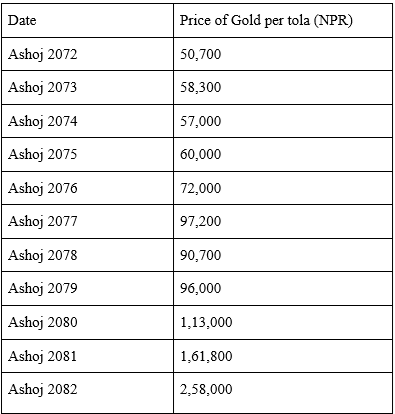
The table below shows the highest price of gold in the last 10 years as on Ashoj every year.
Source: Federation of Nepal Gold and Silver Dealers Association.
As per the above table gold price was Rs. 50,700 per tola during Ashoj 2072 and it surged to Rs. 2,58,000 per tola in Ashoj 2082. It indicates that there is an increment of 408.87% in the duration of 10 years.
Why has the gold price climbed lately?
As per the data from World Gold Council, the price of gold in October 2015 was $806.04 per ounce while in October 2020 price of gold was $1272.00 per ounce and in October 2025 the price of gold surpassed to $3985.96 per ounce. Gold price has highly increased during the year between 2020 - 2025 compared to 2015 - 2020 period.
Russian Dollar asset freeze
Since Russia began its full-scale invasion in Ukraine in February 2022, an estimated $335 billions of Russian assets like cash,bonds,securities, real estate etc has been frozen by US and western nations from May 2023.
The gold price in the international market has highly increased since 2023. In 2023, the price of gold was $2,297 per ounce which has increased to $3985 per ounce in October 2025. Due to the asset freeze by western economies Russia, China and other nations have started to decrease the dependency on dollars and increase the gold reserves.
US unpredictable tariffs and Geo-political tensions
After the new government formed in the US in January 2025 it has announced tariffs to goods imported in the US from many countries like China,EU,UK, and other Asian countries. The US government has imposed reciprocal tariffs with these countries to protect the US economy.
Tariffs make foreign goods expensive, encourage consumers to purchase American goods and boost investment in the US. The US government wants to reduce the trade deficit by increasing the tariffs. This has created trade imbalance and economic uncertainty throughout the world which has led to decrease the demand of dollars.
The Ukraine-Russia war and war in the middle east has increased the geopolitical instability in the world. Geopolitical tensions have disrupted the supply chain, increased cyber warfare, and economic fragmentation. These tensions have increased the uncertainty in the business and financial market, so investment in gold has been steadily increasing.
Central Banks increasing the gold reserve
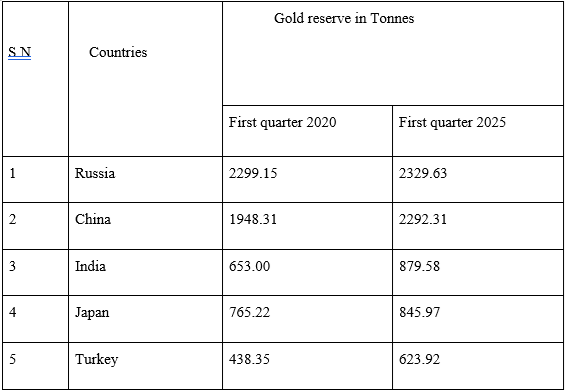
Central banks around the world have purchased gold amid fears of uncertainty in the global economy. The developed economies like Russia, China, Japan and other nations have increased the gold reserves consequently this raises the demand of gold in the international market resulting in elevated prices levels.
The data for gold reserves as compared between Q1 2020 and Q1 of 2025 is shown below:
Source : Wold Gold council.
Drop down of policy rate by Central Banks
Central banks of the US, EU,UK, China and other developed economies have consistently decreased the interest rate since 2024. The US Federal Reserve Bank maintained an interest rate of 5.50% during August 2024, which was later declined to 4.25% by September 2025.
Similarly, European Central Banks had a rate of 4.25% in August 2024 which was reduced to 2.15% in September 2025. Following the similar trend Bank of England has also decreased the interest rate significantly, in August 2024 the interest rate was 5.00% while in September 2025 rate was reduced to 4.00%. Investors have been expecting a series of rate cuts, so their investment has shifted to gold which has been a key driver behind its price escalation.
Article By: Ashish Khati

