

Leaving Again: What Nepal's Foreign Employment Data Reveals
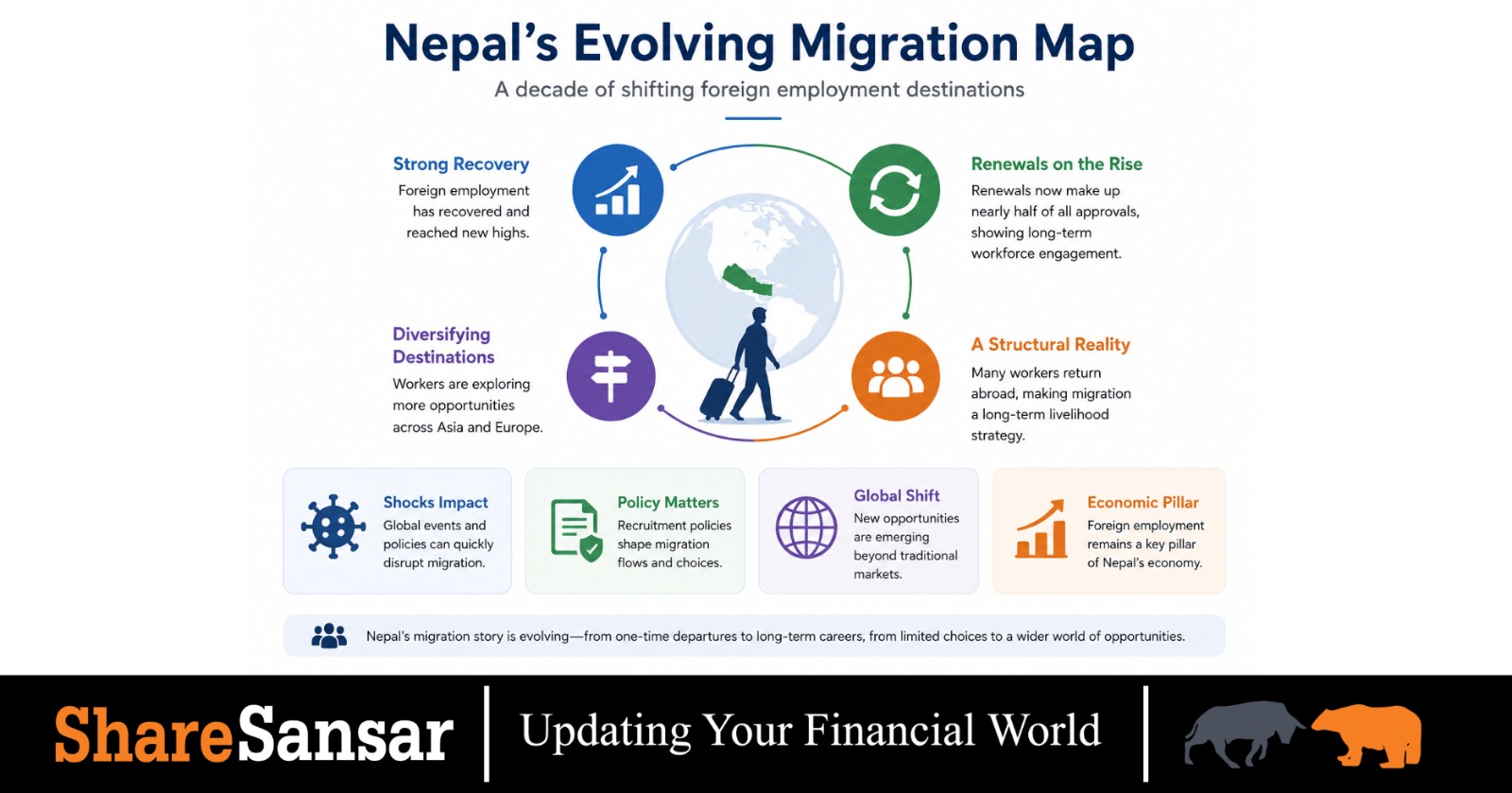
Nepal is one of the world's oldest nations and has never been colonized. The movement of Nepali people in search of opportunities and employment also has a long history. While this article does not discuss the broader history of Nepalese civilization, culture, or migration patterns, it focuses on employment-driven migration.
A key milestone in Nepal's labor migration history was the Treaty of Sugauli in 1816, which allowed the British to recruit Gurkha soldiers into the East India Company's army. This marked one of the earliest organized movements of Nepalis abroad for employment. Since then, the scale and destinations of migration have evolved significantly. Over time, Nepali workers have explored new labor markets across the world, and destination preferences have been continuously shifting.
This article examines foreign employment trends over the past decade, focusing on the changing dynamics of destination countries.
Overall Foreign Employment Trend
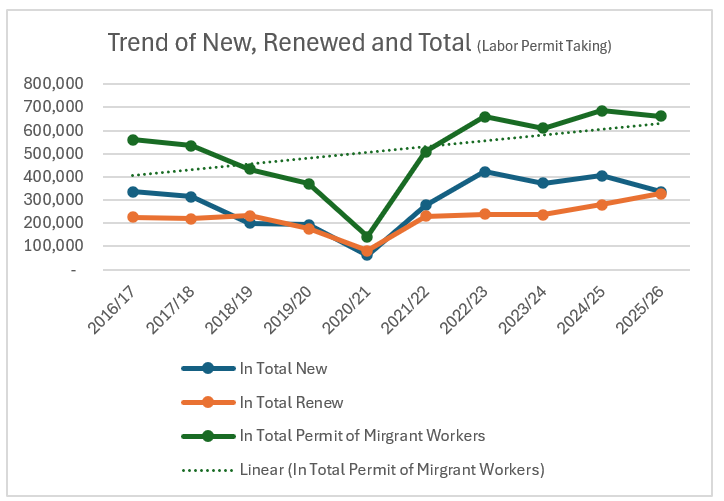
According to labor permit data, the number of foreign employment approvals increased from 560,036 during the first ten months of FY 2016/17 to 661,874 during the same period of FY 2025/26. The most significant disruption occurred during the COVID-19 pandemic. Total labor permit approvals dropped sharply to just 141,955 in FY 2020/21. However, foreign employment recovered rapidly and surpassed pre-pandemic levels by FY 2021/22.
During the review period, Nepal issued 661,874 in ten-month of 2025/26 foreign employment approvals, consisting of 335,510 new labor permits and 326,364 renewals. While total migration approvals remain near historic highs, one of the most notable developments is the narrowing gap between first-time migrants and returning workers. Over the past decade, new labor permits accounted for a median share of 57 percent of total approvals, while renewals represented 43 percent. This suggests that foreign employment demand remains relatively resilient, although major external shocks can temporarily disrupt migration flows.
The increasing share of renewals highlights a growing pool of Nepali workers repeatedly returning abroad instead of being replaced by new entrants. This indicates that labor migration is becoming increasingly institutionalized as a long-term livelihood strategy rather than a temporary employment option.
Gulf Dominance Continues
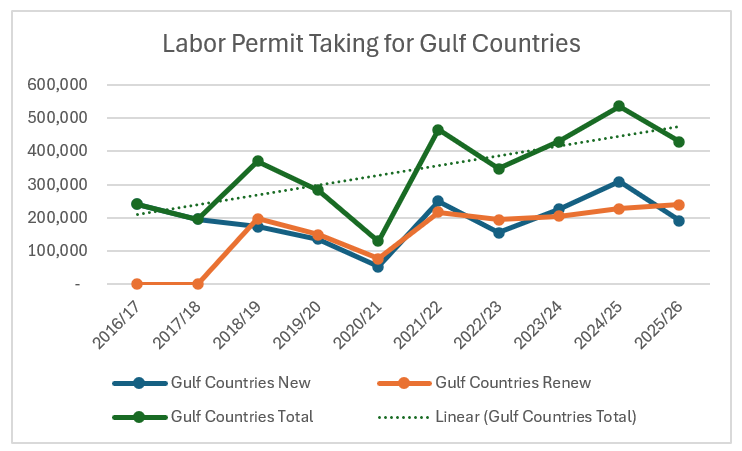
The Gulf region remains the backbone of Nepal's labor migration system. Saudi Arabia, Qatar, the UAE, Kuwait, Oman, and Bahrain collectively continue to absorb a large share of Nepali migrant workers. Over the past decade, Gulf countries accounted for a median of 29 percent of new labor permits issued annually. In other words, nearly three out of every ten first-time migrant workers chose a Gulf destination.
Following the COVID-19 pandemic, labor permit renewals for Gulf countries have shown a steadily increasing trend, indicating a growing degree of labor market institutionalization. The median share of renewals associated with Gulf destinations stood at 17 percent during the review period.
United Arab Emirates (UAE)
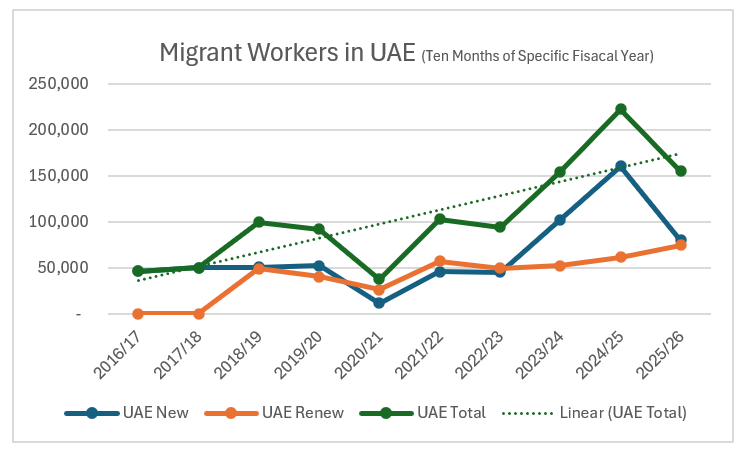
The UAE has emerged as the leading destination for Nepali migrant workers. Before the pandemic, annual labor permit approvals for the UAE generally remained below 100,000. Following COVID-19, however, approvals not only recovered but reached record levels. During the review period, more than 222,000 Nepali workers obtained labor permits for the UAE. Renewal permits have also increased steadily, suggesting growing long-term engagement in the labor market.
Several factors contribute to the UAE's attractiveness. Its business-friendly environment, strong trade and tourism sectors, and relatively diverse employment opportunities provide workers with broader career prospects compared to many traditional labor destinations. Some practical factors influence to labor force to choose UAE.
Qatar
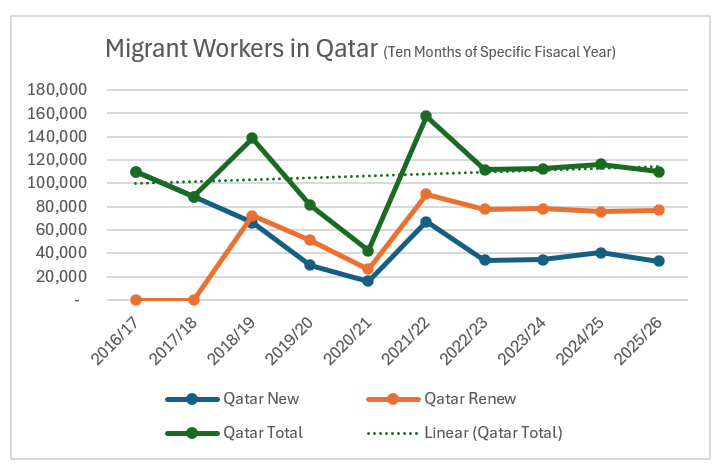
Qatar appears to be one of the most stable and institutionalized labor destinations for Nepali workers. Although the number of new labor permits issued for Qatar has gradually declined over time, renewal permits have steadily increased. This suggests that many workers are satisfied with their employment conditions and choose to extend contracts rather than seek opportunities elsewhere. The growing renewal trend indicates a stable and mature migration corridor between Nepal and Qatar.
Saudi Arabia
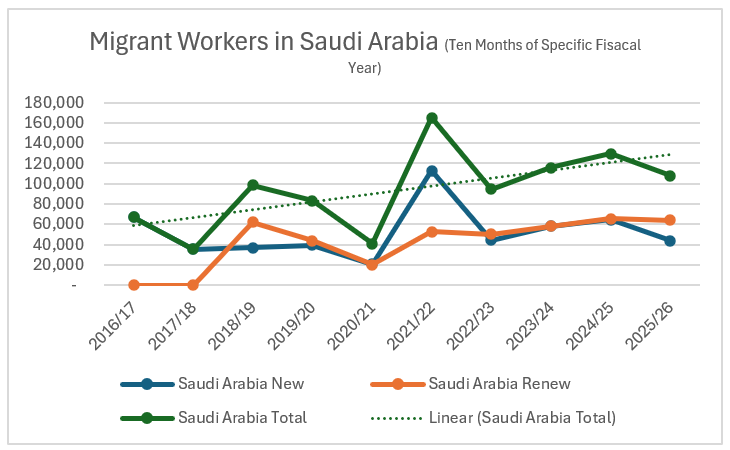
Saudi Arabia remains one of the preferred destinations for Nepali migrant workers. While new labor permit issuance has largely stabilized, renewal permits continue to rise steadily. As a result, total labor migration to Saudi Arabia has remained relatively stable over time.
Kuwait, Oman, and Bahrain
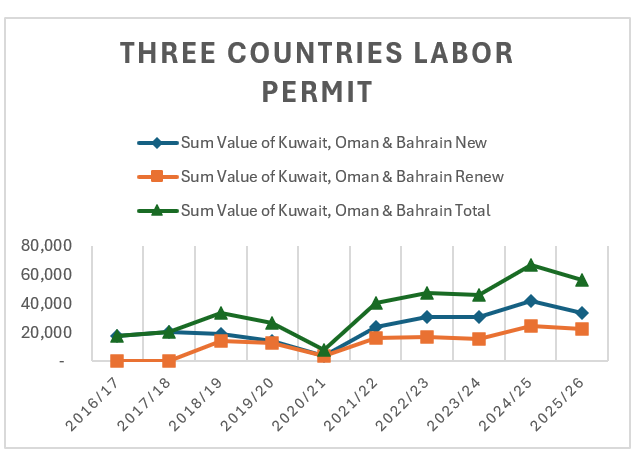
Kuwait, Oman, and Bahrain continue to serve as important destinations for Nepali workers, although at smaller scales compared to the UAE, Qatar, and Saudi Arabia. Over the review period, Kuwait recorded a median annual approval level of approximately 23,000 workers. Oman recorded a median of 4,615 workers, while Bahrain's median stood at 7,009 workers.
These countries continue to provide consistent employment opportunities and contribute to the diversification of Nepal's labor migration portfolio.
Malaysia
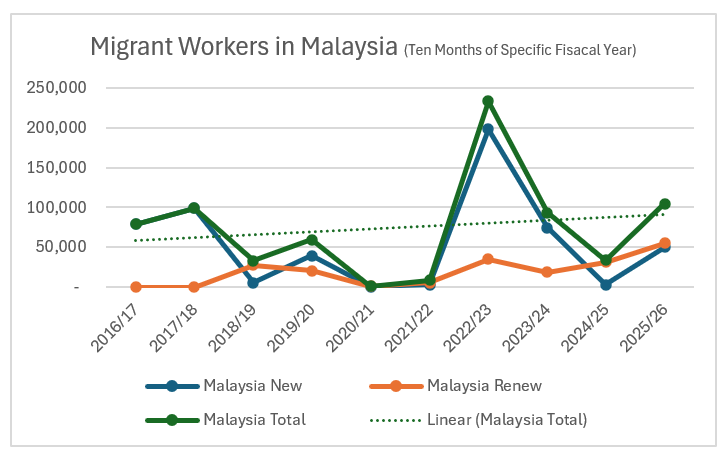
Following years of policy disruptions and recruitment restrictions, Malaysia recorded 104,986 labor approvals during the review period. Although this remains below the exceptional 233,576 approvals recorded in FY 2022/23 following the reopening of recruitment channels, it is substantially higher than pre-pandemic levels. Malaysia's recovery demonstrates how quickly labor demand can rebound when administrative bottlenecks and bilateral labor issues are resolved. It also highlights employers' continued reliance on Nepali workers despite increasing competition from other labor-sending countries.
East Asia Emerges as an Alternative
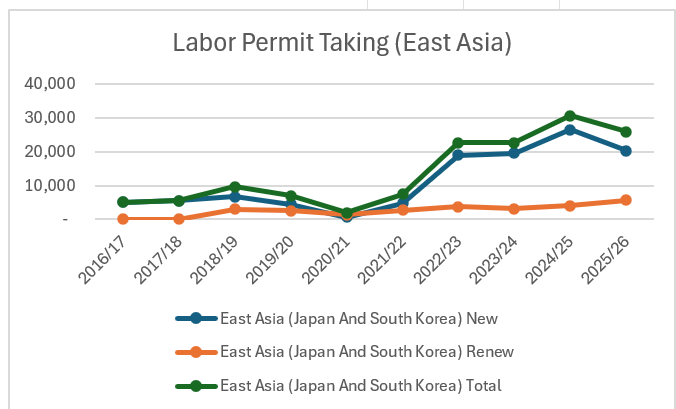
One of the most important long-term developments is the rise of East Asian labor markets. Japan recorded more than 38,000 labor approvals during the review period, while South Korea exceeded 13,000. Although these figures remain below those of major Gulf destinations, they represent a significant increase compared with historical levels.
These destinations are attractive because they generally offer higher wages, stronger labor protections, and greater opportunities for skill development. Their continued growth may gradually reduce Nepal's dependence on traditional low-skilled migration corridors in the Gulf. Evaluate this also subjected to government initiatives and G2G labor agreement.
Europe Quietly Expands
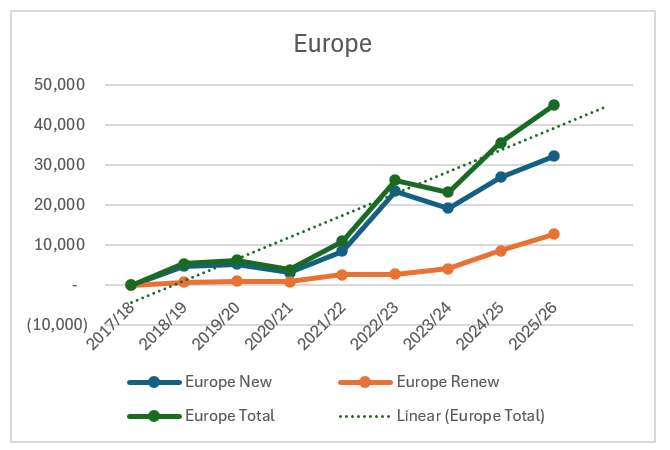
Europe is also emerging as an increasingly important destination for Nepali workers. Romania recorded more than 22,000 approvals during the review period, continuing a trend that has accelerated since the pandemic. Cyprus, Malta, Poland, and several Eastern European countries have also registered growing numbers of Nepali workers.
Although Europe still represents a relatively small share of total migration, its expansion signals the diversification of labor demand beyond Nepal's traditional destinations. As demographic aging and labor shortages intensify across Europe, these labor markets may become increasingly important for Nepali workers.
Renewals Reach Record Levels
Perhaps the most underappreciated trend in the data is the rapid growth in labor permit renewals. Renewal approvals reached 326,364 in FY 2025/26, the highest level recorded during the period under review. A decade ago, foreign employment discussions largely focused on first-time migrants. Today, an increasing number of workers are extending contracts or returning abroad after brief visits home.
This trend suggests that Nepal's foreign employment model is becoming increasingly cyclical and long-term in nature. Many workers are building sustained careers abroad rather than treating migration as a one-time opportunity.
At the same time, rising renewals reveal a deeper challenge. Many returning migrants do not appear to find sufficiently attractive economic opportunities within Nepal. Instead, they choose to re-enter overseas labor markets.
This may be the most important message hidden within the data: Nepal is not simply sending more workers abroad; it is becoming increasingly dependent on a workforce that repeatedly leaves, returns, and migrates again.
While migration destinations are diversifying from the Gulf toward East Asia and Europe, the underlying reality remains unchanged. Foreign employment continues to serve as one of Nepal's most important economic pillars and one of its most enduring structural challenges.
Major Shocks Affecting Foreign Employment
The following events significantly influenced Nepal's foreign employment landscape during the review period:
- The COVID-19 pandemic, which disrupted global labor mobility and recruitment.
- Policy changes and labor market controls implemented by the Malaysian government.
- Changes in UAE recruitment practices following labor market reforms, tighter regulations on visit-visa conversions, and broader demographic and workforce policy adjustments.
- The 2026 Middle East crisis and its potential impact on regional labor demand and migration flows.
Note
This analysis is based on foreign employment approval data published in Nepal Rastra Bank's Macroeconomic Indicators reports. Data covers the first ten months of each fiscal year from FY 2016/17 to FY 2025/26.
For statistical analysis, median values have been used instead of averages. The median provides a more robust measure of central tendency when outliers are present, reducing the influence of unusually high or low observations and allowing for a more representative assessment of long-term trends.

