

Is converting an existing ICE vehicle into an EV economically viable in the absence of government incentives?
Amid growing policy momentum for cleaner transportation, Nepal is once again revisiting the future of mobility. In the global scenario of issue in Middle East Asia power conflict on petroleum production and unrest global situation. As Nepal is full importers of fossil fuel. With those issues attention from policymakers has been renewed. The leadership of Balendra Shah, the government has signaled its intent to introduce regulations facilitating the conversion of petrol and diesel vehicles into electric ones. While the environmental case for electrification is clear, a more pressing question remains for investors, operators, and everyday vehicle owners: is converting an existing ICE vehicle into an EV economically viable in the absence of government incentives?
Background:
The Government of Nepal amended the Motor Vehicle and Transport Management Act, 2049 B.S. in March 2022, easing long-standing restrictions on vehicle modifications. The provision, valid for three years, allows vehicle owners and operators to make changes aimed at improving energy efficiency and environmental performance. Among the most notable opportunities created by this amendment is the conversion of internal combustion engine (ICE) vehicles into electric vehicles (EVs), a process that involves removing the conventional engine and installing an electric powertrain.
Beyond policy momentum, EV conversion presents tangible environmental and economic benefits. By extending the usable life of existing vehicles, it reduces the need for scrappage and helps lower overall carbon emissions. The viability of conversion often depends on factors such as vehicle type and usage patterns, multi-dimensional contribution could provide in local socio-economic status.
Governmental Stakeholder and Policies
While the vehicle topic comes in discussion it attracts multidimensional aspect. Government receives of huge fraction of custom tariffs to owners’ book renewal annually. Not only this this vehicle itself an integrative factor in various socio-economics side. So, governmental stakeholders bind it’s from strong rules and regulations basis. Which may dysfunctional over the time or need a amendment or could be barriers itself for dynamic growth. Policy and Regulatory Aspects; Inadequate EV conversion standards sets and regulations, Limited and contradictory legislative frameworks and lack of government leading parties’ commitment, Engine product modifications require a formal process to which should be seamless approval. Restricted opportunities by allowing only government-declared vehicle conversions. Technical; No institutional suppliers of skilled labor and workshops, Premature infrastructure and charging facilities, Government lingering approach on innovation. Social barriers: Lower public awareness on conversion-based EV. Lack environmental awareness. Weaker public perception on converted EV.
Here are the stakeholders and corresponding policies for EVs. Policy to address conversion issues ‘Environment Friendly Transport Operation and Management Directory (2024); Environment Friendly Transport’s Conversion Criteria (2024). Policies regarding National Climate Change Policy (2019) and National Environment Policy (2019). Polices of transportation National Transport Policy (2001) and Environment Friendly Transport Policy (2014) and other policies which attract the attention from transportation should be stabilized.
As the conversion process go through Four Steps: conducting initial inspection of vehicles, removing thermal elements, integrating the technology, Integrating the technology for vehicles conversion, conducting technical tests and verification. This action seems automotive engineering base task with sound knowledge and expertise-based manpower and infrastructure too. Those conversion channel should be well organized and developed.
Local Resources Mobilization:
Adoption of new technology and system in nation. Need to watch its economic and socio-economic contributions. Which is determined by how much value adding factors produces or how much of portion contributed by local resources. I.e. Infrastructure, Components production, Human resources utilization, and other factors of production utilize.
Bigger infrastructure is needed for EVs conversion with high equipment intensive plant. High energy circulating high tension line to electricity circuit. Accessible EV charging station. Not only this boosting economy by circulating money faster in domestic markets and local economic channels. So, we need to take in account that how much things are utilizing produced by locally. And government should incentivize and give policy-based confidence to investors to invest in such infrastructure. One of Nepalese is policy instability so that investors afraid to make investment decision in new sectors. Some of private companies i.e. Abhiyantriki Karmashala, Ryan Energy, Shree Eco Visionary, Clean Energy International and others in Government/ Public entity Sajha Yatayat trying to adopt this ideal concept of ICE/diesel engine vehicle to EVs. But stable growth to mass production couldn’t be observed till now.
While talking about adoption, how much components produce in local markets and with high value propositions. In this case major components of converting into EVs are: Electric Motor, Electric controller, Battery, Gearbox and adapter plate, Accelerator Sensor, Power Cable, EV Fuses and Circuit Breaker, Contactor, DC-DC Convertor, Volt Meter, Ampere and SOC-Meter, Auxiliary Parts. Are those components being produces by Nepalese market? If those components production activities come in base line of these verticals. Which can generate higher employment and beneficial from multidimension aspect.
Financial Viability for Bus Conversion:
Based on policy advice report prepared by Solutionsplus in June 2024. A comparison of upfront costs and annual returns suggests that diesel buses continue to hold a financial edge over converted electric buses. A new diesel bus, priced at NPR 4,747,500 (USD 35,965), remains significantly cheaper than a converted e-bus, which comes in at NPR 8,507,500 (USD 64,450).
As the topic of investment decision influencing factor is return. The revenue gap is notable. Diesel buses generate higher annual earnings of around NPR 4,236,696 (USD 32,000), while converted e-buses bring in approximately NPR 2,267,004 (USD 17,174). Together, these figures indicate that, despite the external shock of supply chain disruption of fossils fuel as well as price fluctuation and the environmental advantages of electrification, diesel buses currently offer stronger profitability for operators. Short-Term / Private Investor View Choose diesel bus due to highest returns, fastest recovery.
Assumptions:
Operates on the Lagankhel–Budhanilkantha route (32 km roundtrip), completing 3 roundtrips daily and carrying ~366 passengers/day. Energy uses, Requires ~7 hours overnight charging + 1.5 hours opportunity charging. Energy consumption increases from 0.56 kWh/km to 0.93 kWh/km over 10 years due to battery degradation. Cost Accounted: Route permit, road tax, technical inspection, insurance, personnel, electricity, maintenance, and income tax. Investment Accounted; Converted e-bus: NPR 8 million for new e-bus: NPR 13 million and Diesel bus: NPR 4.9 million. Financial Assumption; Discount rate: 10%, Diesel consumption: 0.22 L/km (current fuel prices considered).
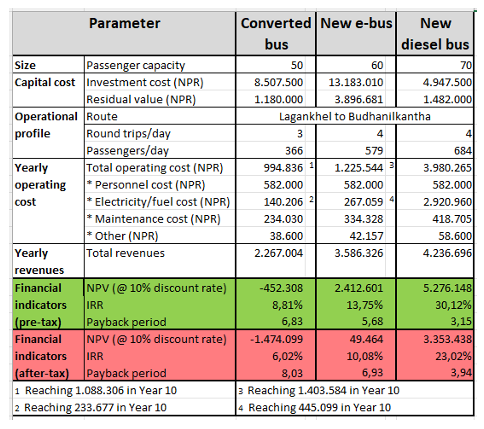
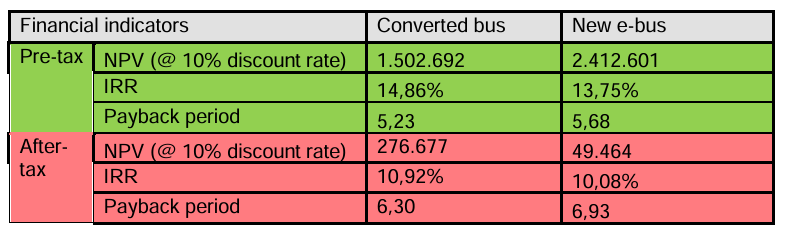
Assumptions on the operation of converted bus prepared by Solutionsplus published entitled “Kathmandu, Nepal: Vehicle Conversion Policy Advice Paper”
The converted bus performs poorly pre-tax (negative NPV, IRR below discount rate), meaning it is not financially viable without improvements. The new e-bus is moderately viable: Positive NPV (2.41M NPR), IRR (13.75%) greater than discount rate (10%), Payback 5.7 years. The new diesel bus appears most profitable financially; Highest NPV (5.27M NPR), Highest IRR (30.12%) and Fastest payback (3.15 years). Main reasons of Diesel buses seem financially strong because of initial cost to own the diesel buses. Which leads to other financial indicators stronger sides. So, Without incentives (tax breaks, subsidies), EV options struggle - especially conversion.
Conversion is not viable at small scale Medium-Term / Business Expansion If operating multiple buses, conversion becomes attractive Scaled conversion can: Compete with new e-buses Require lower upfront capital than buying new e-buses Policy / Government Perspective EV adoption (especially conversion) needs support Tax incentives Subsidies Financing support Without policy backing, market will favor diesel despite environmental costs Final Decision Rule Single or small operator: Avoid conversion Prefer diesel or consider new e-bus if environmentally motivated Fleet operator (scale advantage): Conversion becomes a viable and competitive option Policy takeaway: Conversion can work in Nepal - but only with scale or incentives Financial viability for bus conversion
Mini Truck EV Conversion:
Assumptions
Vehicle & Technology: 2007 pick-up converted to EV with 15 kWh LFP battery and new drivetrain; payload limited to 500 kg. Investment & Life: Cost NPR 1.93M, useful life 6 years, residual value NPR 150K. Operations: 3.5 trips/day × 20 km, 330 days/year → 70 km/day. Revenue Consideration: NPR 1,500/trip NPR 1.73M/year. Costs Accounted: Includes electricity, personnel, maintenance, insurance, tax, and permits; electricity use 0.12 kWh/km, tariff NPR 10/kWh. Performance: Positive returns with high profitability (NPV 3.8M, IRR 64%), payback <1.5 years.
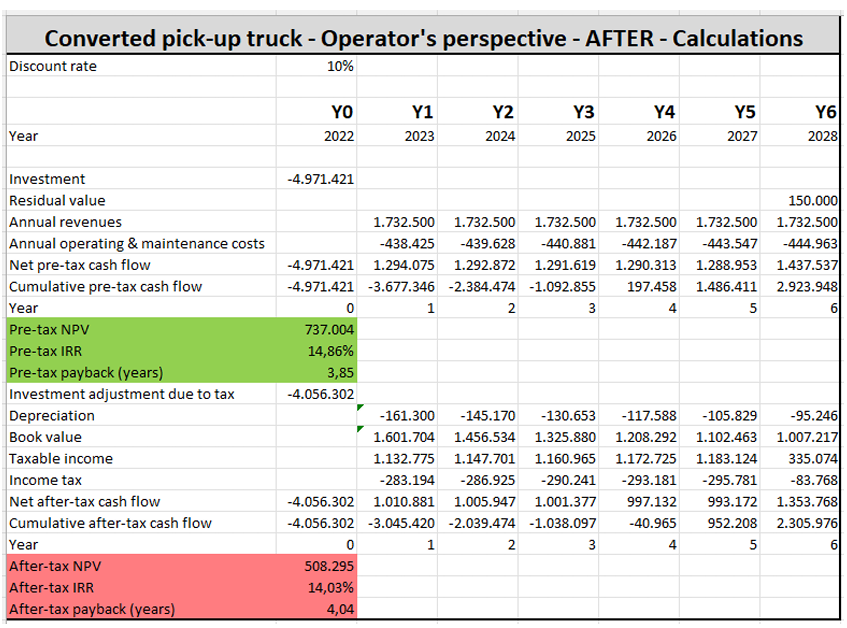
Assumptions on the operation of converted pick up truck prepared by Solutionsplus published entitled “Kathmandu, Nepal: Vehicle Conversion Policy Advice Paper”
Initial Investment (After tax adjustment): NPR 4,056,302, Project life: 6 years, Discount rate: 10% The tax adjustment significantly reduces the effective capital outlay from ~NPR 4.97M to ~NPR 4.06M — this is a major driver of viability. After tax; NPV: NPR 508,295, IRR: 14.03%, Payback: 4.04 years. Interpretation: Project remains financially viable after tax reduces: NPV by ~31% IRR slightly (~0.8%) This is a financially viable but moderately sensitive investment. The project works under current assumptions, but: It is not highly robust It requires stable operations and cost control Policy support would dramatically enhance attractiveness
Conclusion:
Need to address; Policy and Regulatory Aspects; Build adequate EV conversion standards sets and regulations, eliminating limited and contradictory legislative frameworks and commitment by government leading parties, Seamless approval on Engine product modifications require a formal process. Opening floor of opportunities by allowing governmental and private vehicle conversions. Technical; Building an institutional supplier of skilled labor and workshops, highly efficient and technological based infrastructure and charging facilities, Proactive Government approach on innovation. Social barriers to opportunities: More public awareness on conversion-based EV. Sufficient work on environmental awareness. Strengthening public perception on converted EV. Lowering initial and post capital cost, Expensive conversion spare parts and component (battery, motor, controller and electric circuit systems), Costs for battery replacement and disposal, Investment in EV conversion. Easing in obtaining insurance coverage for batteries. Promoting Banks and Financial institutions in financing larger vehicle conversions.
Diesel bus remains most profitable due to low upfront cost. Converted bus is less profitable than new e-bus but requires lower investment with Projected IRR: ~8.81%. If conversion cost is less than 8 million will keep Positive NPV.
Conversion is financially viable but marginal, with profitability improving through cost reductions and economies of scale. In other sides government should give subsidies on those components to make EVs conversion sustainable but government should show generosity on tax tariff not only this sometimes, may have to pay from national account. Other wise not seems so much feasible.
Pick-ups, vans, and delivery vehicles show: High IRR, Quick payback Easier to scale across urban areas. Prioritize light commercial EV conversion programs. Minimal Subsidy Needed
Even without incentives, project is viable Government can: Offer low-interest financing instead of heavy subsidies, Promote through credit schemes. Pick-up EV conversion is a low-risk, high-return opportunity with fast capital recovery.
Data and Report for this article taken entitled “Kathmandu, Nepal Vehicle Conversion Policy Advice Paper” prepared by Solution Plus Policy Paper, in June 2024

