


Fueling the Treasury: Petroleum Taxes Remain Central to Nepal's Revenue

.png)
The Government of Nepal (GoN) has announced its commitment to achieving Net Zero Carbon Emissions by 2045. To meet this target, the country must significantly transform its transportation sector by replacing fossil fuel-powered vehicles with renewable energy-based alternatives. Likewise, the government will need to replace carbon-emitting technologies with cleaner, renewable energy solutions across many other sectors.
However, an important question remains: Is the government prepared for this transition? From a fiscal perspective, is it sustainable? A major portion of the Government of Nepal's revenue comes from various taxes imposed on petroleum products. The revenue generated from this sector cannot be replaced easily soon. Therefore, while accelerating the adoption of renewable energy, the government must also develop alternative sources of tax revenue to offset the decline in petroleum-related taxes.
Nepal's dependence on imported petroleum products has steadily increased over the past decade, making fuel imports one of the country's largest contributors to customs revenue and indirect taxation. An analysis of petroleum import data from Fiscal Year (F.Y.) 2072/73 to 2082/83* reveals how changes in international oil prices, domestic demand, and government tax policies have influenced import values, customs revenue, and fuel costs.
Although the quantity of imported fuel has remained relatively stable in recent years, the overall import bill has risen sharply due to fluctuations in global crude oil prices. Customs revenue has also grown significantly, highlighting petroleum products as one of the government's most reliable revenue sources.
KL = Kilo Liters
MT = Metric Tons
Petrol: Higher Prices Drive Revenue Growth
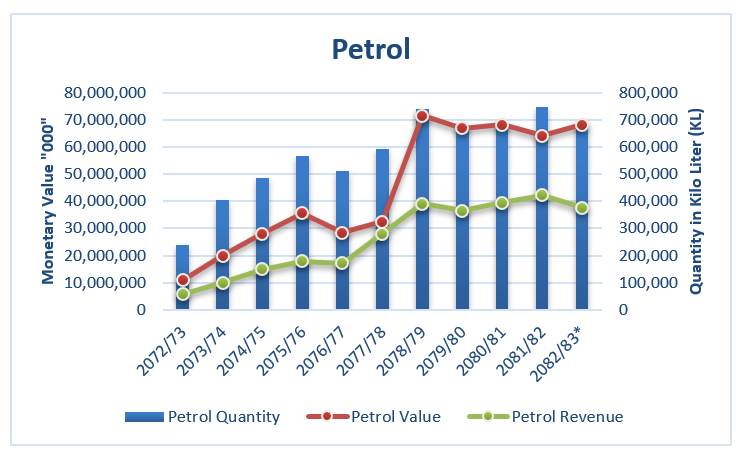
Petrol imports increased from 238,641 KL in F.Y. 2072/73 to 685,271KL in F.Y. 2082/83*, representing nearly a threefold rise over the decade. The value of petrol imports expanded even more dramatically from Rs. 10.99 billion to Rs. 68.18 billion reflecting the impact of rising international fuel prices rather than volume growth alone.
Government revenue collected from petrol imports also showed substantial growth. Revenue increased from Rs. 5.68 billion in 2072/73 to Rs. 37.60 billion in 2082/83* by more than 6 folds. Customs and tax collection per liter more than doubled, rising from Rs. 23.81 to Rs. 54.89.
Border cost per liter peaked at Rs. 99.51 in 2082/83*, illustrating continued exposure to international market volatility. Despite fluctuations in annual import volume, petrol remains one of the government's largest tax-generating commodities.
Diesel Continues to Dominate Nepal's Fuel Consumption
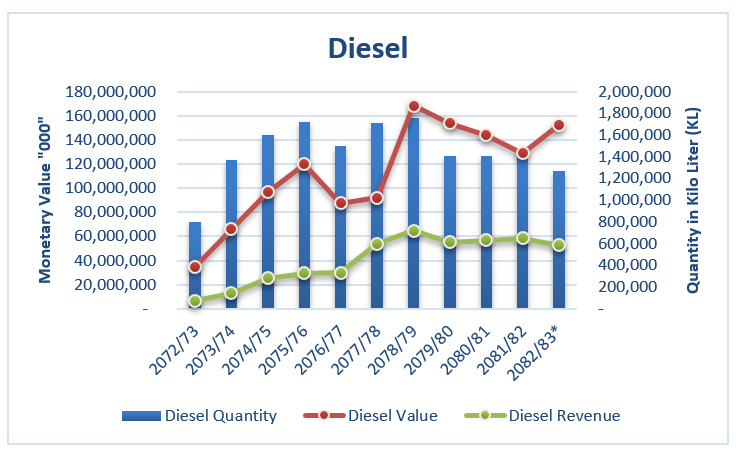
Diesel remains Nepal's most imported petroleum product, reflecting its extensive use in transportation, agriculture, construction, and industrial activities. Imports climbed from 802,129 KL in F.Y. 2072/73 to more than 1.26 million KL in 2082/83*. Although volumes declined slightly after reaching their peak, diesel consumption has remained consistently high.
The financial impact has been significant:
- Import value surged from Rs. 35.02 billion to Rs. 152.68 billion.
- Customs revenue expanded from Rs. 6.69 billion to Rs. 52.82 billion.
- Border cost per liter increased from Rs. 43.66 to Rs. 120.71.
- Tax collection per liter rose from Rs. 8.33 to Rs. 41.76, nearly five times higher than a decade ago
- Diesel alone contributes the largest share of petroleum-related government revenue, making it strategically important for fiscal management.
Kerosene Consumption Continues to Decline
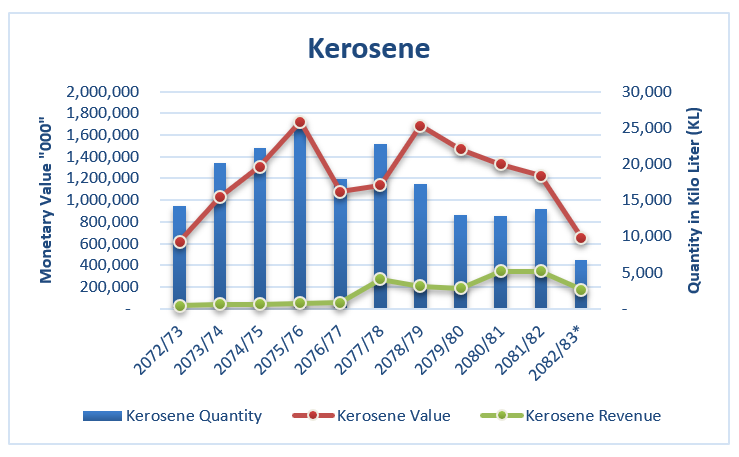
Unlike petrol and diesel, kerosene imports have shown a clear downward trend. Imports fell from 14,167 KL in 2072/73 to only 6,796 KL in 2082/83*, indicating a gradual shift toward LPG, electricity, and cleaner household energy alternatives.
Although tax per liter increased considerably from Rs. 2.00 to Rs. 25.79 overall customs revenue remains relatively small because of declining consumption. Based on data suggests our energy transition is steadily reducing dependence on kerosene for household use.
Aviation Fuel Reflects Tourism Recovery
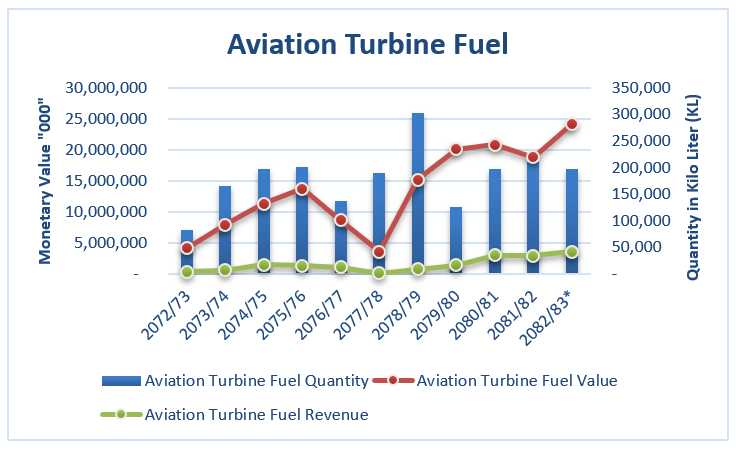
Aviation Turbine Fuel (ATF) imports demonstrate the direct relationship between fuel demand and Nepal's aviation and tourism sectors. During the COVID-19 pandemic, ATF imports and government revenue declined sharply. In F.Y. 2077/78, border cost dropped dramatically to only NPR. 19.07 per liter, while customs revenue fell to NPR. 142 million. However, the recovery of international tourism has strengthened demand.
By F.Y. 2082/83*:
- Import value reached Rs. 24.07 billion.
- Customs revenue increased to Rs. 3.60 billion.
- Border cost climbed to Rs. 121.92 per liter.
- Tax collection reached Rs. 18.22 per liter, the highest level in the observed period.
The data reflects Nepal's post-pandemic aviation recovery alongside renewed international travel.
LPG Demand Remains Strong
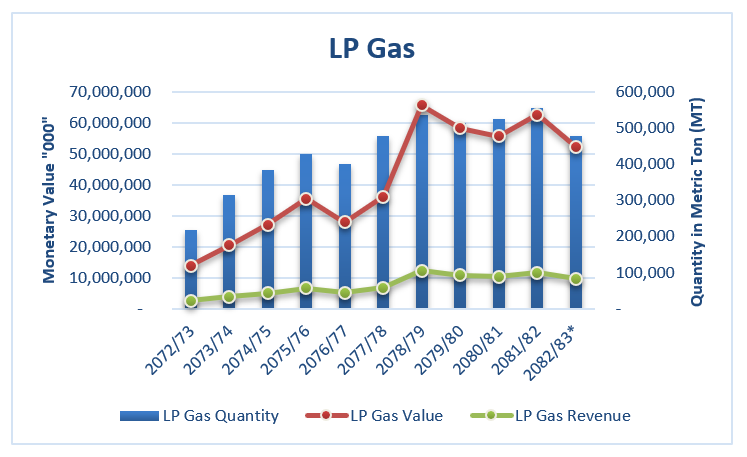
Liquefied Petroleum Gas (LPG) has become Nepal's primary cooking fuel, replacing traditional biomass and kerosene in many households. Import volume increased steadily from 217.7 thousand metric tons in 2072/73 to 476 thousand metric tons in 2082/83*, despite some year-to-year fluctuations.
The financial indicators also highlight its growing importance.
- Import value increased from Rs. 13.81 billion to Rs. 52.22 billion.
- Government revenue expanded from Rs. 2.58 billion to Rs. 9.74 billion.
- Border cost per unit rose from Rs. 63.41 to Rs. 109.70.
- Tax per unit nearly doubled from Rs. 11.83 to Rs. 20.46.
Although LPG remains heavily subsidized relative to other petroleum products, its increasing demand continues to contribute significantly to customs collections.
Global Oil Prices Continue to Shape Nepal's Import Bill
The data clearly demonstrates that Nepal's petroleum import expenditure is driven more by international price movements than by changes in import quantity.
Between 2078/79 and 2080/81, international crude oil prices surged following the global economic recovery and geopolitical tensions. As a result, the border cost of nearly every petroleum product increased substantially, pushing Nepal's total import bill to record levels.
Although global prices moderated during 2081/82, import values remained elevated compared to historical averages, underscoring Nepal's vulnerability as a fully import-dependent energy market.
Petroleum Taxes Remain a Major Fiscal Pillar
One notable trend is the steady increase in tax collection per liter across almost every petroleum product. Higher tax rates have enabled the government to maintain strong customs revenue even when import volumes have remained relatively stable. Petrol and diesel together now generate tens of billions of rupees annually, making petroleum taxation one of Nepal's most dependable sources of indirect revenue.
However, increasing fuel taxation also raises transportation and production costs across the economy, contributing to inflationary pressure and affecting household purchasing power.
Looking Ahead
The decade-long trend highlights Nepal's dual challenge of ensuring energy security while managing the fiscal dependence on imported fossil fuels. As the country gradually expands hydropower generation and promotes electric mobility, petroleum consumption may eventually stabilize or decline. Until then, imported fuels will continue to play a central role in supporting transportation, industry, tourism, and government revenue.
While international oil prices remain beyond Nepal's control, improving fuel efficiency, diversifying energy sources, and accelerating the transition toward renewable energy can help reduce external vulnerabilities over the long term.
2082/83 represents data up to the month of Jestha (mid-May to mid-June) of the current fiscal year.*

