

Foreign Direct Investment in Nepal’s Agriculture: Why Global Investors Still Hesitate
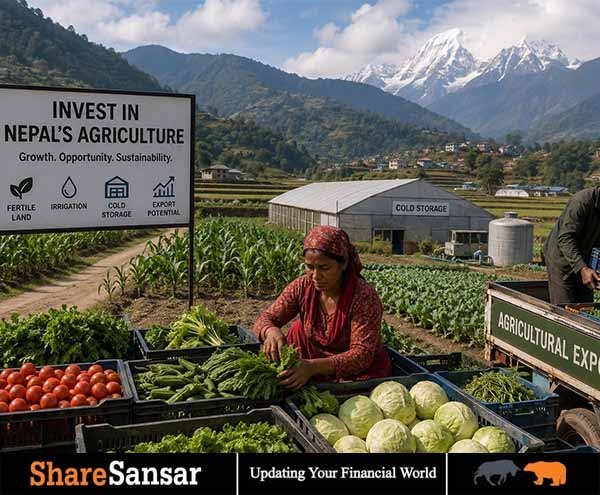
Nepal has long been known for its fertile land, varied climate, and wide range of agricultural products. From the hot plains of the Terai to the cool hills and mountain regions, farmers grow rice, tea, fruits, vegetables, herbs, and livestock products. Agriculture is a crucial sector in Nepal's economy, providing livelihoods for a significant portion of the population and playing a key role in the country's overall development. Despite the strong agricultural base, global investors continue to hesitate to invest in Nepal’s farm sector.
Foreign direct investment in Nepal’s agriculture growing in recent years. In the first seven months of fiscal year 2025/26, agriculture received investment promises worth Rs 40.28 billion, which is the highest among all sectors. China pledged Rs 20 billion for a buffalo meat processing plant, which became the largest agricultural investment pledge so far by permitting 100% ownership in processing facilities and providing tax benefits for five to ten years, the government has also made it easier for foreign investors to enter the market. On paper, these steps look promising. In practice, however, many investors are still waiting to see real progress.
For perishable goods such as fruits, vegetables, milk, and meat, poor transportation is one of the biggest threats to business profitability. Inadequate roads, lack of refrigerated vehicles, and limited cold storage facilities mean that products often spoil before they even reach the market. Every hour lost due to bad roads, vehicle breakdowns, or weather disruptions adds to the cost and reduces the quality of the product. For a business, this means dealing with unsold inventory, unhappy buyers, and wasted resources. When transportation is unreliable, businesses cannot make consistent deliveries, cannot build trust with customers, and ultimately cannot grow making Nepal's agricultural sector a risky and unattractive option for serious investors.
Nepal currently loses around 30% of its fruits and vegetables after harvest, and the primary reason behind this massive loss is the lack of adequate cold storage facilities across the country it means that a huge portion of produce simply rots before it can be transported, sold, or consumed. From an investor's point of view, this is a serious red flag, because when nearly one-third of agricultural output is wasted before it even reaches the market, the overall return on investment drops significantly, making the sector appear financially unattractive and highly risky for anyone looking to put their money into Nepal's agriculture.
Furthermore, irrigation remains another deep-rooted and persistent challenge for farmers across Nepal, as a large number of farming areas still depend heavily on seasonal rainfall rather than a reliable and controlled water supply system, which means that crop production is inconsistent, unpredictable, and highly vulnerable to weather changes ultimately reducing the volume and quality of output that farmers and businesses can count on throughout the year. Only 30% of Nepal's farmland has proper irrigation, which means the majority of farmers still rely on rainfall to grow their crops. However, due to climate change, rainfall has become increasingly unpredictable and unreliable, making it even harder for farmers to plan and produce consistent harvests throughout the year. when it rains too little, the soil becomes dry and crops cannot grow properly, but when it rains too much, the fields get flooded and crops get damaged or completely destroyed. In both situations, farmers suffer losses they either produce less or the quality of their crops becomes very poor, making it hard to sell them at a good price in the market. This uncertainty makes it difficult for investors to plan large-scale farming operations that need stable output throughout the year.
One of the biggest problems in Nepal's agriculture is that farmland is extremely fragmented, with the average farm size being only 0.7 hectares. There is an odd situation where people who want to invest in farming cannot find enough land, while those who already own land are simply not interested in farming it. Large-scale commercial farming needs big, connected pieces of land, but in Nepal, even where land is available, it is broken into tiny scattered pieces. When land is passed down through generations, it gets divided among family members, making it nearly impossible to bring enough land together for one big farming project. On top of this, unclear ownership records, outdated registration systems, and slow legal processes make things even more complicated. Because of all these reasons, foreign investors simply walk away. They need large plots, legal clarity, and a smooth process to set up modern, machine-based farming, and Nepal currently offers none of that. As a result, Foreign Direct Investment in Nepal's agriculture remains very low, and the country continues to miss out on the modern technology, capital, and expertise that could genuinely transform its farming sector.
The approval process itself creates another major barrier for investors who are seriously considering entering Nepal's agricultural sector although the government claims to have a one-window policy designed to make the process easier and faster, the reality on the ground is very different investors still have to visit and deal with multiple government offices and fill out numerous forms before they can even begin their project. They are required to go through several departments and offices including the Department of Industry, water offices, forest offices, and local government bodies, each of which has its own set of requirements, procedures, and timelines. This lengthy and complicated process consumes a great deal of time, causes unnecessary frustration, and discourages serious investors from moving forward with their plans. For foreign investors who are used to faster and simpler systems, these delays alone can be enough reason to take their investment to another country. Policy uncertainty makes things even worse. Investors need clear and stable rules before committing large amounts of money, but Nepal has seen frequent political changes, ongoing debates, and sudden policy shifts over the years. This makes the business environment feel unpredictable and risky. Foreign companies are simply not willing to invest heavily in a country where the rules might change at any time or where local politics could block their project without warning.
The market system is another major weak point that is holding back the growth of Nepal's agricultural sector. Despite being an agricultural country, Nepal imports food worth Rs 250 to 300 billion every year, which clearly shows that domestic production is not enough to meet the demands of its own population. At the same time, agricultural exports remain very low, sitting well below 100 million dollars annually, which means Nepal is spending far more on buying food from other countries than it is earning by selling its own products abroad. This huge gap between imports and exports is a strong sign that Nepal's agricultural market system is inefficient, poorly organized, and not competitive enough to take advantage of its own farming potential. This shows that the country is not yet strong in production, processing, packaging, and export management. Middlemen often control the market, while farmers receive low prices.
Quality testing is another serious weakness in Nepal's agricultural sector. International buyers demand products that are safe, clean, and properly certified before they are willing to purchase them. However, Nepal does not have enough well-equipped laboratories and internationally recognized quality standards to meet these expectations. As a result, even when Nepali farmers produce good crops, those products cannot be properly verified or certified, making it very difficult for Nepal to compete and sell its agricultural goods in the global market. Despite all these challenges, Nepal does have some clear and promising strengths in its agricultural sector. Products such as tea, apples, herbs, cardamom, kiwi, buffalo meat, and organic goods are among the country's finest and most competitive agricultural offerings. These products already have strong natural qualities and growing demand in global markets, but in order to fully capitalize on this potential, they need to be properly processed, graded, packed, and certified to meet international standards. With the right investment, infrastructure, and support, these products have the ability to perform very well in global markets and significantly boost Nepal's agricultural exports. Nepal has a big export opportunity that can be achieved by improving its overall agricultural system. Instead of trying to compete in every area of farming, Nepal should focus on the products where it already has a natural advantage such as tea, cardamom, herbs, and organic goods. By putting more effort and resources into these specific products and making them meet international standards, Nepal can attract more foreign investors, grow its exports, and make a much bigger impact in the global agricultural market.
Both foreign investment and aid can be beneficial, but only if they are applied properly, according to the report, funding frequently goes into food processing, greenhouse growing, cold storage, roads, irrigation, and training although the manual cautions against misuse, these areas are helpful since they promote actual output. Although aid is promised to help farmers, it is often delayed by excessive paperwork, corruption, and political pressure, and even when money is provided, poor monitoring means that projects remain unfinished and farmers receive little to no real benefit.
The government should also encourage farmers to work together through cooperatives. Small farms alone cannot get access easily to reach export markets, but groups of farmers can produce more and negotiate better prices. Nepal must invest in modern testing laboratories, export certification processes, and proper packaging systems to ensure that its products meet international standards and can successfully compete in global markets. It should also train farmers and young people in modern farming, post-harvest handling, and food processing. If Nepal truly wants to compete in the global market, it needs skilled and capable people just as much as it needs money, and at the same time, strong oversight of aid and investment is essential to ensure that funds are not wasted or misused, which is why the government must actively transparently monitor projects and regularly report the results to the public so that accountability is maintained at every level. Aid money, when used with full honesty and accountability, has the remarkable power to transform farming communities through better roads, water systems, storage facilities, and training programs, but the moment it is misused, manipulated, or stolen, the trust of the people shatters, investors turn their backs, and the dream of a stronger and more prosperous nation slips further and further away.
In the end, Nepal has real agricultural promise, but it has not yet created the right environment for global investors. Poor infrastructure, small landholdings, slow approvals, weak quality control, and policy uncertainty all make investors hesitate. At the same time, Nepal’s special products and rich farming base give it a strong chance to grow. If the government improves systems, uses aid honestly, and supports farmers properly, Nepalese agriculture can become a strong export sector and attract more foreign investment in the future.
Article By: Mukesh Rana Magar & Dhirendra Rawal

