Rauniyar Proposes 15-Point Reform Agenda to Modernize Nepal’s Capital Market
Mon, Aug 10, 2026 8:39 PM on National, NEPSE News, Stock Market, Latest,
.png)
Calls for Lower Capital Gains Tax, Removal of Trading Restrictions, Modern Market Infrastructure and Stronger Regulatory Oversight
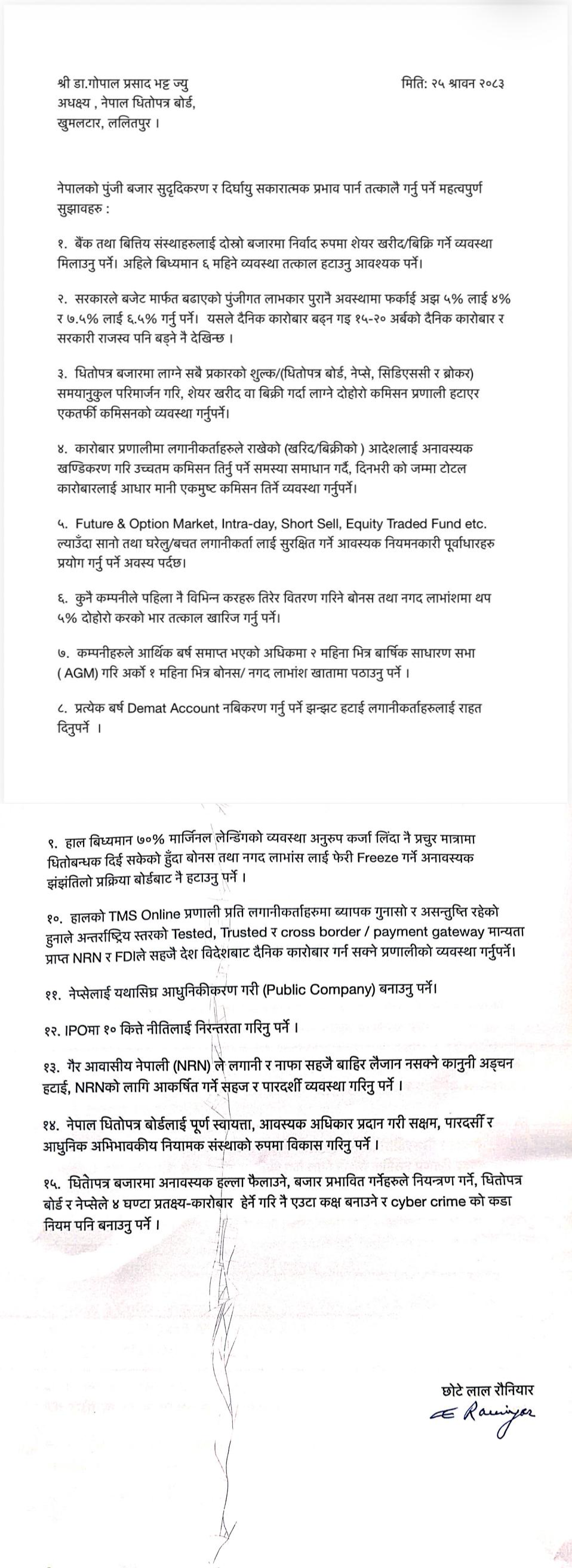
Investor and former lawmaker Chhotelal Rauniyar have submitted a 15-point set of suggestions to the Securities Board of Nepal (SEBON), calling for immediate policy and structural reforms to strengthen and modernize Nepal’s capital market and make it more investor-friendly.
Rauniyar submitted the suggestions to SEBON Chairman Dr. Gopal Prasad Bhatt on Monday. His proposals cover secondary market participation, taxation, trading systems, new financial instruments, investor protection, dividend distribution, market infrastructure, and regulatory reforms.
Rauniyar has called for banks and financial institutions to be allowed to freely buy and sell shares in the secondary market and urged the regulator to immediately remove the existing six-month restriction.
He has also suggested reverting the capital gains tax rates increased through the government’s budget to their previous levels, reducing the rates from 5% to 4% and from 7.5% to 6.5%. According to Rauniyar, lower tax rates would encourage trading activity and could ultimately increase government revenue through higher transaction volumes.
Similarly, he has called for a timely revision of all charges applicable in the securities market and the abolition of the double-commission system on share transactions. He has proposed that commission be charged only once on a transaction.
Rauniyar has also suggested addressing the issue of investors paying higher commissions due to the unnecessary fragmentation of buy and sell orders. He has proposed a system under which commission would be calculated based on an investor’s total transaction volume during the trading day rather than on individual orders.
He has called for the introduction of futures and options, intraday trading, short selling, and exchange-traded funds (ETFs) in Nepal’s capital market. At the same time, he has emphasized the need to establish adequate regulatory and risk-management infrastructure to protect small and retail investors while introducing such instruments.
Rauniyar has also called for the immediate removal of the 5% tax imposed on investors on bonus shares and cash dividends, arguing that companies have already paid applicable taxes before distributing such returns to shareholders.
He has proposed that companies be required to conduct their annual general meetings (AGMs) within a maximum of two months after the end of the fiscal year and distribute bonus shares and cash dividends to investors within one month following the AGM.
He has further suggested abolishing the annual Demat account renewal fee to reduce the financial burden on investors.
Regarding margin lending, Rauniyar has called for the removal of the practice of freezing bonus shares and cash dividends when investors have already provided sufficient collateral under the existing 90% margin-lending arrangement. He described the additional freezing requirement as an unnecessary and cumbersome process for investors.
Rauniyar has also raised concerns over the existing Trading Management System (TMS), citing widespread complaints and dissatisfaction among investors. He has called for the development of a secure, reliable, and internationally tested online trading system.
He has proposed establishing a modern cross-border trading and payment-gateway system to enable non-resident Nepalis (NRNs) and foreign investors to conduct transactions conveniently from both Nepal and abroad.
Similarly, he has called for the Nepal Stock Exchange (NEPSE) to be modernized at the earliest and transformed into a public company.
Rauniyar has also advocated the continuation of the existing policy of allocating 10 shares to individual investors in initial public offerings (IPOs).
He has called for the removal of legal and procedural barriers preventing non-resident Nepalis from bringing investment into Nepal and repatriating investment proceeds and profits abroad. He has emphasized the need for a simple, transparent, and investor-friendly framework to attract greater NRN investment.
Likewise, Rauniyar has urged the government to develop SEBON into a fully autonomous, capable, transparent, and modern regulatory institution with stronger oversight capacity.
He has also proposed that SEBON and NEPSE establish a dedicated 24-hour market surveillance unit to monitor trading activities and control the spread of unnecessary rumors and other activities that could manipulate or adversely affect the market. He has further called for stronger legal provisions to prevent and control cybercrime in the capital market.
Rauniyar said that addressing the existing policy and technological challenges in the capital market and strengthening investor confidence would help increase market activity as well as government revenue.