


Is NEPSE Still a Banking Market? A Two-Decade Analysis Says Otherwise


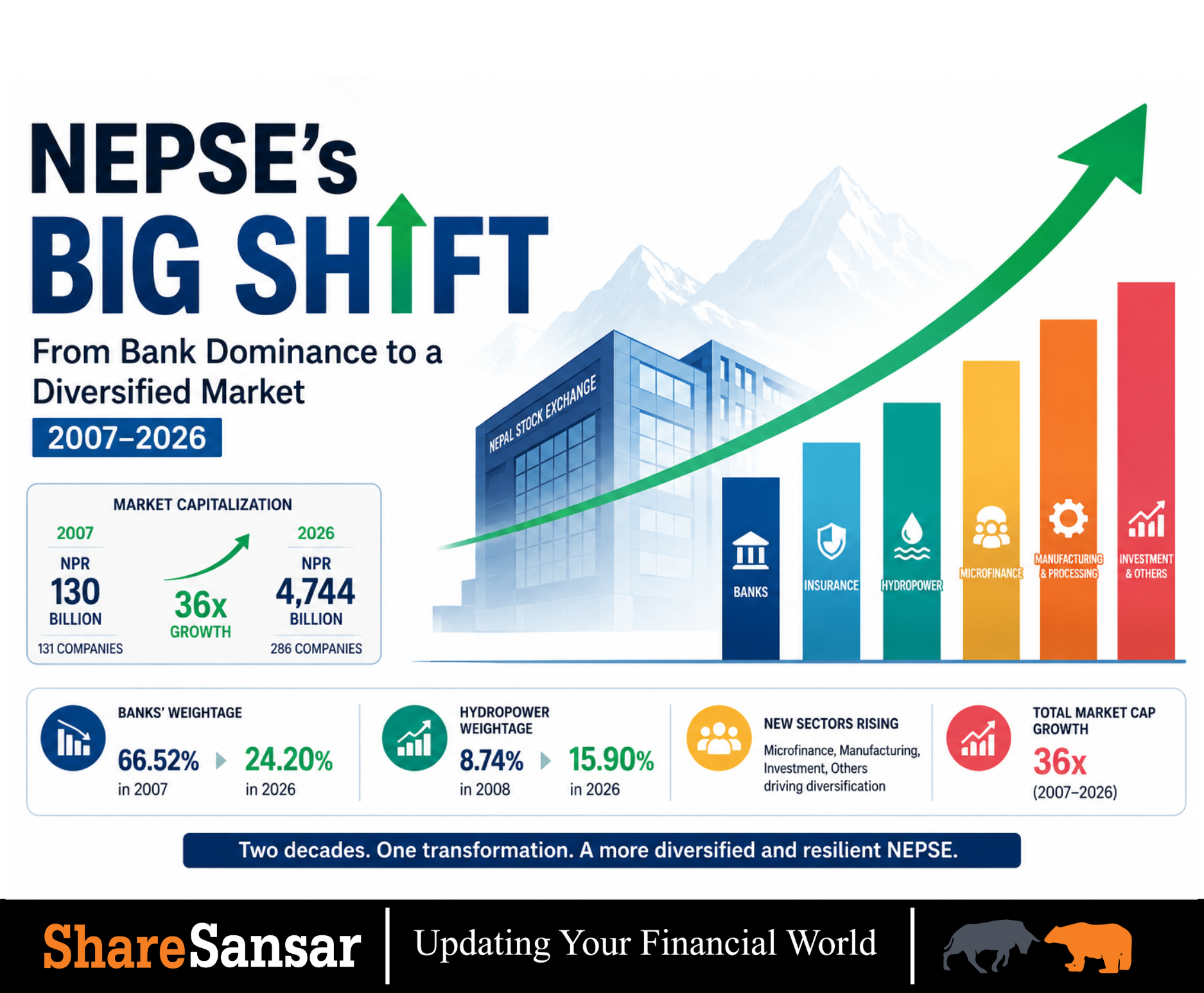
Most of us discuss the Nepal Stock Exchange (NEPSE) in terms of its index, total capitalization, and sectoral weightage. We traditionally associate the market with Banks and Financial Institutions (BFIs), including the insurance sector. However, do current market conditions support this perspective, or are they signaling a new trend for the future? By examining the sector-wise weightage of market capitalization, the provided data reveals a significant transformation over the last two decades. The market has evolved from a bank-dominated landscape into a more diversified ecosystem, accompanied by a massive surge in total valuation.
Data of every year’s Mid-March or (Eight Month of Every Fiscal Years)
Base year is 2007 for this article’s data
Trend of Market Capitalization by Value
At the beginning of this study period in Mid-March 2006, NEPSE featured 131 listed companies with a total market capitalization of NPR 130.17 billion. Over the following two decades, the market underwent significant transformation through various mergers, acquisitions, delisting, and new listings. By Mid-March 2026, the number of existing companies increased to 286, while the total market capitalization of the entire exchange surged to NPR 4,744.73 billion. The following analysis details the sector-wise market capitalization values, and the specific trends observed throughout this period.
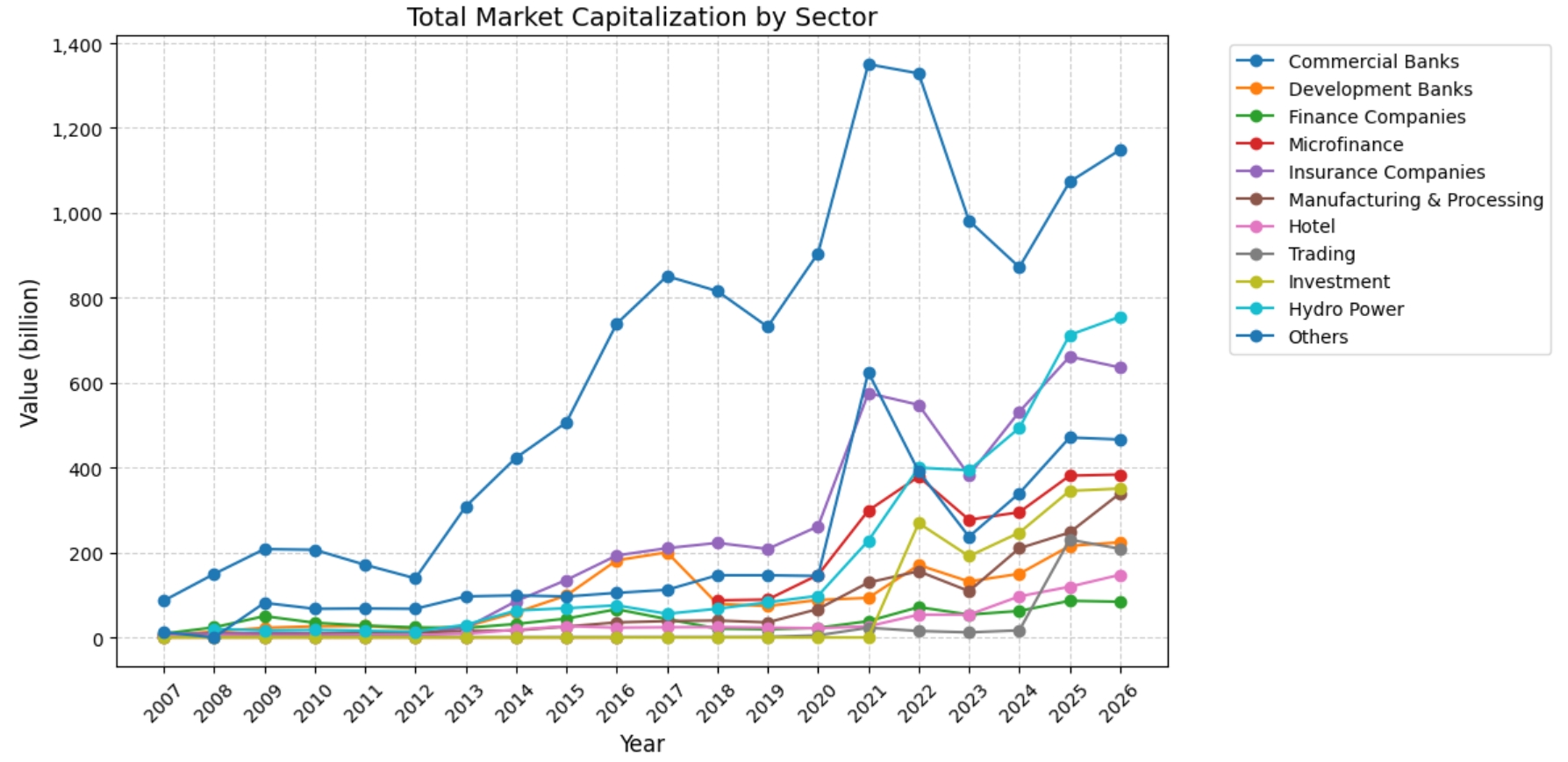
Trendline Analysis
Commercial Banks:
As the largest sector in NEPSE, commercial banks have experienced high volatility. Momentum surged after 2012 due to high return expectations. Between 2015 and 2017, capitalization was heavily influenced by the Nepal Rastra Bank (NRB) mandate to increase paid-up capital four-fold (from NPR 2 billion to NPR 8 billion). Driven by the post-COVID-19 market surge, the sector reached a peak capitalization of NPR 1,350 billion in 2021.
Development Banks:
While maintaining a steady upward trend, development banks have lacked the explosive momentum seen in other sectors. As of mid-March 2026, the sector’s market capitalization stood at NPR 224 billion.
Finance:
The Finance sector has struggled to maintain its market weightage. Its total capitalization has never exceeded NPR 100 billion, reflecting a declining trend relative to the overall market.
Microfinance:
Since getting its own index in late 2017, the microfinance sector has become a powerhouse. After starting at NPR 87.48 billion in early 2018, it has grown significantly to reach NPR 383.70 billion by mid-March 2026. It currently holds the second-largest portion of market cap among the four banking categories.
Insurance Sector:
The insurance sector consistently maintains a strong position, usually trailing only commercial banks. Despite competition from other sectors, it remains a pillar of the market, with a capitalization of NPR 635.95 billion as of mid-March 2026.
Manufacturing and Processing:
This sector has grown from NPR 6.17 billion in 2007 to NPR 339.39 billion in 2026. Given the current policy priority to promote "real sector" companies in the stock market, its weightage in NEPSE is expected to increase further.
Hotel and Tourism:
Over two decades, the number of listed companies in this sector doubled from four to eight. Capitalization grew from NPR 3.02 billion in 2007 to NPR 147.62 billion in 2026, with further growth expected as tourism expands.
Trading:
Despite a decrease in listed companies (from five to four), the sector's capitalization skyrocketed from NPR 762 million in 2007 to NPR 208.94 billion in 2026. This massive jump was largely due to a 2025 Supreme Court verdict that allowed Bishal Bazar Company Limited (BBC) to capitalize its land value into shares.
Investment:
Established as a separate index in 2022, this sector previously fell under “Others.” Its capitalization grew from NPR 269.27 billion at its inception to NPR 350.74 billion by mid-March 2026.
Hydropower:
Hydropower is NEPSE's fastest growing and most promising sector. In 2008, only three companies were listed with a value of NPR 20.19 billion. By 2026, the number of companies surged to 97, with a total market capitalization of NPR 755.35 billion.
Others:
The "Others" sector has seen substantial growth, rising from a market capitalization of NPR 12.51 billion in 2007 to NPR 466.31 billion by mid-March 2026.
Weightage Trendline of Market Capitalization
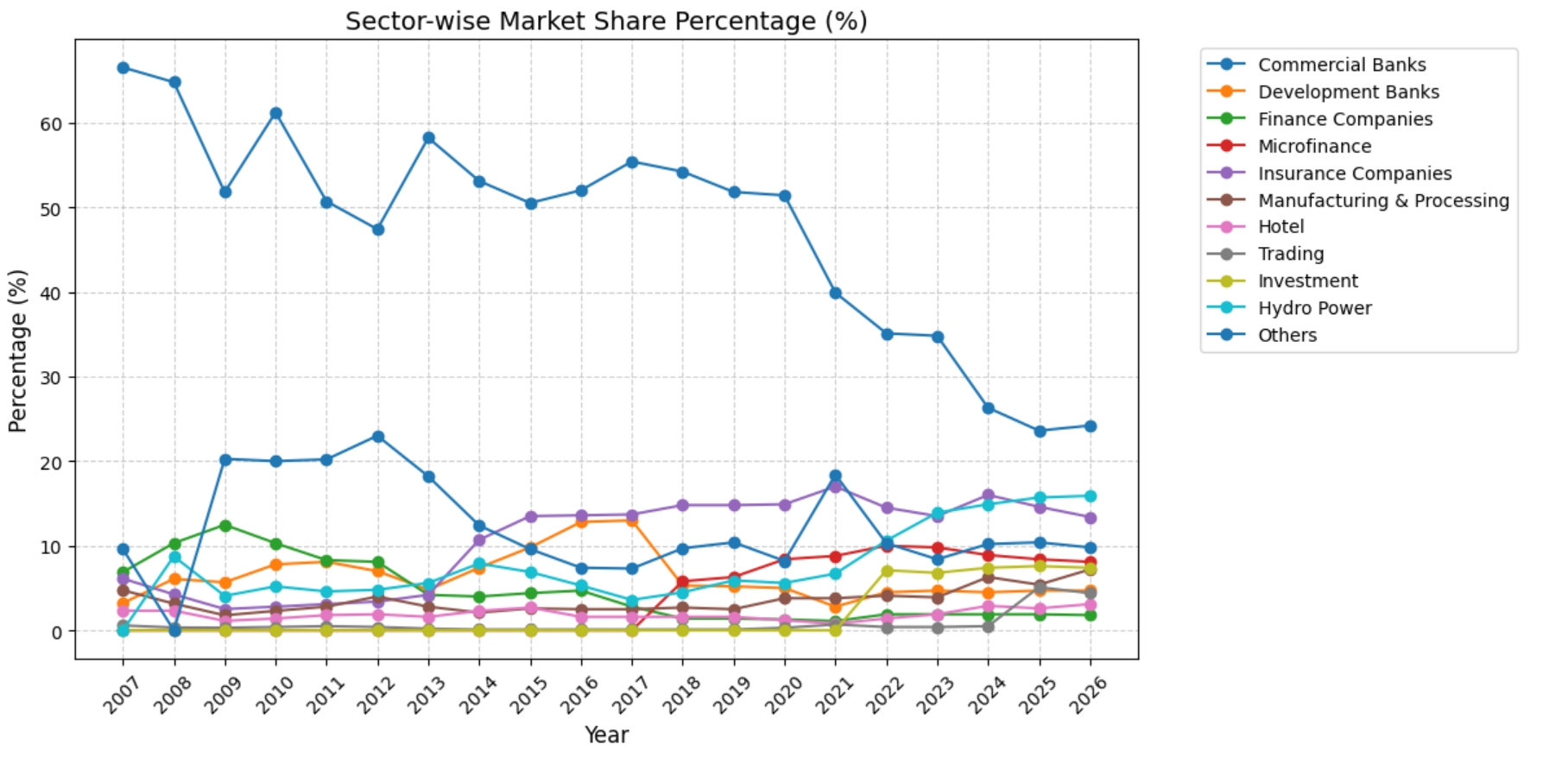
Trendline Analysis:
Commercial Banks
The weightage of commercial banks in the overall index has been on a steadily declining trend. In mid-March 2007, the sector accounted for 66.52% of the total index. Over the past two decades, this share has significantly decreased to 24.20%.
Development Banks
The market capitalization share of development banks in NEPSE has fluctuated over the review period; however, it has shown relative stability in recent years. As of mid-March 2026, the sector’s weightage stands at 4.70%.
Finance Companies
The trend for Class “C” institutions indicates an initial expansion followed by a sustained decline. In mid-March 2007, the sector held a weightage of 6.88%, which increased to a peak of 12.47% in 2009. Thereafter, the share has steadily declined, reaching 1.80% as of mid-March 2026.
Microfinance
According to data published by Nepal Rastra Bank, Class “D” financial institutions were assigned a separate sub-index in NEPSE in November 2017. The sector accounted for 5.80% in 2018 and has gradually increased to 8.10% by 2026, with relatively low volatility over the period.
Insurance Companies
In 2007, there were 16 listed insurance companies (both life and non-life), collectively accounting for 6.12% of NEPSE’s total market capitalization. As of mid-March 2026, the sector’s share has increased to 13.40%, reflecting steady growth.
Manufacturing & Processing
At the base period taken for this study, the Manufacturing and Processing sector accounted for 4.74% of total market capitalization. This share declined to 1.78% in 2009 but has since recovered. In the recent review period, the sector holds a 7.20% share.
Hotel & Tourism
The Hotel and Tourism sector experienced prolonged stagnation, with only four listed companies between 2007 and 2021. Its share declined to a low of 0.80% in 2021 from 2.32% in 2007. As of mid-March 2026, the sector has modestly recovered to 3.10%.
Trading
The Trading sector has been one of the most stagnant in NEPSE in terms of company listings. Its market capitalization remained below 1% until 2024, standing at 0.50%. However, the sector experienced a sharp increase to 5.10% in 2025, primarily driven by a Supreme Court verdict allowing Bishal Bazar Company Limited (BBC) to capitalize its land value into shares.
Investment
The Investment sub-index was introduced in 2022, comprising six companies that were previously categorized under the “Others” sector. The sector currently accounts for approximately 7% of the total market capitalization.
Hydro Power
Hydropower is one of NEPSE’s fastest growing and most promising sectors. In 2008, only three companies were listed, with a combined share of 8.74%. By 2026, the sector’s share has increased to 15.90% of the total market capitalization.
Others
This sector includes telecommunications, media, reinsurance, alternative renewable energy, and agriculture-based companies. The number of listed companies in this category has been steadily increasing, reflecting diversification. Currently, the sector holds approximately 9.80% of total market capitalization and has strong potential for future growth.

