


Human Development Index in Nepal


The HDI was created to emphasize that people and their capabilities should be the ultimate criteria for assessing the development of a country, not economic growth alone.
The Human Development Index (HDI) is a summary measure of average achievement in key dimensions of human development: a long and healthy life, being knowledgeable and having a decent standard of living. The HDI is the geometric mean of normalized indices for each of the three dimensions.
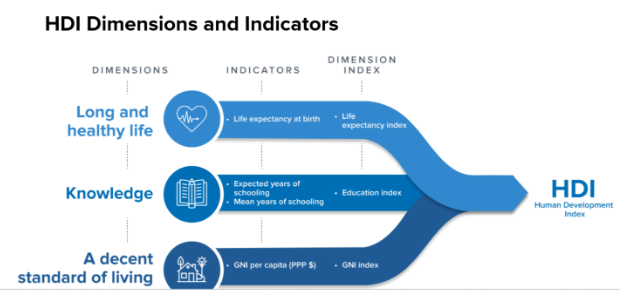
The health dimension is assessed by life expectancy at birth, the education dimension is measured by mean of years of schooling for adults aged 25 years and more and expected years of schooling for children of school entering age. The standard of living dimension is measured by gross national income per capita. The HDI uses the logarithm of income, to reflect the diminishing importance of income with increasing GNI. The scores for the three HDI dimension indices are then aggregated into a composite index using geometric mean.
The HDI can be used to question national policy choices, asking how two countries with the same level of GNI per capita can end up with different human development outcomes. These contrasts can stimulate debate about government policy priorities.
The HDI simplifies and captures only part of what human development entails. It does not reflect on inequalities, poverty, human security, empowerment, etc. The HDRO provides other composite indices as broader proxy on some of the key issues of human development, inequality, gender disparity and poverty.
Comparison of HDI of South Asian countries
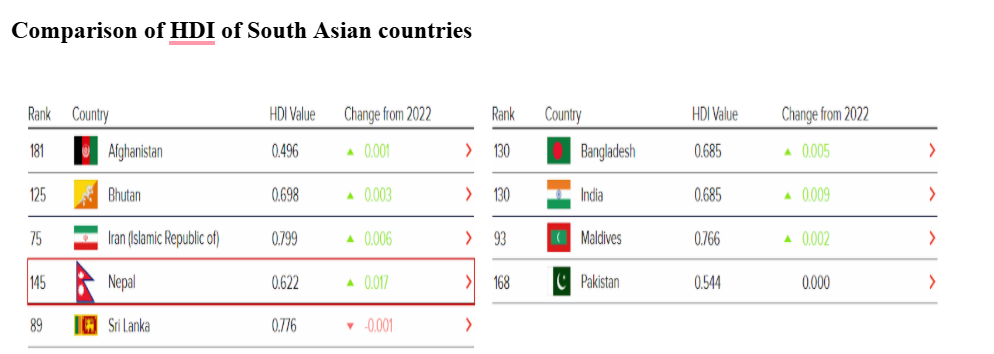
Nepal’s Human Development Index (HDI) value of 0.622 (rank 145) places it in the medium human development category and above Afghanistan (0.496) and Pakistan (0.544), but below most other South Asian countries shown in the picture, including India and Bangladesh (0.685 each), Bhutan (0.698), Sri Lanka (0.776), Maldives (0.766), and Iran (0.799); however, Nepal stands out for recording the highest improvement (+0.017) from 2022, indicating relatively faster recent progress in health, education, and living standards despite still lagging behind regional leaders in overall human development.
Nepal’s HDI is low due to low per capita income, widespread poverty, unemployment, and weak industrial development. Poor quality of education, inadequate healthcare facilities—especially in rural areas—and poor nutrition and sanitation reduce human development outcomes. Social, regional, and gender inequalities, along with youth out-migration, political instability, weak governance, and low public investment in health and education, further constrain HDI improvement.
HDI in Nepal can be enhanced by improving the quality of education and skill-based training, strengthening healthcare and nutrition services, and creating productive employment through agriculture, industry, and SMEs. Reducing inequality, promoting women empowerment, improving governance, expanding basic infrastructure, and effectively utilizing human capital and remittances are essential to achieve sustainable human development.
In conclusion, HDI highlights that true development depends on people’s health, education, and living standards, not income alone. Although Nepal has made noticeable progress and falls under the medium human development category, it still lags behind many South Asian countries due to economic and social constraints. Strengthening human capital through inclusive growth, quality education, better healthcare, and good governance is essential for improving Nepal’s HDI sustainably.
Article By: Shreya karn

