

Debentures in Nepal: Fixed Returns in an Uncertain Market
Wed, Jun 24, 2026 6:05 PM on Bonds & Debentures, Exclusive,
.png)
The Nepal Stock Exchange (NEPSE) is primarily known as an equity market where shares of listed companies are traded. However, among the various securities listed on NEPSE, debentures remain the only widely traded fixed-income instrument available to investors. While equities offer ownership and capital appreciation opportunities, debentures provide predictable income through periodic interest payments and principal repayment upon maturity.
In our context, debentures are primarily issued by Nepal Rastra Bank (NRB)-licensed Banks and Financial Institutions (BFIs), particularly Class 'A' Commercial Banks, Class 'B' Development Banks, and Class 'C' Finance Companies. These instruments have become an important source of long-term funding for BFIs while providing investors with relatively stable returns. In total, 70 debentures are listed in NEPSE. Value of those debentures NPR. 167.71 billion.
About Debenture
A debenture is a long-term debt instrument through which an issuer borrows funds from investors and agrees to pay a fixed rate of interest (coupon) over a specified period. Upon maturity, the issuer repays the principal amount to investors.
Unlike common shares, debenture holders do not become owners of the issuing institution. Instead, they act as creditors and receive fixed interest income regardless of the issuer's profitability, provided the institution remains financially sound. In our context, most listed debentures are subordinated debt instruments issued to comply with regulatory capital requirements and strengthen the long-term funding base of BFIs.
Debenture from Investors' Perspective
For many investors, especially passive and risk-averse individuals, debentures serve as an attractive investment alternative. They offer regular cash flow through coupon payments and are generally less volatile than equities.
Investors often choose debentures to:
- Generate predictable income.
- Reduce portfolio risk.
- Protect against short-term stock market fluctuations.
- Diversify investment holdings.
- Preserve capital while earning higher returns than traditional savings deposits.
Institutional investors are among the largest buyers of debentures. Insurance companies, mutual funds, Citizen Investment Trust (CIT), Employees Provident Fund (EPF), and other public and private institutions prefer debentures because they match their long-term liability structures and provide stable returns.
Furthermore, debentures can offer an opportunity for capital gains if market interest rates decline after issuance, causing their market prices to rise.
Strategic Move of BFIs
Historically, BFIs issued debentures to fulfill regulatory requirements, strengthen capital adequacy, and diversify funding sources. Debenture issuance allowed institutions to secure long-term funds without diluting ownership through equity issuance.
However, in recent years, the pace of debenture issuance has slowed considerably. Several factors may have contributed to this trend:
- Improved liquidity within the banking system.
- Reduced credit demand in the economy.
- Availability of cheaper deposit-based funding.
- Increased cost associated with issuing debentures.
- Changing regulatory and capital management strategies.
- Banks could reshuffle their maturing high-coupon-rate debentures by replacing them with lower-coupon-rate issuances amid excess liquidity in the market.
As a result, many BFIs appear less inclined toward issuing new debentures. Whether this trend continues, or reverses will largely depend on future liquidity conditions, credit growth, and regulatory developments.
Listing Trend
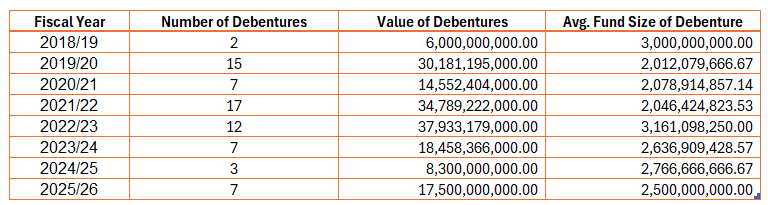
The number of debentures listed on NEPSE increased significantly during periods when regulatory requirements encouraged BFIs to strengthen their capital structure through long-term debt instruments.
Commercial banks have remained the dominant issuers, accounting for most listed debenture issues. Development banks and finance companies have also participated but on a relatively smaller scale. Which is proportionate based to capital size of BFIs. Regional Level developments haven’t issued debenture.
The total value of listed debentures expanded rapidly during the banking sector's growth phase. Large commercial banks frequently issued debentures worth billions of rupees to meet regulatory capital requirements and support loan portfolio expansion.
Offered Coupon Rate vs Commercial Banks Interest Rate
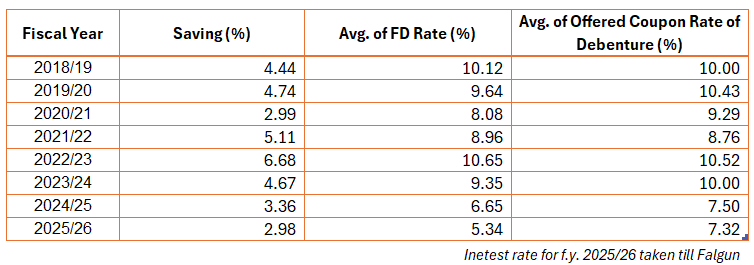
The coupon rate is one of the most important features influencing investor demand. Based on trends, debentures' offered coupon rate higher than Fixed Deposits rate, sometimes lower too. Debentures have offered coupon rates ranging between 7% and 12%, depending on prevailing market interest rates, liquidity conditions, and issuer credit quality.
During periods of tight liquidity and high deposit rates, newly issued debentures generally carried higher coupon rates. Conversely, when banking liquidity improved and interest rates declined, coupon rates also decreased. For income-focused investors, higher coupon rates make debentures attractive compared to fixed deposits and savings products.
Liquidity
Despite being listed on NEPSE, debenture trading volume remains relatively low compared to equities.
Several factors contribute to lower liquidity:
- Investors often hold debentures until maturity.
- Institutional investors dominate ownership.
- Limited retail investor awareness.
- Smaller number of listed instruments.
As a result, buying and selling large quantities of debentures in the secondary market can sometimes be challenging. However, investors who intend to hold until maturity generally consider liquidity risk less important.
Capital Gain Opportunity
Although debentures are primarily income-generating instruments, investors can also earn capital gains through secondary market trading.
The price of a debenture moves inversely to market interest rates: When market interest rates fall, existing debentures with higher coupon rates become more attractive, causing their prices to rise.
When market interest rates rise, existing debentures become less attractive, causing prices to decline. Therefore, investors may realize capital appreciation in addition to coupon income if market conditions become favorable.
Maturity
Based on NEPSE record, 8 debentures worth more than NPR 12 billion have already matured. Debentures listed in Nepal have maturity periods ranging from 5 to 10 years. Most of debenture has maturity terms of 10 years and few of (5, 6, 7 and 8) years.
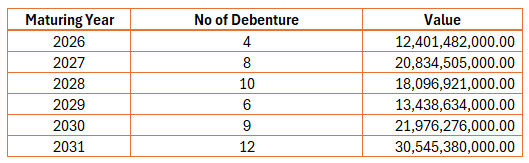
From July 2026 to till 2031 Dec, 49 debentures out of 70 going to matured in coming six years. Which value is worth NPR 109 billion. Longer maturity periods provide issuers with stable funding while allowing investors to lock in fixed returns for extended periods.
At maturity, investors receive:
- The face value of the debenture.
- Final coupon payment.
- Any applicable redemption benefits.
Conclusion
Debentures remain the only significant fixed-income instrument actively traded on the Nepal Stock Exchange (NEPSE). They provide an important bridge between issuers seeking long-term funding and investors seeking predictable returns.
For investors, debentures offer portfolio diversification, stable income, and potential capital appreciation. For BFIs, they serve as an alternative source of long-term funding and capital management.
However, recent trends suggest that BFIs are no longer prioritizing debenture issuance as they once did. Improved banking sector liquidity, slower credit expansion, and evolving funding strategies may have reduced the urgency of raising funds through debentures.
Whether debenture issuance regains momentum in the coming years will depend on future interest rate movements, regulatory requirements, and the overall liquidity environment of Nepal's financial sector. Until then, debentures will continue to occupy a unique position as NEPSE's principal fixed-income investment instrument.

