


The Impact of Finance Minister Appointments on NEPSE (2018–2025)

Sun, Mar 29, 2026 10:09 AM on NEPSE News, Stock Market, Exclusive,

A stock represents partial ownership in a company and is traded by both individual and institutional investors for wealth creation and capital growth. In Nepal, all stock market activities are regulated and conducted through a single exchange, the Nepal Stock Exchange (NEPSE), which serves as the primary indicator of the country’s capital market performance.
While long-term market trends are shaped by fundamental economic factors such as the Balance of Payments (BOP), interest rates, inflation, and liquidity, short-term movements are largely driven by investor sentiment. In this regard, the appointment of a Finance Minister often acts as a significant short-term catalyst for market reactions.
This study examines eight Finance Minister leadership changes between 2074 BS and 2082 BS (2018–2025 AD) to assess their immediate impact on the NEPSE index. The analysis indicates that macroeconomic conditions provide the foundation for market movements, while the Finance Minister’s perceived ideology and policy stance function as the trigger influencing investor confidence.
Chronological Analysis of Leadership Changes
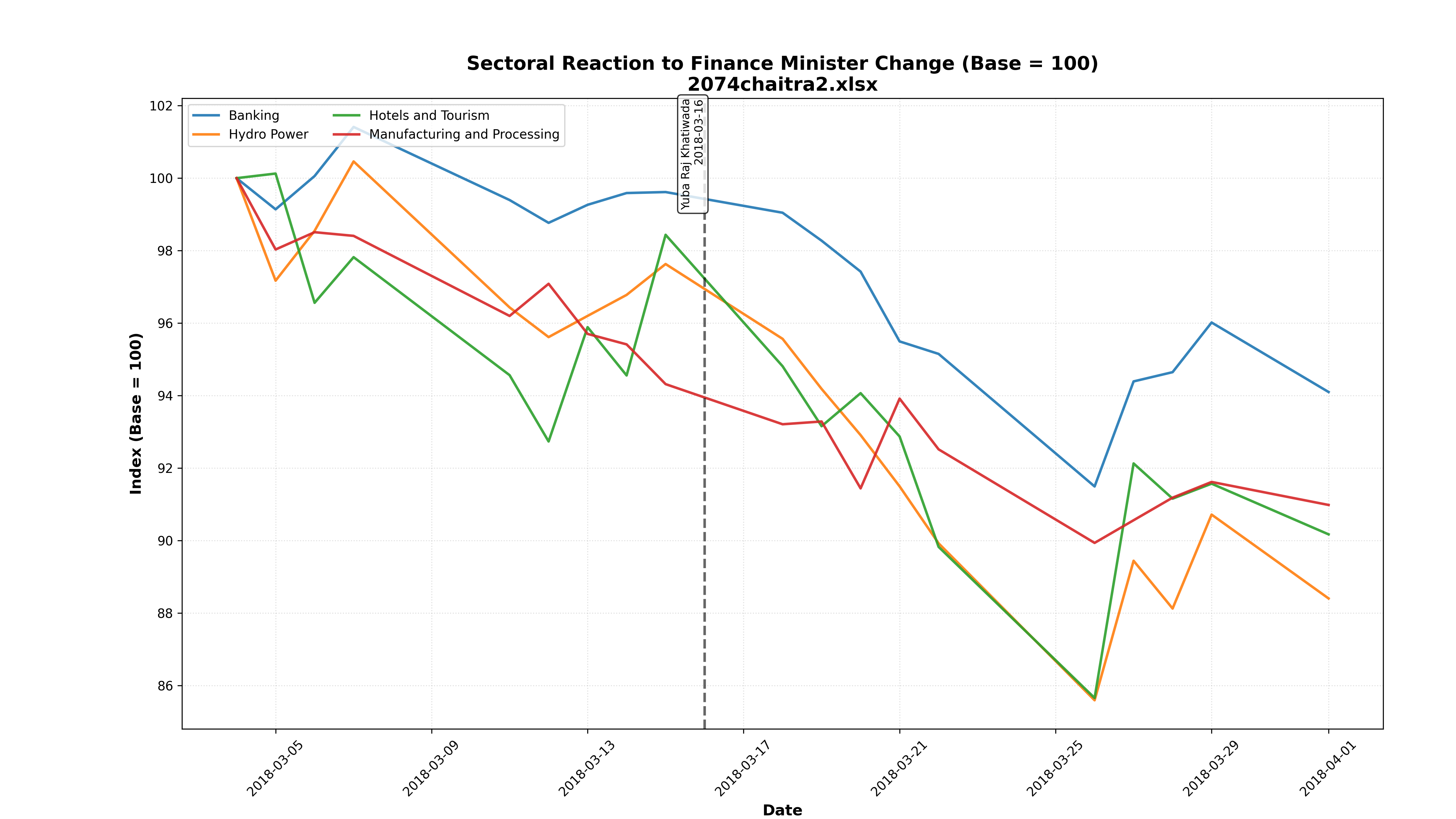
For each Finance Minister appointment, two graphs are used: one showing the NEPSE Index and another showing sectoral indices rebased to 100 to capture relative changes. A vertical dotted line indicates the date of the Finance Minister’s appointment.
Sectoral analysis is limited to Hydropower, Manufacturing, Banking, and Finance. All data are sourced from the NEPSE Monthly Reports, published by the Nepal Stock Exchange. https://www.nepalstock.com/reports/monthly-reports
I. March 16, 2018 – Dr. Yuba Raj Khatiwada
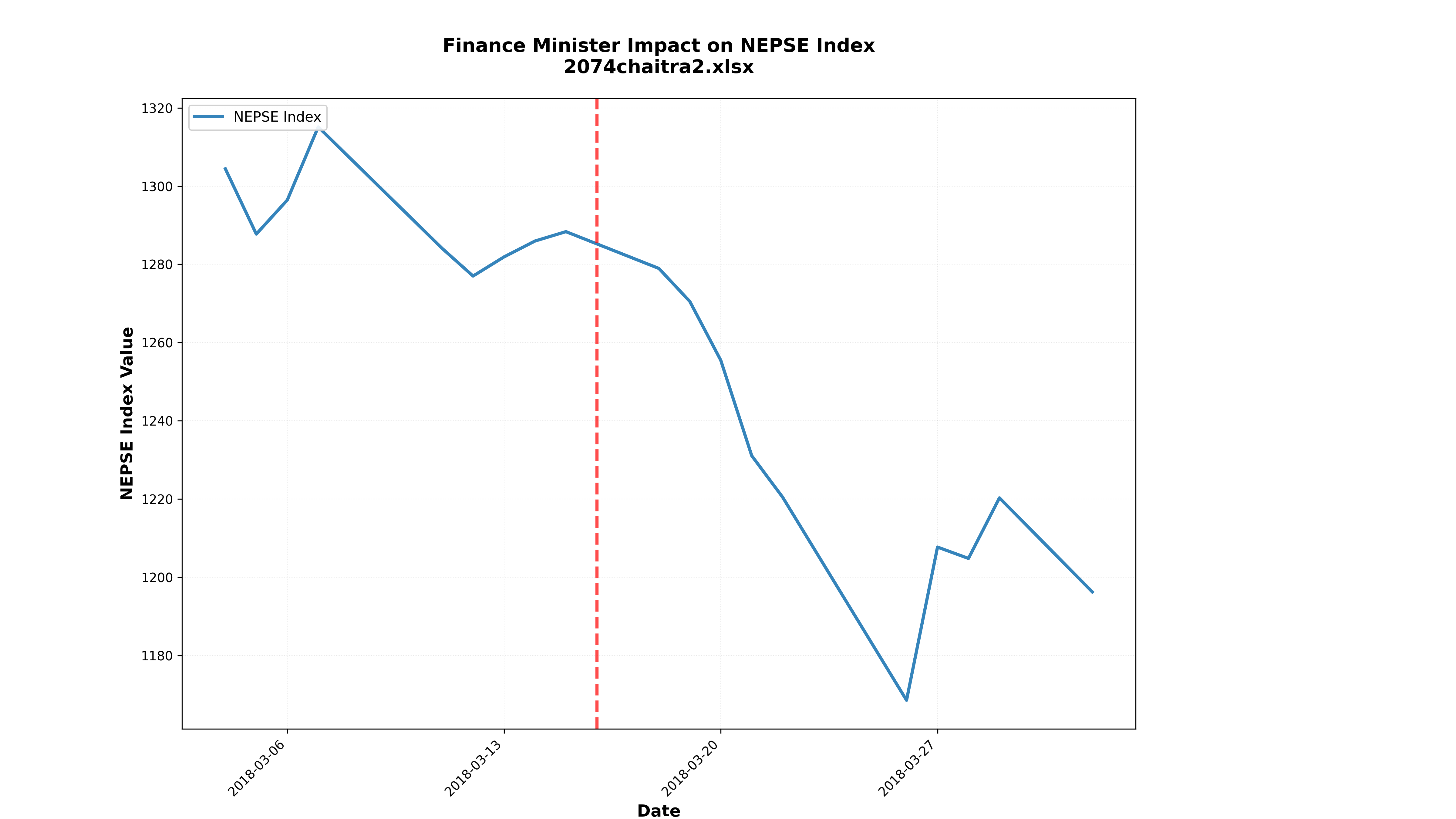
- Market Signal: Regulatory Fear (Bearish).
- NEPSE Impact: The index fell by about 12% in the early weeks.
- Pre-Appointment: All sectors were unstable but generally trending downwards.
- Immediate Reaction: The downward slope steepened following the appointment.
- Post-Appointment Trend: Prolonged bearishness. Every sector fell significantly below the base of 100.
- Key Finding: This was the most bearish reaction. Hotels/Tourism and Hydro Power were the hardest hit, dropping to ~86 index points.
- Reason: His reputation as a strict regulator caused immediate capital flight from high-risk sectors.
II. October 14, 2020 – Bishnu Prasad Paudel
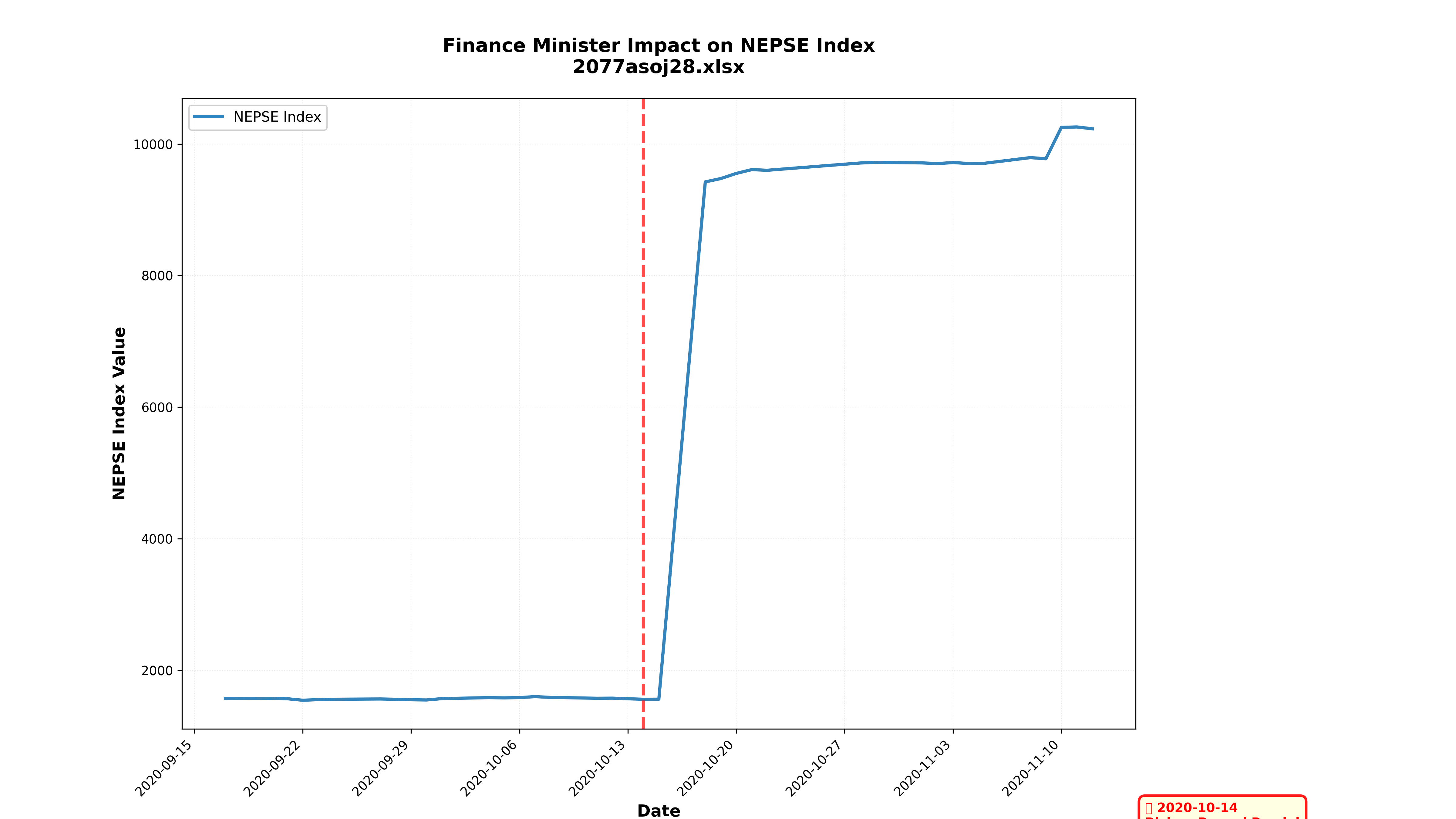
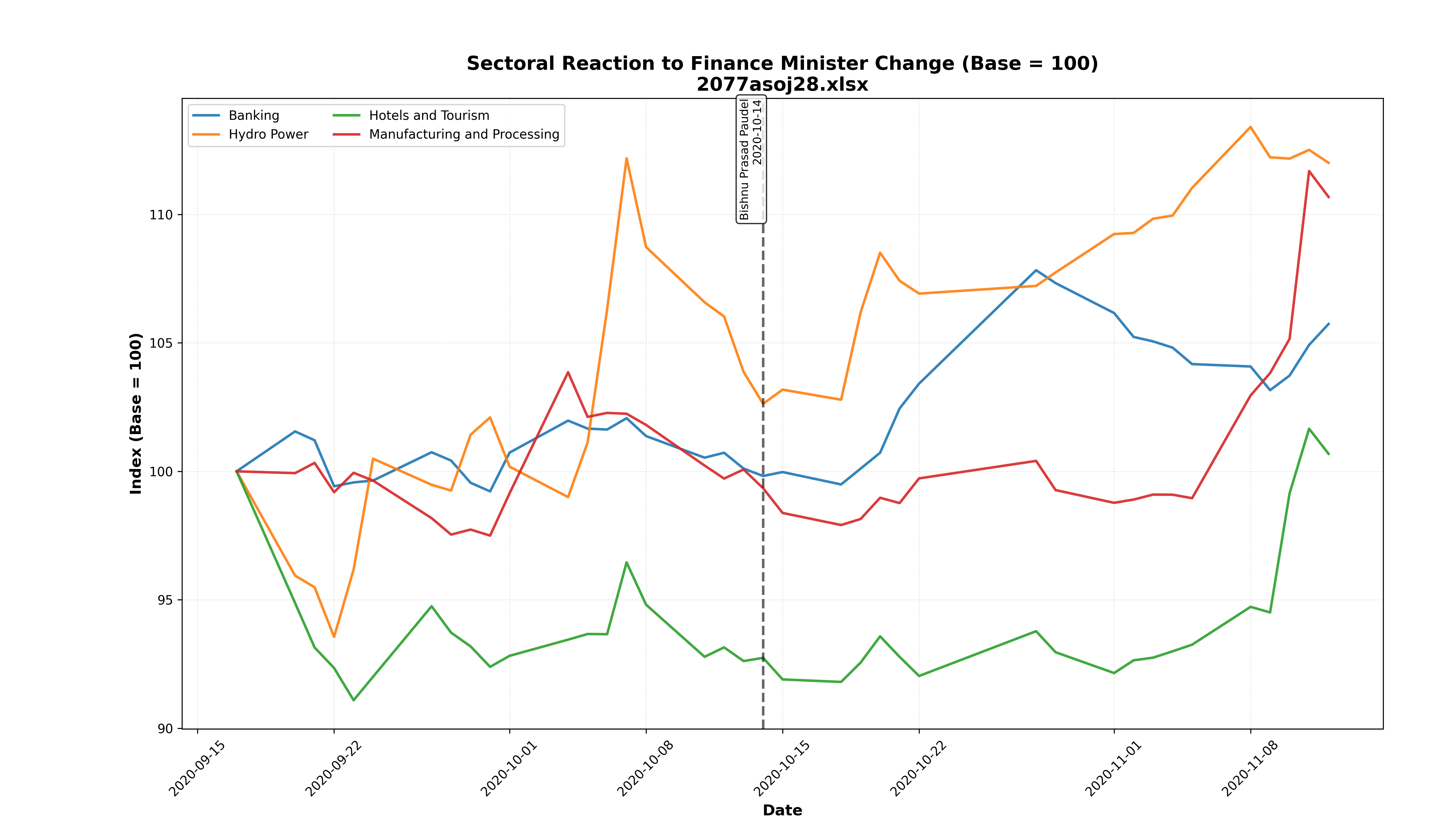
- Market Signal: Liberalization (Bullish).
- NEPSE Impact: Marked the start of the historic bull run toward 3,000+ points.
- Pre-Appointment: Extreme volatility in Hydro Power. Hotels and Tourism were performing poorly (at 92).
- Immediate Reaction: The market took a few days to react before starting a bull run.
- Post-Appointment Trend: Strong gains in Hydro Power, Banking, and Manufacturing.
- Key Finding: Hydro Power was highly unstable but finished strongest (~113), while Hotels and Tourism remained the laggard throughout.
- Reason: Appointment signaled "cheap money" and a business-friendly environment, encouraging retail investors to leverage into low-cap stocks.
III. July 13, 2021 – Janardan Sharma
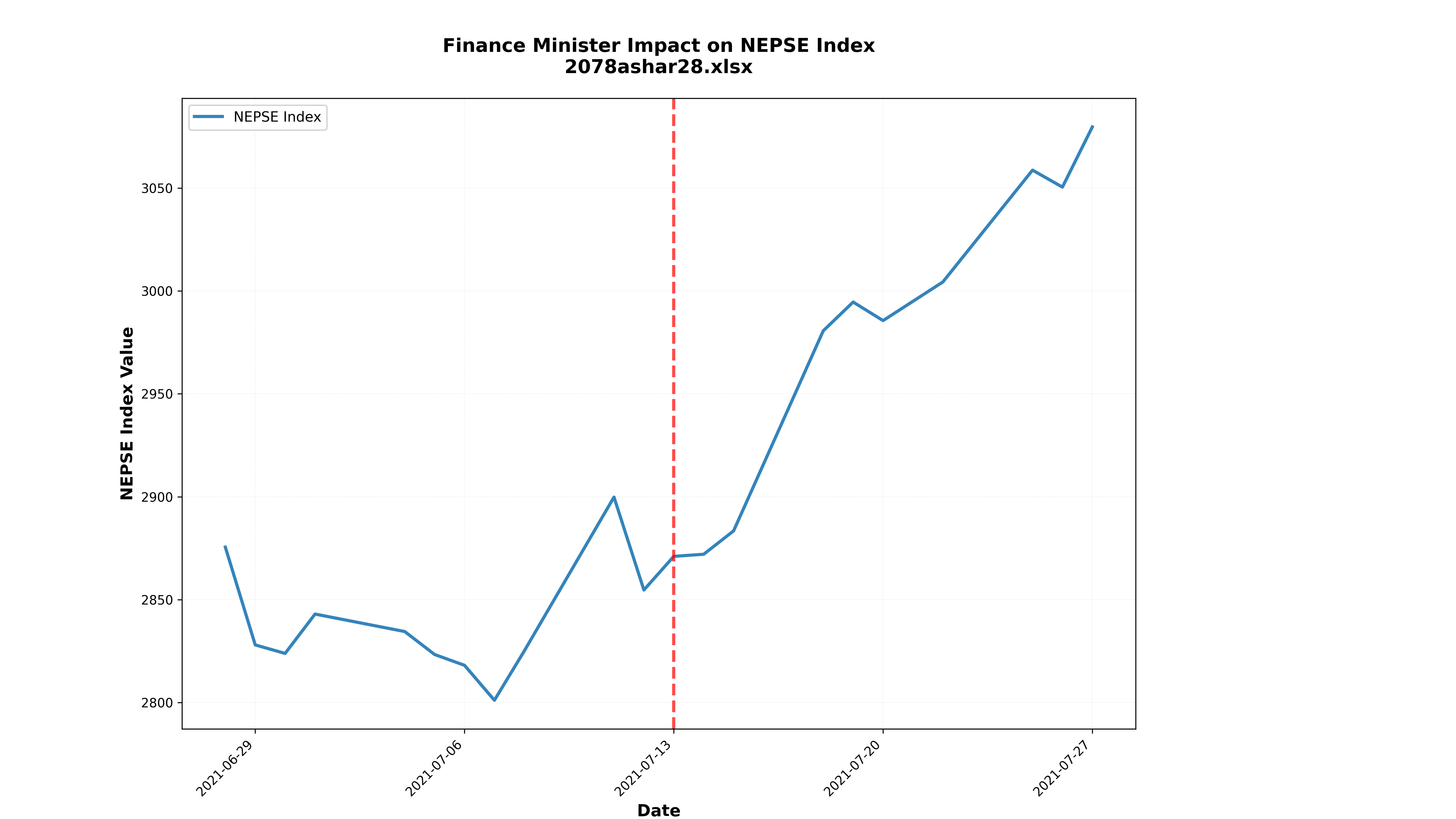
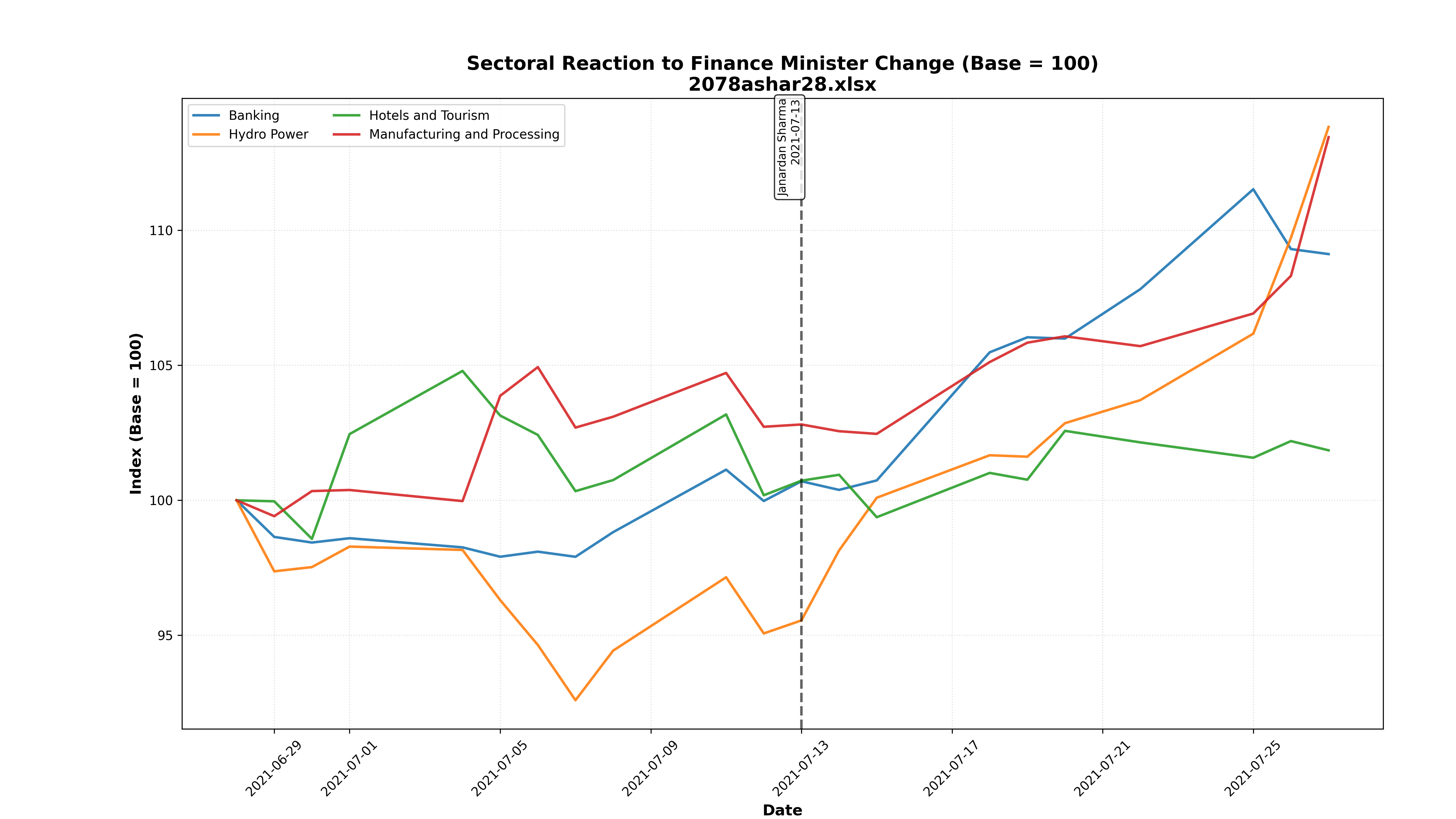
- Market Signal: Policy Friction (Bullish).
- NEPSE Impact: Initial peak at 3,198 followed by the "Great Correction."
- Pre-Appointment: Hydro Power was struggling significantly (at 95), while Banking was slightly up.
- Immediate Reaction: Positive reversal for Hydro and continued strength in Banking.
- Post-Appointment Trend: A steady upward climb for all sectors except Hotels and Tourism, which remained flat.
- Key Finding: Banking and Hydro Power were the primary beneficiaries, ending the period with ~10% gains.
- Reason: Although the minister was perceived as market-friendly, the NRB’s “4/12 crore” lending limit restricted further upside. As a result, sectors dependent on borrowed capital, particularly finance companies, experienced the largest price swings.
[4/12 crore: The Nepal Rastra Bank (NRB) set limits on how much loan money investors could use to buy shares. An individual could borrow up to NPR 4 crore from a single bank and no more than NPR 12 crore in total from all banks for share investment. These limits reduced the amount of borrowed money entering the stock market, which lowered trading activity and restricted further price increases.]
IV. December 26, 2022 – Bishnu Prasad Paudel
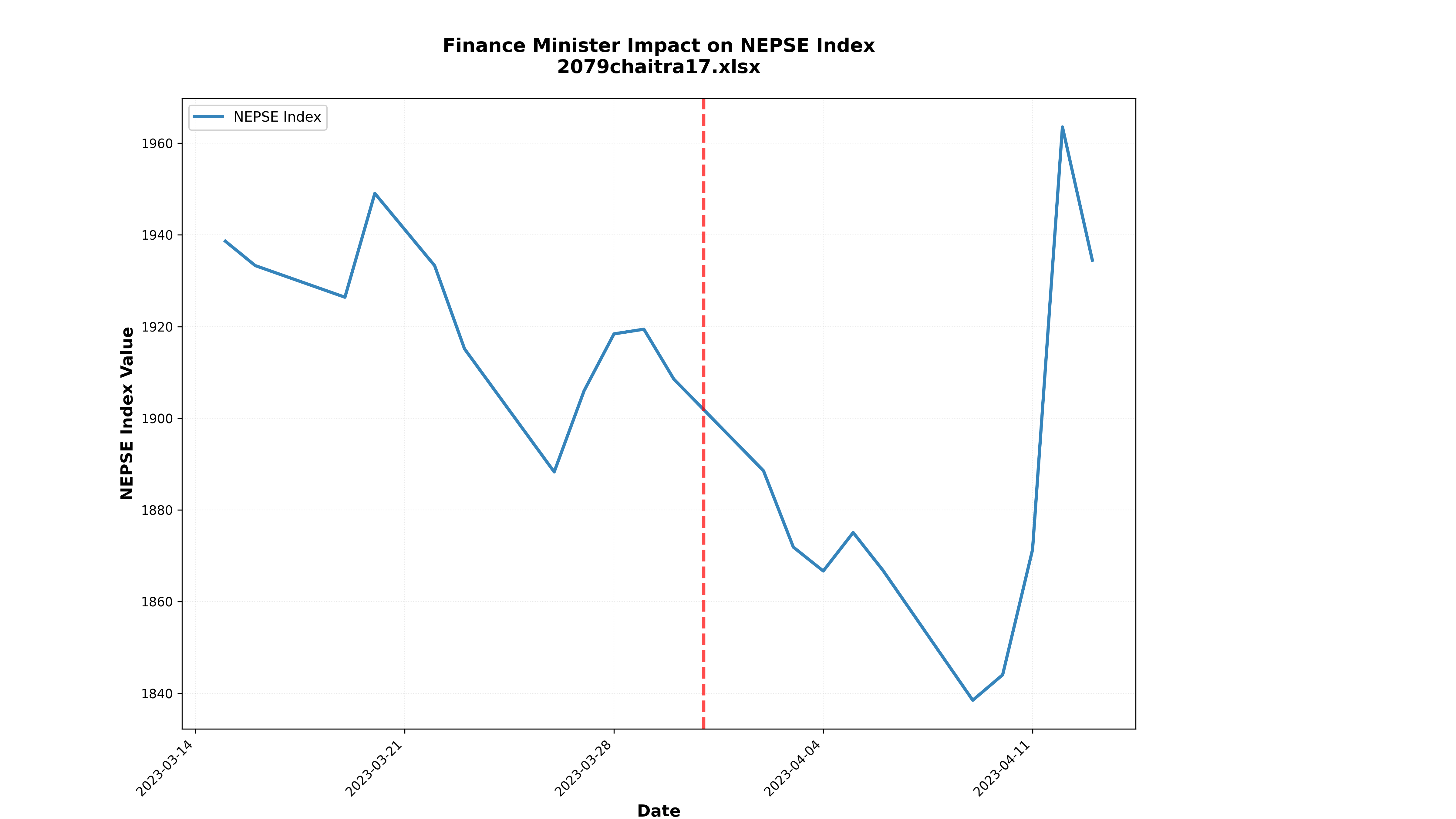
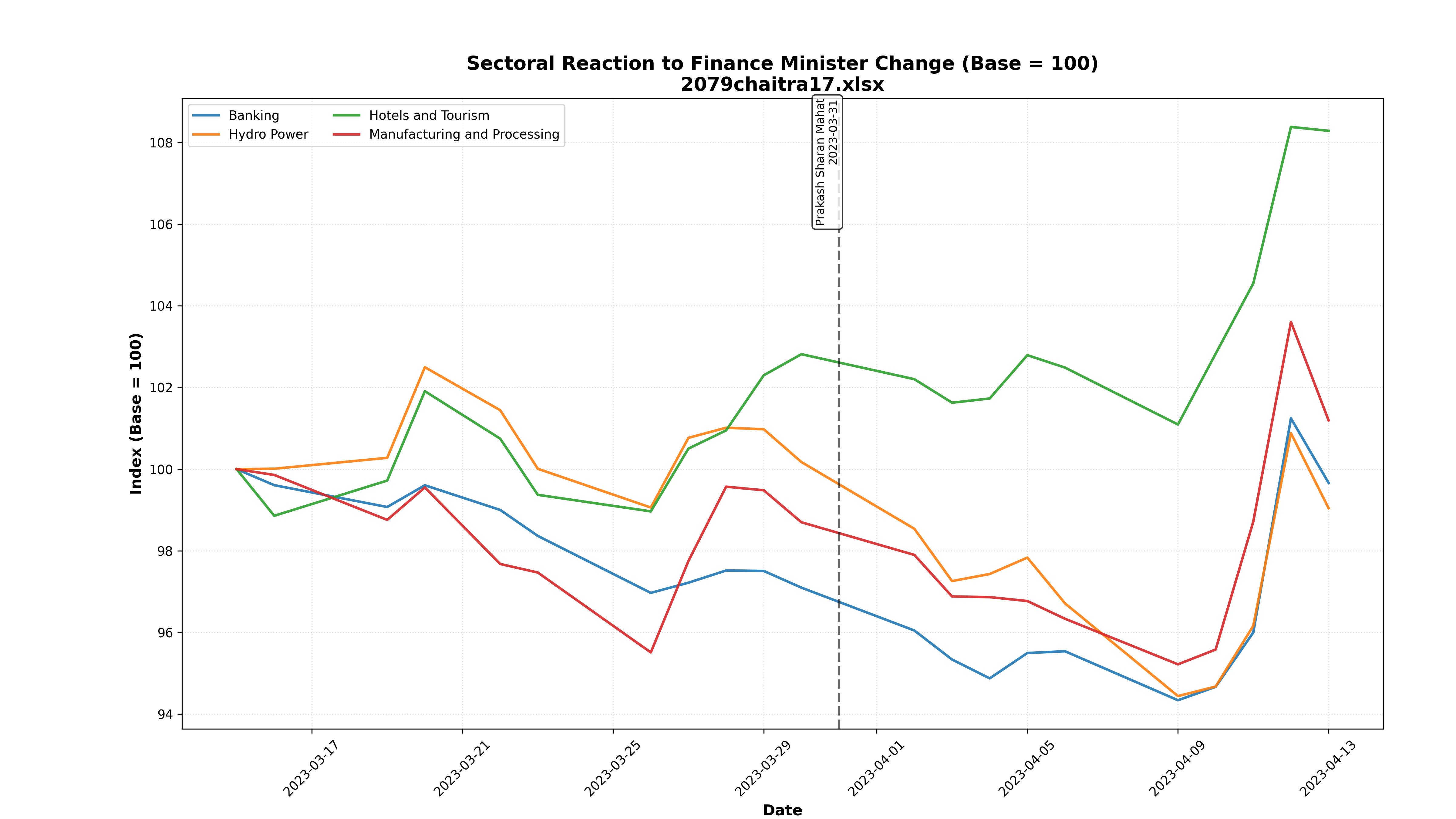
- Market Signal: Wait-and-Watch (Sideways).
- NEPSE Impact: Index stagnated and declined marginally.
- Pre-Appointment: High volatility with a general downward bias.
- Immediate Reaction: All sectors continued to slide immediately after the appointment.
- Post-Appointment Trend: Mostly bearish, with a late "dead cat bounce" in mid-April.
- Key Finding: Hotels and Tourism was the only sector that managed to stay consistently above the 100 base, while Banking and Hydro reached lows of ~94.
- Reason: High interest rates and tight liquidity overpowered the political change.
V. March 31, 2023 – Dr. Prakash Sharan Mahat
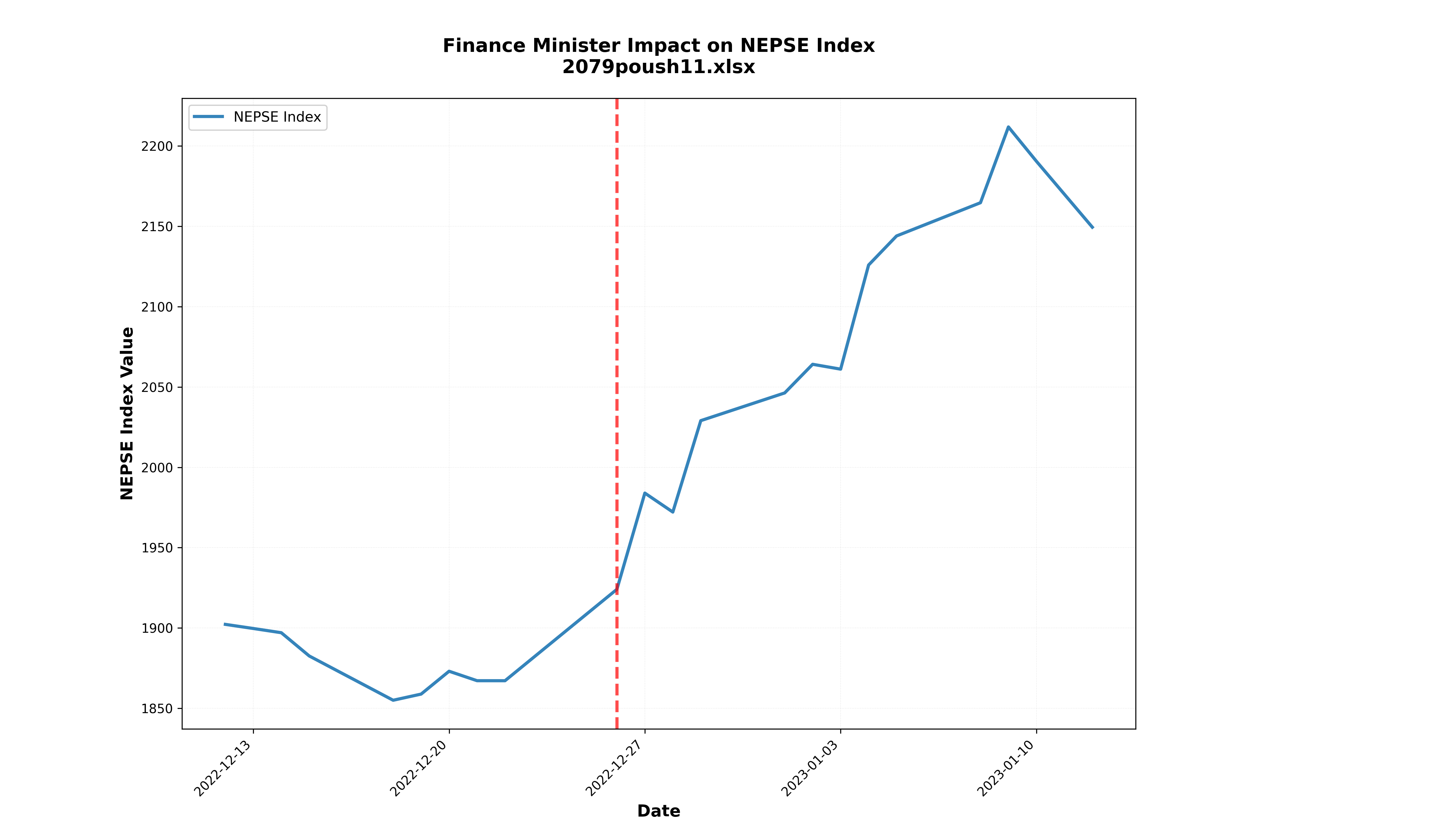
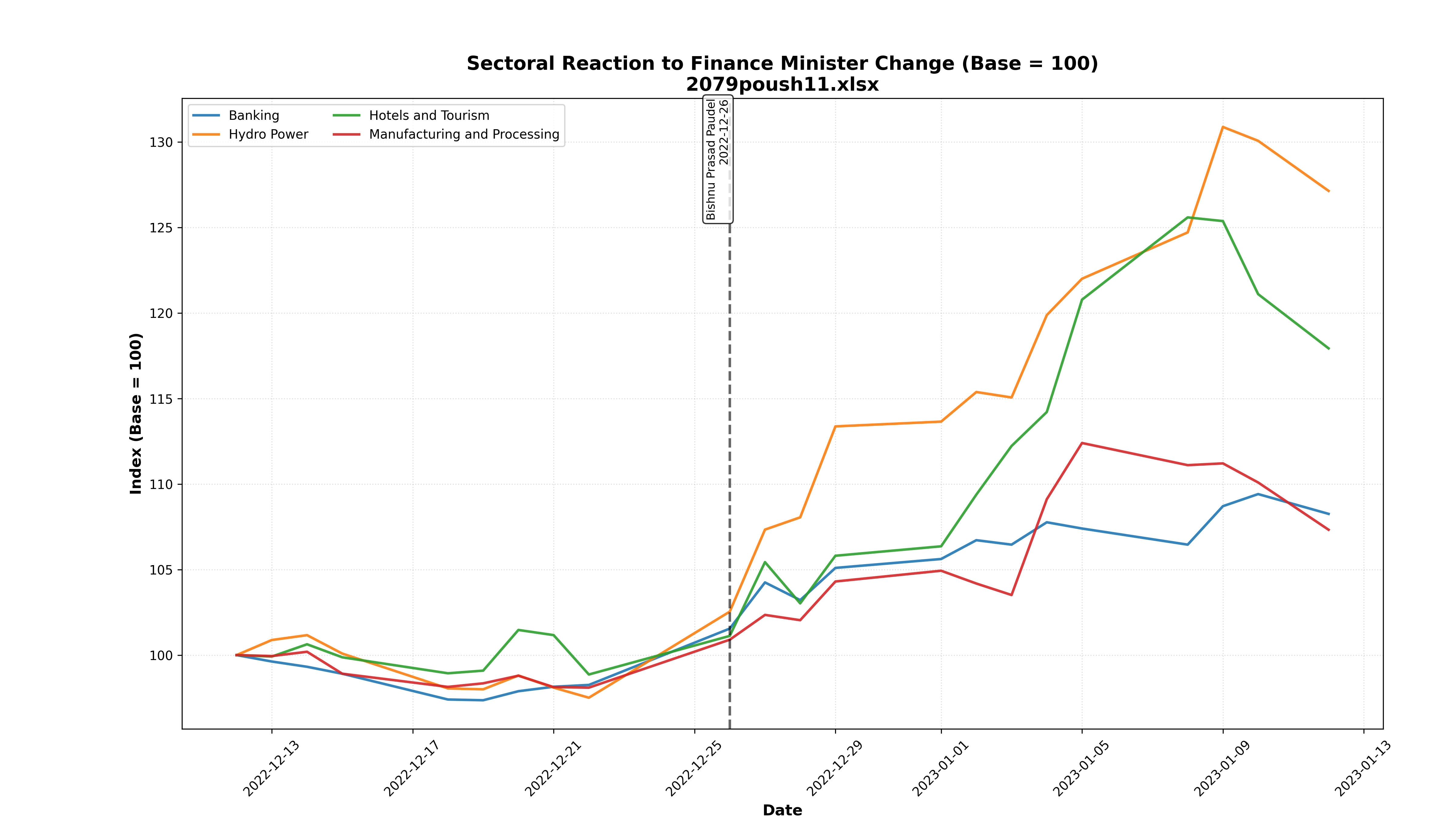
- Market Signal: Confidence Rally (Bullish).
- NEPSE Impact: Immediate 200-point jump.
- Pre-Appointment: Bearish sentiment with all sectors trading below the 100 base.
- Immediate Reaction: Extremely positive. All sectors saw a vertical climb immediately following the appointment.
- Post-Appointment Trend: Continued bullish momentum for three weeks.
- Key Finding: Hydro Power, Hotels, and Tourism saw the highest gains (peaking above 125), indicating strong short-term, sentiment-driven buying during this period.
- Reason: A purely psychological rally; investors bought in anticipation of future regulatory easing and better NRB coordination.
VI. March 6, 2024 – Barsaman Pun
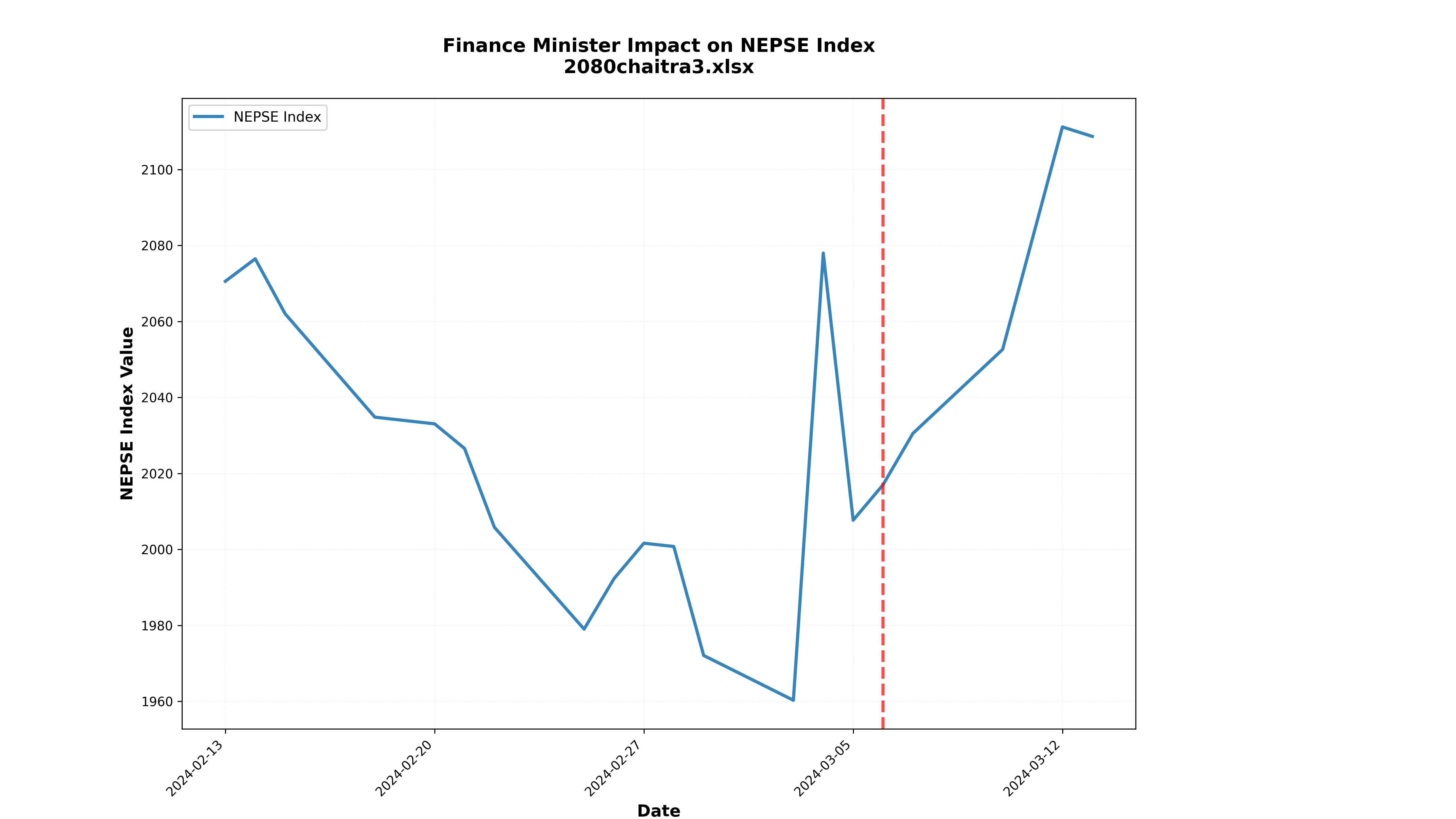
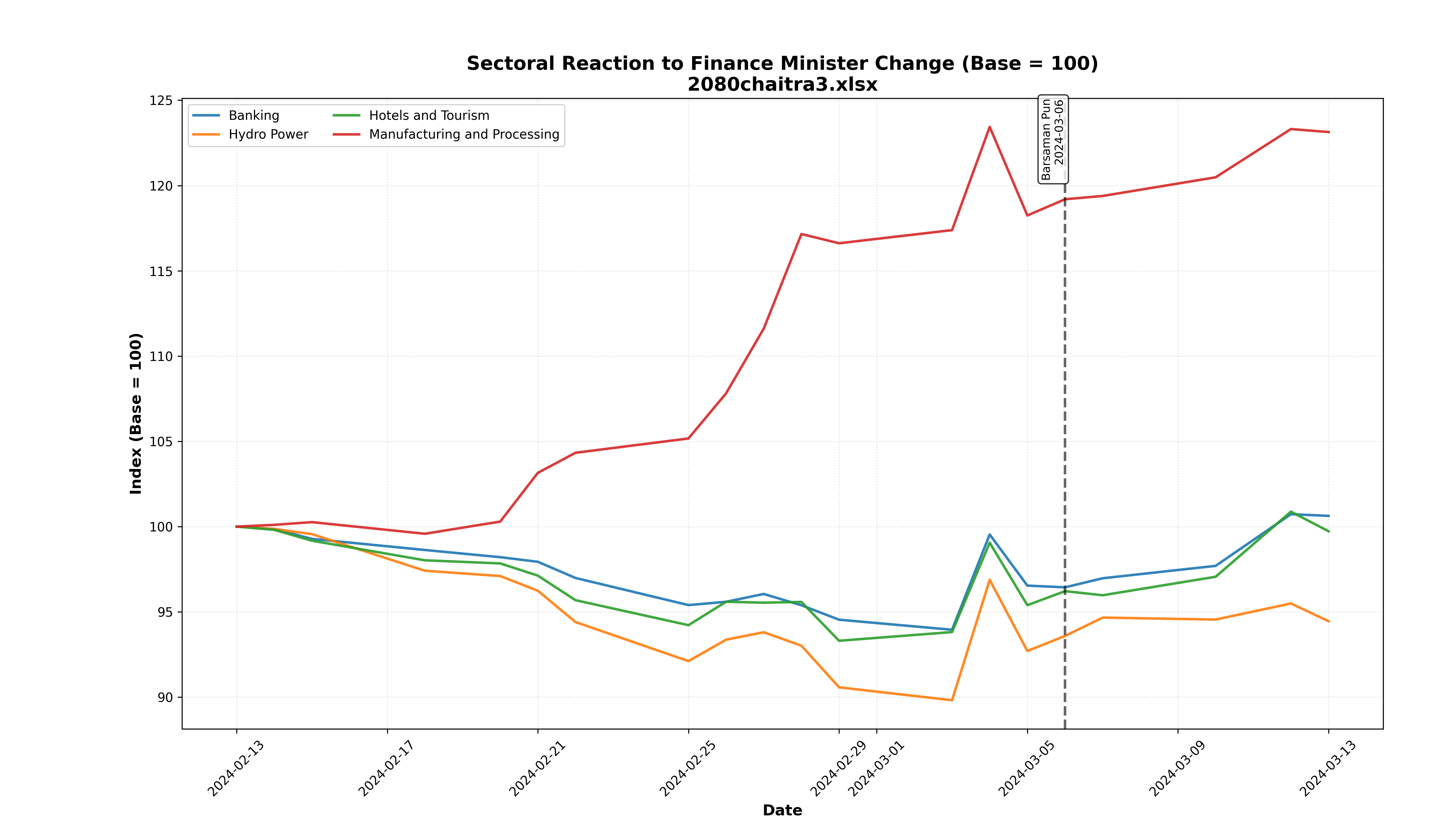
- Market Signal: Policy Reset (Bullish Spark).
- NEPSE Impact: Vertical recovery with multiple circuit breakers.
- Pre-Appointment: Manufacturing and Processing saw a massive independent rally, rising nearly 20% while other sectors remained flat or declined.
- Immediate Reaction: Neutral to slightly negative. The market (except Manufacturing) saw a small dip followed by sideways movement.
- Post-Appointment Trend: Manufacturing remained high but plateaued. Banking and Hydro stayed below their base 100.
- Key Finding: The appointment did not spark a broad market rally; the focus remained strictly on Manufacturing.
- Reason: His appointment suggested a push for more expansionary monetary measures, sparking a short-term driven rally.
VII. July 15, 2024 – Bishnu Prasad Paudel
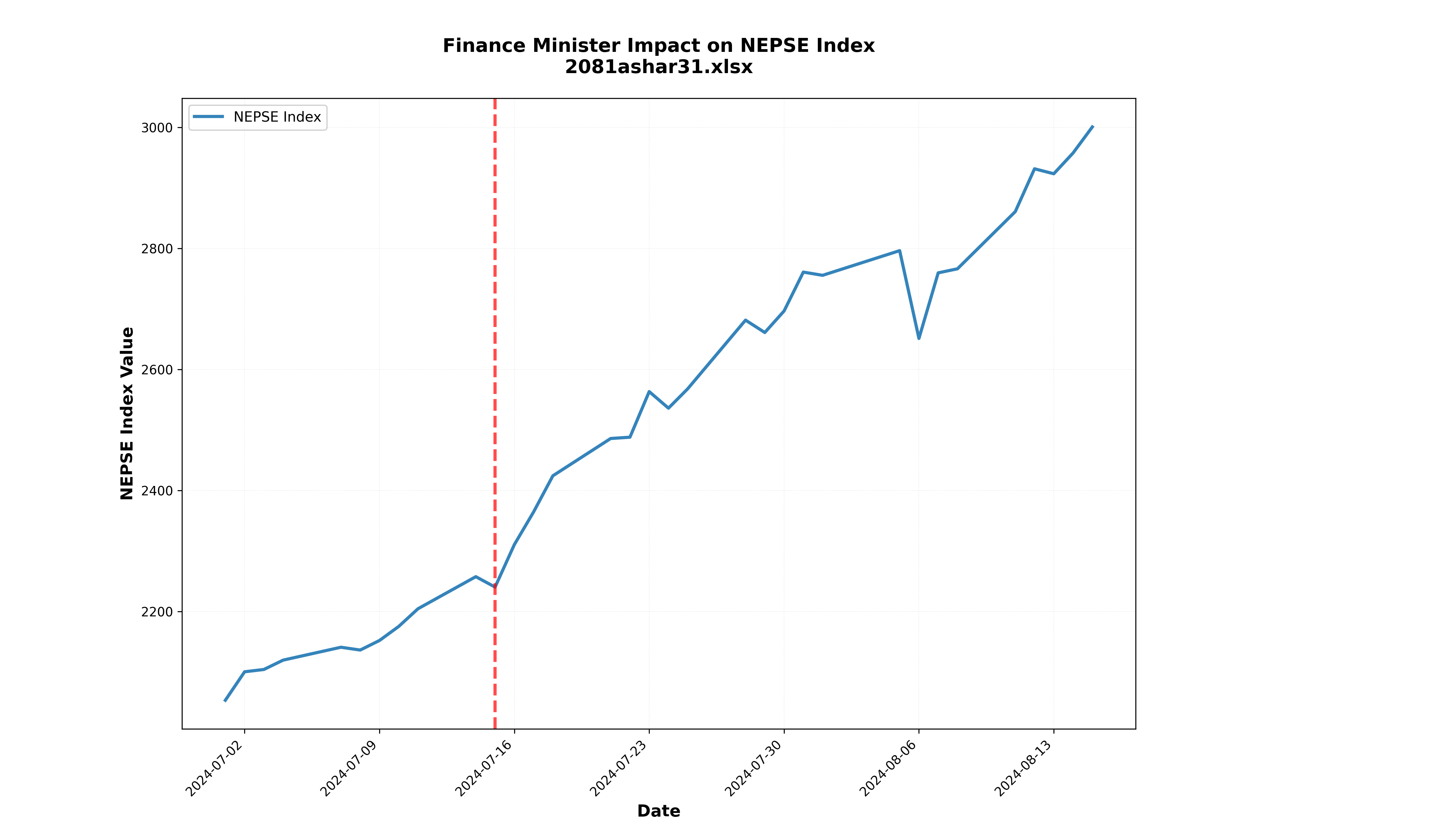
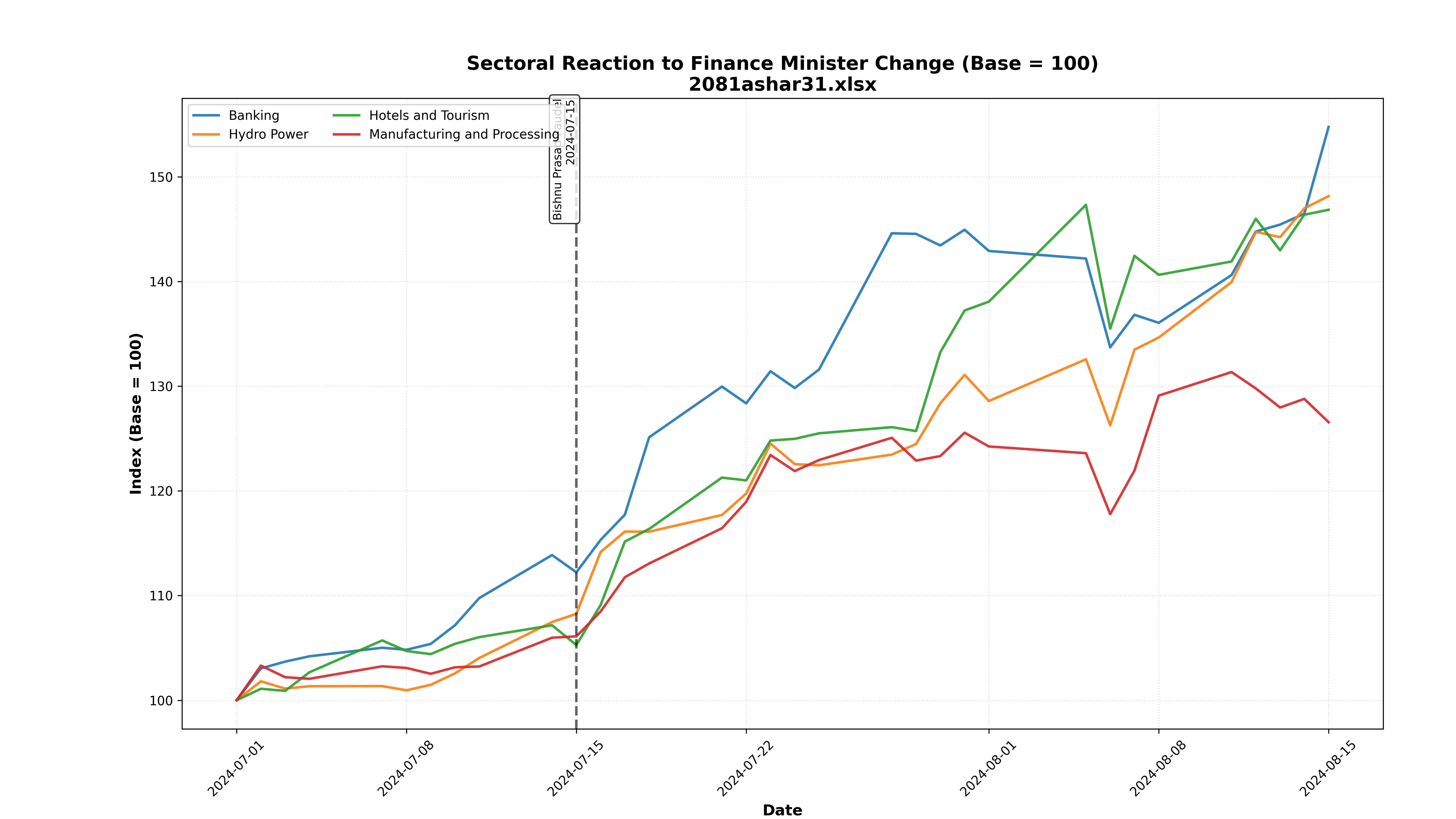
- Market Signal: Policy Stability (Sustained Bullish).
- NEPSE Impact: Reached 26-month highs.
- Pre-Appointment: Steady growth across all sectors, with Banking leading the way.
- Immediate Reaction: An explosive bullish breakout. The appointment acted as a major catalyst for market confidence.
- Post-Appointment Trend: Sustained growth. Banking skyrocketed to ~155 index points.
- Key Finding: This was the most positive reaction among all charts. Banking was the star performer, significantly outperforming other sectors.
- Reason: Clearer policy alignment between the government and regulators, particularly on interest rates, liquidity management, and market regulations, boosted investor confidence and institutional participation.
VIII. September 15, 2025 – Rameshwor Prasad Khanal
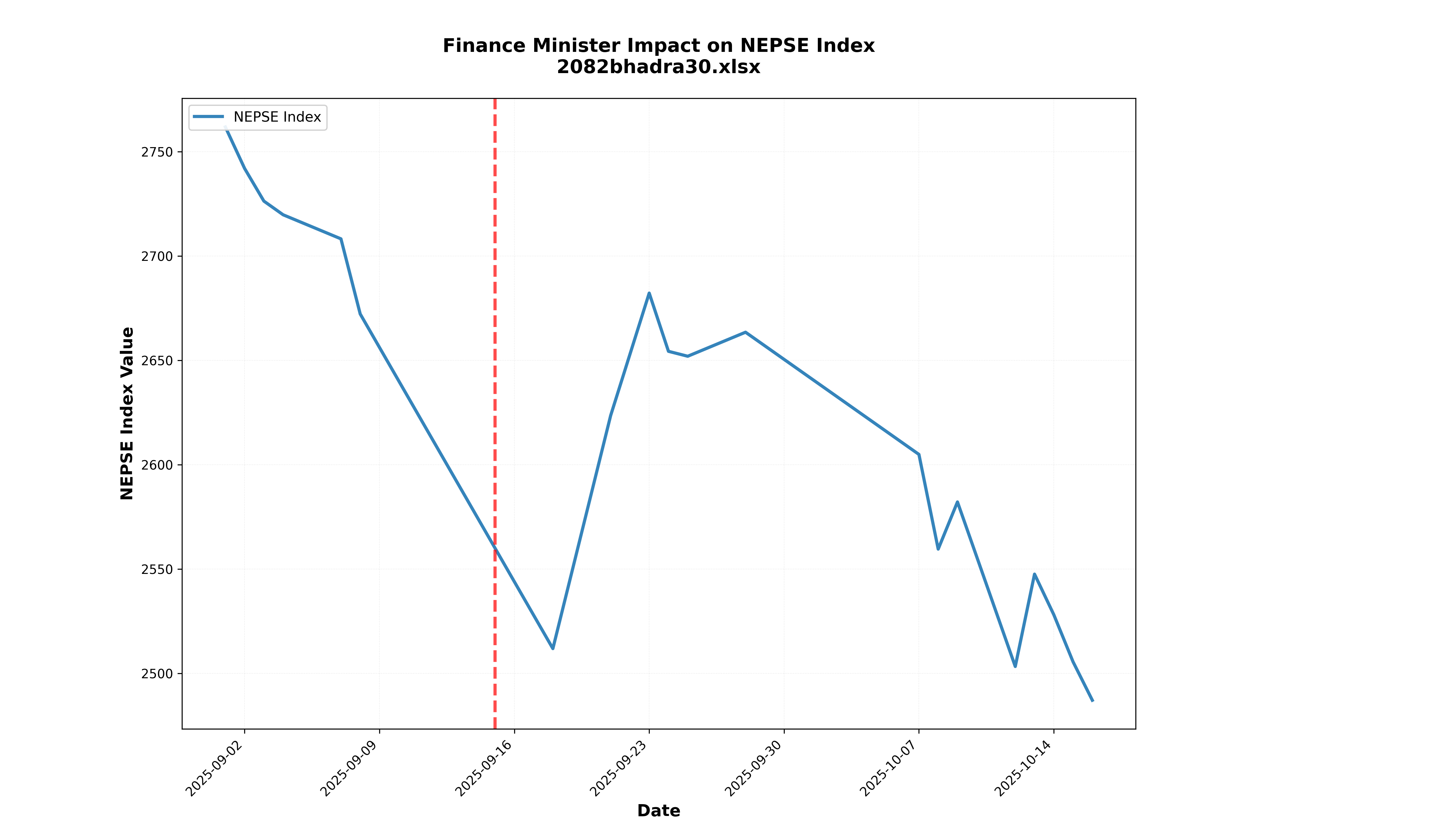
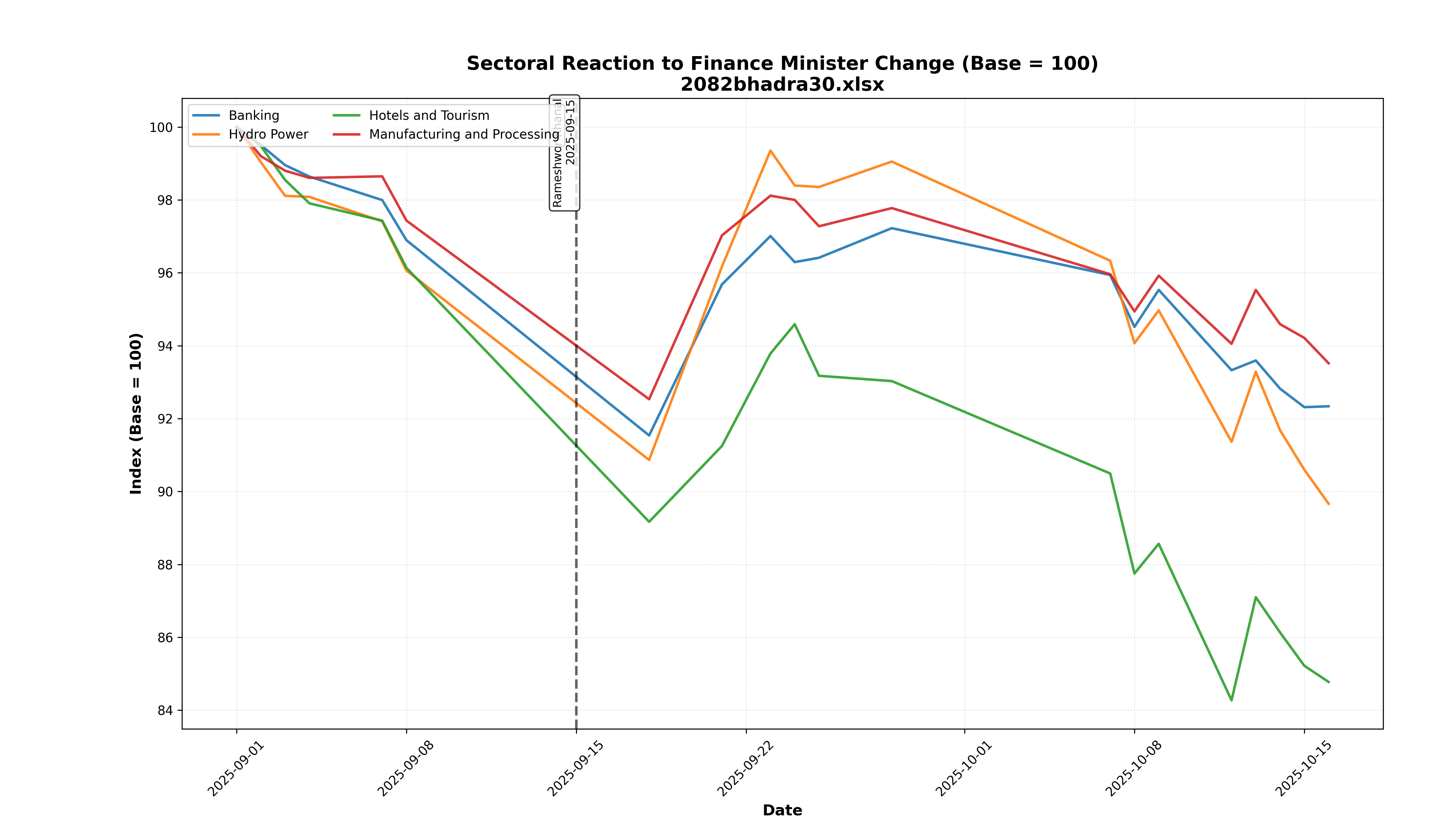
- Market Signal: Risk Reduction (Stable).
- NEPSE Impact: Reduced volatility and flat index.
- Pre-Appointment: All sectors were in a sharp decline, dropping 4–8% in the two weeks leading up to the change.
- Immediate Reaction: A sharp "V-shaped" recovery occurred immediately after the appointment, with all sectors rallying for about a week.
- Post-Appointment Trend: The rally was short-lived. By mid-October, all sectors resumed a downward trend.
- Key Finding: Manufacturing was the most resilient, while Hotels and Tourism suffered the deepest decline, ending near 85.
- Reason: His technocratic background signaled fiscal discipline and institutional reform rather than short-term price pumping.
Key Findings & Comparative Matrix
To summarize the recurring patterns observed across all eight Finance Minister appointments, two comparative matrices are presented below. These matrices condense complex market behavior into easily interpretable categories.
Sector-Market Matrix
This matrix explains how different market sectors typically respond to a Finance Minister appointment, based on volatility, sensitivity to political change, and their role in guiding overall market direction.
Volatility (Beta) refers to the degree to which a sector’s index fluctuates relative to the overall NEPSE index, indicating how sharply it reacts to market-wide and political events.
|
Sector |
Beta (Volatility) |
FM Change Sensitivity |
Market Role |
Observation from Graphs |
|
Commercial Bank |
Medium |
High |
Market Anchor |
The " key indicator " If Banking stays above 100 post-appointment, the whole market usually rallies (e.g., July 2024). |
|
Hydro Power |
Very High |
Extreme |
Speculative Engine |
The "Fast Mover." Often shows the steepest "V" or "A" shapes immediately after an FM change. |
|
Hotel & Tourism |
High |
Medium |
Cyclical / Laggard |
Frequently struggles to maintain the 100-base line compared to other sectors, showing slower recovery. |
|
Manufacturing |
Low-Medium |
Low (Independent) |
Defensive / Value |
Can " moved independently " and move upward even when political sentiment is neutral or slightly negative (e.g., March 2024). |
Across all 8 charts, the Commercial Bank and Hydro Power sectors are the most "politically sensitive", meaning their direction within the first 5–10 days of a new Finance Minister's appointment almost always dictates the trend for the following month.
Minister-Market Matrix
This matrix categorizes Finance Ministers based on how markets typically respond to their appointment, focusing on perceived policy stance rather than political affiliation.
|
Minister Type |
Key Ministers |
Market Reaction |
The "Why" |
|
The "Bull" |
Bishnu Prasad Paudel |
Green (Up) |
Investors expect easy loans and business-friendly rules. |
|
The "Disciplinarian" |
Dr. Y.R. Khatiwada |
Red (Down) |
Fear of strict rules, higher taxes, and "anti-speculation" stance. |
|
The "Wildcard" |
Janardan Sharma / Barsaman Pun |
Yellow (Unstable) |
High excitement at first, followed by uncertainty or clashes with the bank. |
|
The "Safe Anchor" |
Rameshwor Khanal / Dr. P.S. Mahat |
Blue (Stable) |
Market stops moving wildly; focus shifts to institutional stability. |
- Rockey Chamling Rai

