


Sustainable Growth of Digital Nepal Framework

Wed, Mar 25, 2026 10:10 AM on Exclusive,

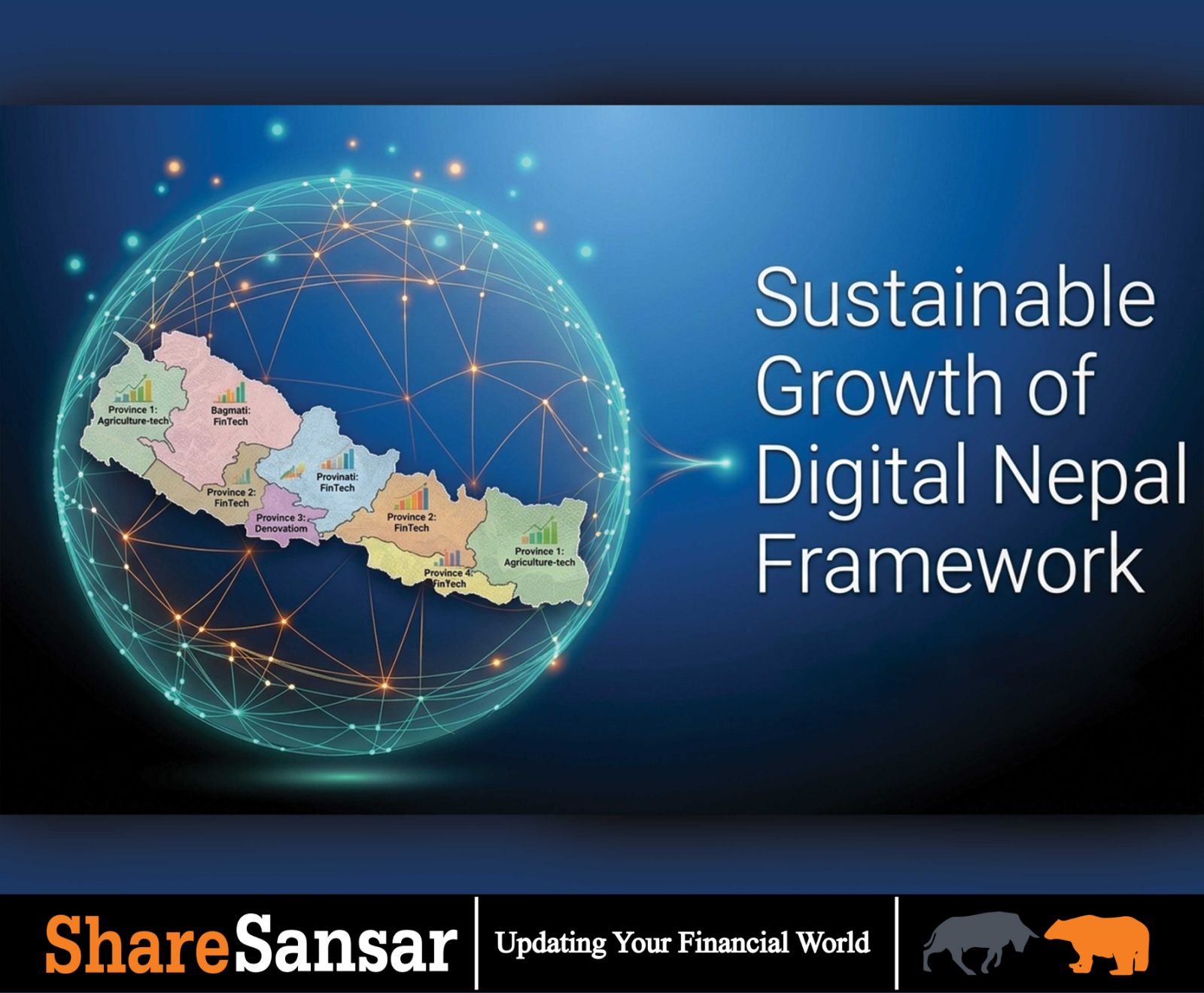
The development of telecommunication services plays a pivotal role in enhancing the ecosystem with the vision of sustaining the digital sector in the country. Effective internet services are envisioned to unlock the journey of improving the digital economy growth of the country. With the possible growth of the digital economy, the government has set the framework to sustain the ecosystem of digital growth.
However, in order to enhance the digital sector, there are challenges for telecommunications, and some of them are proper infrastructure development, quality services, healthy competition among internet service providers, and improving cybersecurity policy. With the high mobile and internet penetration rate in countries like Nepal, a small country, adopting a tremendous growth in the digital sector. Expansion, development, and extension to both urban and rural areas, for the inclusive and sustainable growth of the economy, telecommunication has been able to provide better infrastructure and technical services to various sectors, such as primary, secondary, and tertiary, to improve the digital economy for the betterment of the national interest.
According to Nepal Telecommunication Authority (NTA), various services are consumed, as 48.25% consumed wired fixed broadband, 0.42% consumed wireless fixed broadband, 90. 86% mobile broadband services and 139.53% consumed broadband internet services. In the advancement of technology, 2.96% of the total population accessed 3G services, whereas 87.90% accessed 4G services in the year 2025, respectively. With the further enhancement to increase the services for the improvement of enabling the vision of digital growth, regulators have extended to create the road map of optimizing the 5G services for the smooth flow of activities, effectively and conveniently.
Advancement of technology promotes improving the standard of living of people with the objective of smoothing operational work in personal and professional life. In order to improve the construction and development of infrastructure for inclusive growth, different platforms have been enabled for different sectors to effectively utilize them to further create the digital revolution in the country. Integration and inclusion of technology in agriculture, health, education, banking and financial institutions, tourism, and energy is a transformation of optimizing to add value with the aim of increasing productivity in terms of labour, material, and machine growth.
Tourism is the backbone of the economic development of the country as it promotes the brand image of the country globally, creates employment opportunities, improves the balance of payment by maximizing the foreign currency, and boosts the economic growth of the country. Digital initiatives in the tourism sector boost the goal of creating an image and attracting visitors by promoting different places with natural beauty in the country. Intending to promote digital initiative, the Department of Immigration is collaborating with the Nepal Clearing House Limited to enable the platform of gateway payment for electronic visa payment to increase government revenue.
Financial Technology is rapidly developing, expanding, and establishing with the objective of improving the clearing and payment system in the country. To maintain the stable growth of the payment system, the Governor of Nepal Rastra Bank, the Secretary of the Finance Ministry, members of the Financial Comptroller General of Auditors, the Chairman of Nepal Telecommunication Authority, and the Executive Director of Nepal Rastra Bank have formed a National Payment Board under the Payment and Settlement Act 2075. The National Payment Board aims to improve security and stability, mitigate risk, regulate, supervise, and inspect the payment system of the country.
Cash, mobile banking, internet banking, digital wallet, connectIPS, debit card, credit card, prepaid card, branchless banking, electronic cheque clearing, inter-bank payment system, real-time gross settlement, and so on are the different modes of payment channels in the payment system.
|
Mode of Payment |
Market Share (%) |
|
connectIPS |
2.02 |
|
Mobile Banking |
38.63 |
|
Internet Banking |
3.09 |
|
Digital Wallet |
36.2 |
|
Debit Card |
18.67 |
|
Credit Card |
0.44 |
|
Prepaid Card |
0.37 |
The above table states that the market share of the different modes of payment systems in 2082-Magh. Mobile Banking holds the market share with 38.63% and, followed by Digital wallet 36.2%, Debit Card (18.67%), Credit Card (0.44%), Prepaid Card (0.37%), and connectIPS (2.02%) respectively.
Electronic Cheque Clearing is the payment mode of channel with 54 direct members of commercial banks, development banks, finance, Nepal Rastra Bank, and Nepal Infrastructure Bank. It is an image-based cheque processing solution where the original paper cheque is converted into an image for electronic processing and is transferred through a secure medium between participating member Banks and Financial Institutions. Different parties are involved in processing cheque clearing, and they are the presenting member, paying member, Nepal Clearing House Limited, and Nepal Rastra Bank.
Inter Bank Payment System is a system for clearing bulk transactions that provides a mechanism for participating members to safely transfer funds from one to another held at any of the participating members on behalf of their customers and for their own purposes.
ConnectIPS is a faster payment system implemented as a standardized single payment platform for real-time retail payments. According to the Payment Settlement Act 2075, it states that banks and financial institutions process the transactions in real time. Fonepay and Smart Card Technology are other modes of a faster payment system on a real-time basis.
Cyber-enabled fraud is the most challenging, which impacts the payment system of the country. With the rapidly increasing use of digital banking for promoting and expanding the cashless culture in society, it has also been creating havoc in the ecosystem of the entire payment system of the country. Cyber-related crime is one of the greatest threats to the payment system, and to tackle such vulnerability, reporting institutions shall take drastic reforms and play a pivotal role in implementing a policy of a strong risk management framework to mitigate such damages that impact the reputation risk of an organization. The most common types of cyber-enabled crimes are ransomware, phishing, online banking scams, computer intrusions, digital extortion, and business email compromises, botnets, etc., are rapidly increasing, along with the innovative concept of digitization in the financial sector.
Technology plays a crucial role in enhancing a digital ecosystem in various sectors such as education, health, agriculture, energy, and urban infrastructure. Lack of public awareness, inefficient technical expertise, political instability, and poor institutions are the key problems of the sustainable growth of the digital economy in the country.

