


Rasuwa Flood Deals Major Blow to Hydropower Sector; Calls Grow for Targeted Relief

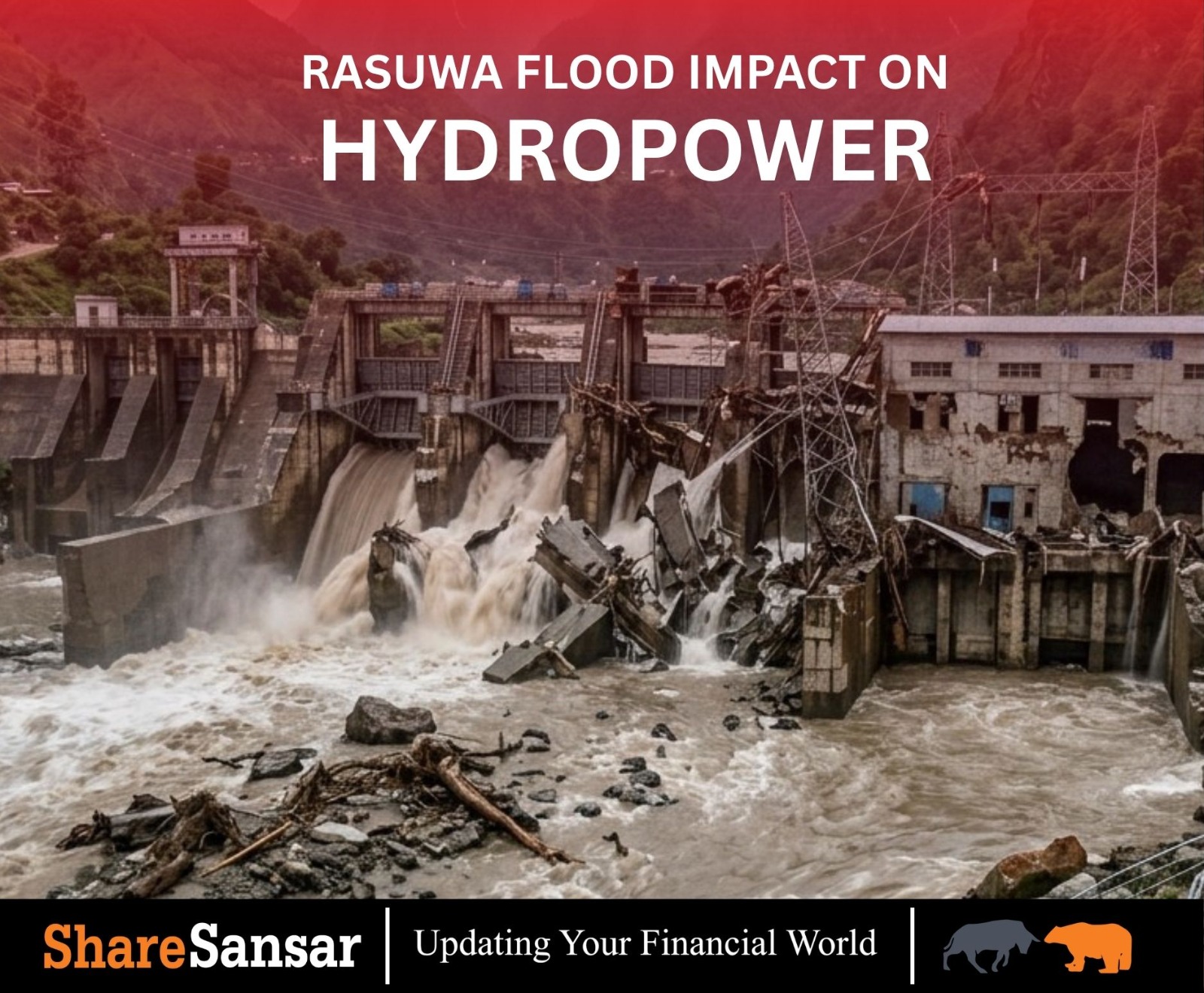
Following catastrophic flash floods in the Bhotekoshi and Trishuli river basins on August 26, 2026, the government officially declared a state of emergency across the affected districts to prioritize high-level search, rescue, and rehabilitation operations. Following the devastating August 26 flash floods along the Bhotekoshi and Trishuli river corridors, restoring grid connection and transmission capabilities has emerged as an urgent priority for Nepal's energy authority.
Multi-ton transmission towers situated near riverbanks were undermined by torrents of water and debris. The surge destroyed key transmission towers, substations, and high-voltage evacuation lines, stranding operational power plants and disconnecting hundreds of megawatts from the national grid.
The floodwaters destroyed key physical infrastructure, headworks, and transmission networks, disconnecting over 430–740 MW of power from the national grid and triggering severe market volatility on the Nepal Stock Exchange (NEPSE).
Affected Operational Hydropower Projects
Five listed operating plants with a total combined capacity of 164.42 MW in Rasuwa (alongside several downstream plants in Nuwakot) suffered structural damage or were forced off the national grid:
• Rasuwagadhi Hydropower Project: 111 MW
• Chilime Hydropower Project: 22 MW
• Langtang Khola Hydropower Project: 20 MW
• Upper Mailung A Hydropower Project: 6.42 MW
• Mailung Khola Hydropower Project: 5 MW
Call for Immediate Sector Relief:
In light of the declared government emergency, investors and energy producers (IPPAN) shall urge authorities to pair disaster relief efforts with concrete economic policies. An indicative list for such a bailout plan may be as follows:
1. Extension of Generation Licenses: Expanding license validity periods beyond the standard 35-year policy up to the statutory 50-year cap under Section 4 of the Electricity Act, 1992. Currently, generation licenses are officially issued by the Department of Electricity Development (DoED) under the Ministry of Energy, Water Resources and Irrigation. Although section 4 of the Electricity Act, 1992 grants legal authority to issue generation licenses for an upper ceiling of "up to 50 years," the Hydropower Development Policy, 2001 subsequently capped standard operational terms at 35 years.
Legal Grounds for Extension: Because the 35-year limit is an administrative policy restriction rather than a statutory cap, the Ministry and DOED hold the legal authority under the governing Electricity Act, 1992 to extend licenses up to the full 50-year ceiling. Stakeholders contend that granting extended license terms to flood-affected plants provides a low-cost regulatory mechanism to offset operational downtime, revenue loss, and long reconstruction timelines without requiring direct government financial bailouts.
2. Concessional Financing: To prevent default and secure the financial survival of flood-hit hydropower projects, soft or interest-free loans shall be granted to rebuild infrastructure and ensure equitable returns to the capital providers through uninterrupted management of funds required for bringing back such affected projects into operations.
3. VAT/Customs Exemptions: Restoring complex hydropower civil structures and electromechanical systems often requires millions of dollars in capital expenditure. Waiving standard import duties directly reduces reconstruction costs, allowing cash-strapped projects to reallocate scarce capital toward physical restoration.
4. Extension of Required Commercial Operation Date (RCOD): For under-construction projects whose progress was set back by months or years due to destroyed access infrastructure, banks extend grace periods on loan principal repayments to match updated project completion timelines.
5. Fast-track rehabilitation of Grid Infrastructures: NEA and DOED shall coordinate and prepare an action plan for quick rehabilitation of the swept-away transmission towers, substations, switchyards, and other distribution systems.
All listed companies except explicity listed in the notice dated Chaitra 17, 2082 shall not be eligible for availing margin trading facilities.
Article By: Anil Basnet

