


Nepal Rastra Bank Unveils Annual Macroeconomic and Financial Report for FY 2025/26

Wed, Aug 26, 2026 9:05 PM on Economy, National, Latest, Recommended,
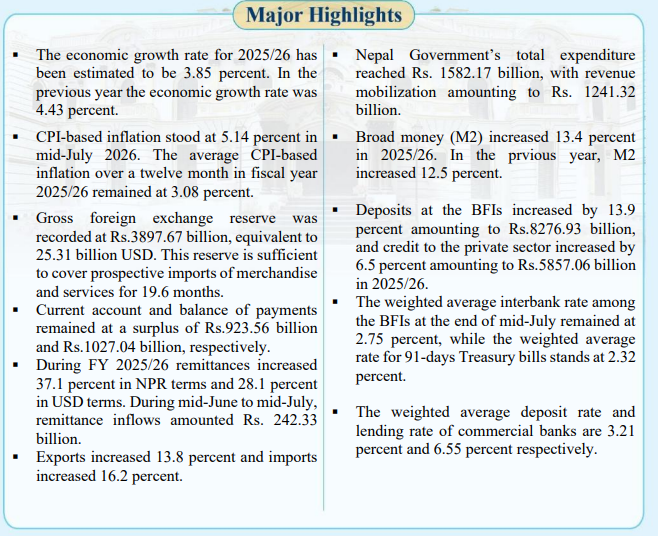
Nepal Rastra Bank, the central bank of Nepal, has unveiled the current macroeconomic and financial situation of Nepal based on Annual data for FY 2025/26.
Overall
Nepal Rastra Bank estimated that inflation remained at 3.85 percent on a year-over-year basis. The gross foreign exchange reserves stood at Rs.3897.67 billion, equivalent to 25.31 billion USD, whereas the total imports and exports increased 16.2 percent and 13.8 percent, respectively.
The NEPSE index stood at 2590.29 in mid-July 2026 compared to 2794.79 in mid-July 2025.
Inflation Remains Moderate
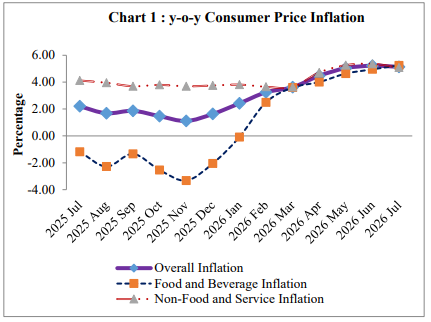
The year-on-year (y-o-y) consumer price inflation stood at 5.14 percent in mid-July 2026, up from 2.20 percent recorded in the corresponding period a year earlier. Meanwhile, the annual average consumer price inflation remained at 3.08 percent during FY 2025/26, compared to 4.06 percent in the previous fiscal year.
The annual average wholesale price inflation increased to 4.27 percent in FY 2025/26, from 3.84 percent a year earlier. On a y-o-y basis, wholesale price inflation reached 6.67 percent in mid-July 2026, compared to 1.05 percent in the same period of the previous year.
Tourism Arrivals Cross 1.15 Million
Tourist arrivals increased by 0.95 percent to 1,158,459 during FY 2025/26. The modest increase indicates continued recovery and stability in Nepal’s tourism sector.
Travel income also increased 1.5 percent to Rs. 90.05 billion, while travel payments declined 6.5 percent to Rs. 209.10 billion. Of the travel payments, Rs. 141.92 billion was spent on education.
Remittance Inflows Rise 37.1 Percent
Remittance inflows recorded a strong increase during the review year, rising 37.1 percent to Rs. 2,363.13 billion in FY 2025/26. In US dollar terms, remittances increased 28.1 percent to USD 16.19 billion.
During the final month of the fiscal year, from mid-June to mid-July, remittance inflows reached Rs. 242.33 billion, compared with Rs. 189.11 billion during the same period a year earlier.
The number of Nepali workers receiving first-time approval for foreign employment stood at 406,519, while 385,783 workers received approval for renewal of entry.
Foreign Exchange Reserves Reach $25.31 Billion
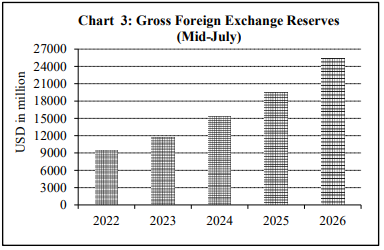
Nepal’s gross foreign exchange reserves increased by 45.6 percent to Rs. 3,897.67 billion by mid-July 2026 from Rs. 2,677.68 billion a year earlier. In US dollar terms, reserves increased 29.8 percent to USD 25.31 billion.
The reserves are sufficient to cover approximately 23 months of merchandise imports and 19.6 months of merchandise and services imports, providing a strong external-sector buffer for the economy.
The current account recorded a surplus of Rs. 923.56 billion, while the balance of payments remained in surplus at Rs. 1,027.04 billion.
Exports and Imports Both Increase
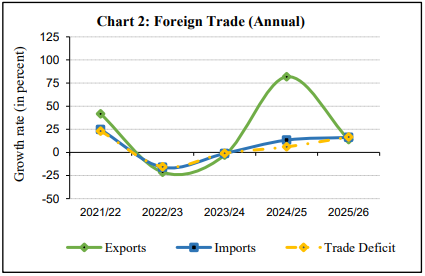
Merchandise exports increased 13.8 percent to Rs. 315.29 billion during FY 2025/26. Exports to India increased 15.1 percent, while exports to other countries rose 10.1 percent. However, exports to China declined by 28 percent.
Merchandise imports increased at a faster rate, rising 16.2 percent to Rs. 2,096.38 billion. Imports from India, China and other countries increased by 13.0 percent, 24.7 percent and 17.5 percent, respectively.
Total trade deficit increased 16.6 percent to Rs.1781.09 billion in 2025/26. Such a deficit had increased 6.0 percent in the previous year. The export-import ratio decreased to 15.0 percent in the review year from 15.4 percent in the previous year.
Government Spending Reaches Rs. 1.58 Trillion
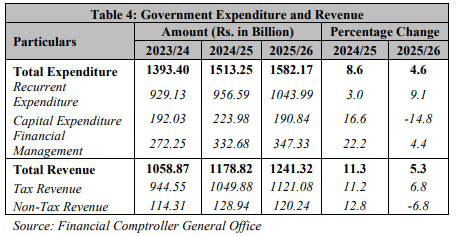
Government expenditure stood at Rs. 1,582.17 billion during FY 2025/26, an increase of 4.6 percent from the previous year.
Recurrent expenditure increased 9.1 percent to Rs. 1,043.99 billion, while capital expenditure declined 14.8 percent to Rs. 190.84 billion. Financial expenditure stood at Rs. 347.33 billion.
Government revenue increased 5.3 percent to Rs. 1,241.32 billion, including Rs. 1,121.08 billion in tax revenue and Rs. 120.24 billion in non-tax revenue.
Public Debt Rises to Rs. 2.97 Trillion
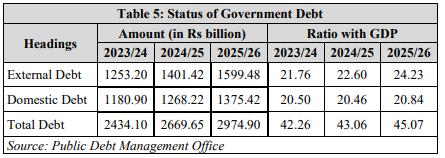
Outstanding public debt reached Rs. 2,974.90 billion by mid-July 2026, equivalent to 45.07 percent of GDP. External debt stood at Rs. 1,599.48 billion, while domestic debt reached Rs. 1,375.42 billion.
The government mobilized Rs. 358.66 billion in domestic debt and repaid Rs. 250.56 billion in principal during the review year, resulting in net domestic debt mobilization of Rs. 108.10 billion.
Bank Deposits Grow Faster Than Private-Sector Credit
Broad money supply increased 13.4 percent during FY 2025/26, compared with 12.5 percent a year earlier.
Deposits at banks and financial institutions increased 13.9 percent, or Rs. 1,013.05 billion, to reach Rs. 8,276.93 billion.
Meanwhile, private-sector credit increased 6.5 percent, or Rs. 359.36 billion, to Rs. 5,857.06 billion. Credit expansion was particularly strong in construction, consumable goods, transportation, and communication sectors.
Interest Rates Continue to Decline
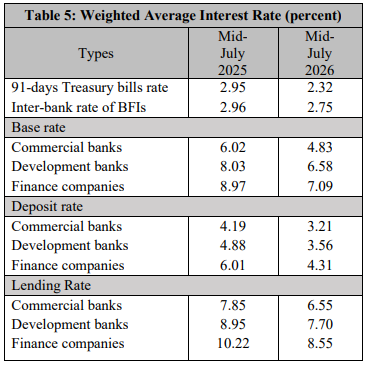
Interest rates declined across major categories during the review year. The weighted average interbank rate fell to 2.75 percent from 2.96 percent a year earlier, while the 91-day Treasury bill rate declined to 2.32 percent from 2.95 percent.
The weighted average deposit rate of commercial banks fell to 3.21 percent, while their average lending rate declined to 6.55 percent, compared with 4.19 percent and 7.85 percent, respectively, a year earlier.
The average base rate of commercial banks also declined significantly to 4.83 percent from 6.02 percent.
Banking Access and Financial Soundness
As of mid-July 2026, 105 banks and financial institutions were operating in Nepal, including 20 commercial banks, 17 development banks, 16 finance companies, 51 microfinance institutions and one infrastructure development bank.
The number of BFI branches stood at 11,332. Deposit accounts reached more than 63.42 million, while loan accounts stood at over 2.03 million.
The average non-performing loan ratio of BFIs stood at 5.66 percent, while the core capital-to-risk-weighted assets ratio was 9.95 percent and the total capital-to-risk-weighted assets ratio stood at 12.76 percent.
NEPSE Market Capitalization Declines
The NEPSE index stood at 2,597.80 in mid-July 2026, down from 2,794.79 a year earlier. Market capitalization declined to Rs. 4,463.55 billion from Rs. 4,656.99 billion.
However, the number of companies listed on NEPSE increased to 302, compared with 272 a year earlier. Securities worth Rs. 157.06 billion were listed during the fiscal year.
Price of Oil and Gold
The international price of Crude Oil Brent increased by 16.6 percent to USD 81.23 per barrel in mid-July 2026, up from USD 69.67 per barrel a year earlier. Similarly, the price of gold rose by 20.2 percent to USD 3,993.55 per ounce, compared to USD 3,323.80 per ounce in mid-July 2025.
Foreign Exchange Reserves and Adequacy Indicators
Nepal’s gross foreign exchange reserves increased by 45.6 percent to Rs. 3,897.67 billion in mid-July 2026 from Rs. 2,677.68 billion a year earlier. In US dollar terms, reserves rose 29.8 percent to USD 25.31 billion. Of the total reserves, those held by Nepal Rastra Bank increased 43.8 percent to Rs. 3,473.19 billion, while reserves held by banks and financial institutions increased 61.4 percent to Rs. 424.48 billion.
Based on the imports of FY 2025/26, the foreign exchange reserves of the banking sector are sufficient to cover 23 months of prospective merchandise imports and 19.6 months of merchandise and services imports. The reserves-to-GDP ratio stood at 63.8 percent, the reserves-to-imports ratio at 163.4 percent, and the reserves-to-M2 ratio at 43.8 percent in mid-July 2026.
Balance of Payments
Nepal’s current account remained in surplus at Rs. 923.56 billion in FY 2025/26, significantly higher than the Rs. 409.84 billion surplus recorded in the previous fiscal year. In US dollar terms, the current account surplus increased to USD 6.33 billion from USD 3.01 billion.
Meanwhile, the country’s Balance of Payments (BoP) recorded a surplus of Rs. 1,027.04 billion during FY 2025/26, compared with a surplus of Rs. 594.54 billion in the previous year. In US dollar terms, the BoP surplus stood at USD 7.05 billion, up from USD 4.37 billion a year earlier. Net capital transfer amounted to Rs. 18.50 billion, while foreign direct investment inflows on an equity-only basis increased to Rs. 28.49 billion from Rs. 12.02 billion.

