


Sir Isaac Newton, the South Sea Bubble & FOMO: Trading Psychology Everyone Must Learn

Tue, Mar 17, 2026 12:07 PM on Economy, International, Exclusive,

Isaac Newton is arguably the greatest scientist to ever walk on planet Earth. He invented calculus, discovered gravity, and revolutionized science and mathematics forever.
But he was a failure in the stock market. He ended his stock market career with the quote, "I can calculate the motion of heavenly bodies, but not the madness of people."
Throwback to Britain in the 1700s: the national debt of the country was enormous; the lenders started questioning the government about their money. Right then, the South Sea Company was formed. The lenders were offered the shares of the company equivalent to the amount that the government owed them. The South Sea Company was supposed to be a huge business success because it was given the monopoly to trade with South America; the company promised huge profits and dividends.
But this all turned out to be a cunning move by the government to reduce its national debt. Actually, Spain controlled most of South America, so Britain’s trade authority was very limited.
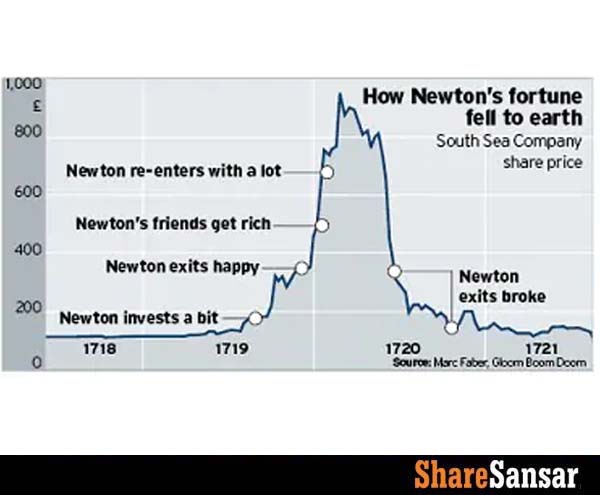
Around the 1720s, the South Sea Company became the hot topic of every conversation in Britain. Pamphlets & advertisements promised unimaginable wealth. The parliament was bribed to pass legislation favoring the company. Even Prince George I became the governor of the company, which boosted the confidence of the people. The stock price surged from £100 to £1000 in just a few months.
Isaac Newton bought early and made a staggering 100% return on his investment, earning about £7000 (about 2 million USD or 25 crore NRs today).
Later, the FOMO kicked in; he felt that he was missing out on enormous wealth and decided to jump in again when the price was hitting its top. He lost about £20,000 (5 million USD or about 60 crore Hrs today).
But why does this matter at all? The South Sea Bubble was not just a financial crash but a template. If you look at the Dotcom bubble in the 1900s or the housing bubble in 2008, or the recent crypto or meme coin, which are backed by nothing but just speculation, they all resemble the South Sea bubble crash.
In the context of Nepal, a recent example is the rise in hydropower stocks that are not backed by fundamentals but by the concept of herd mentality. More and more people pile up in the rally; the earliest ones make a fortune, whereas most people get absolutely cooked.
The main lesson is to have financial knowledge; if you don’t know how a bubble is formed, you are bound to be caught in one. Moreover, the promises of easy riches, whether in the 18th or the 21st century, are designed to pull you into the layer of the pyramid, which is bound to end at some point. And real wealth isn’t built on hype; it’s built on understanding true value, traps, and understanding how finance and systems actually work.
Author: Prashant Panta

