


Nepal Faces Massive Capital Spending Gap Despite Stable Revenue Mobilization

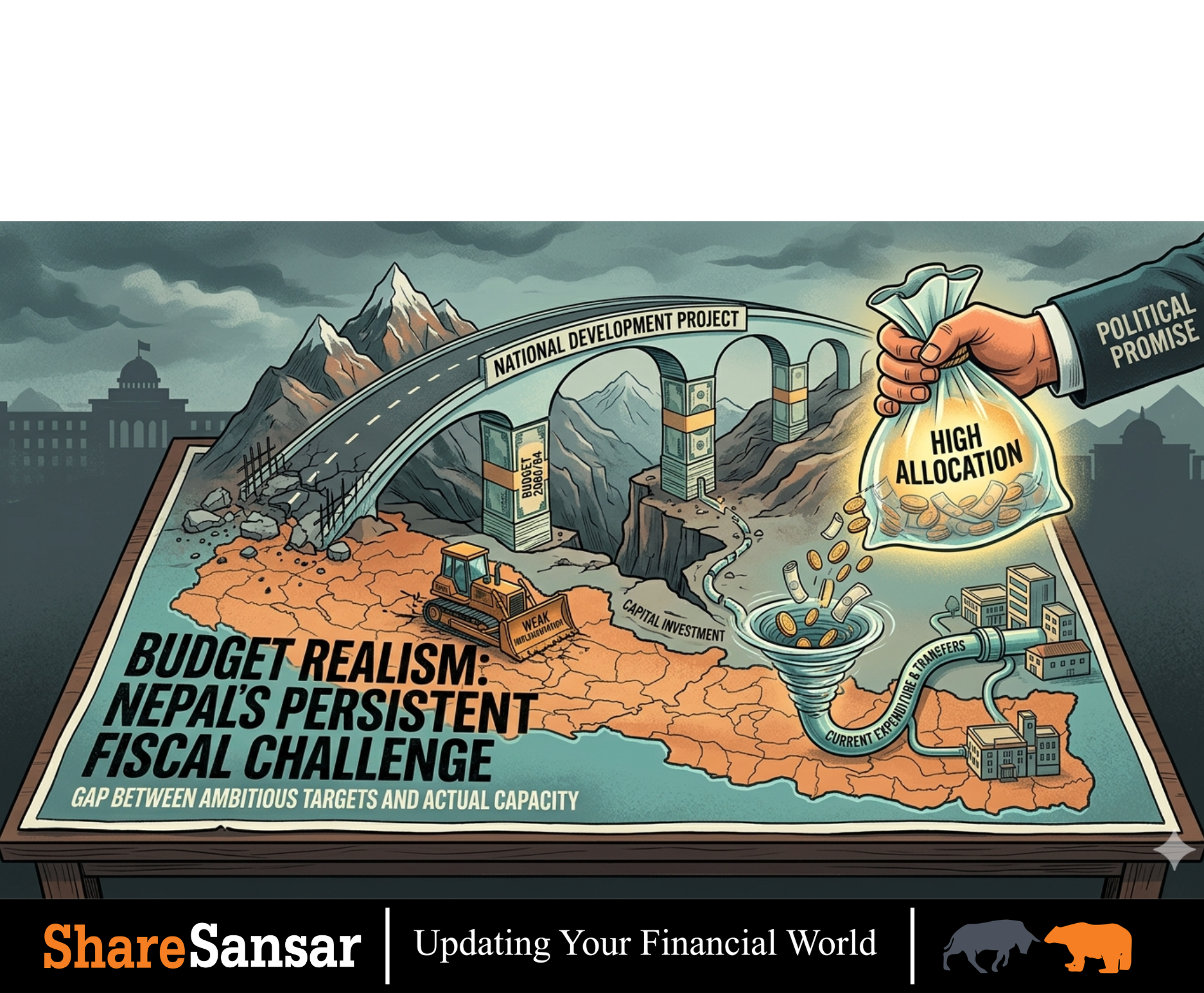
With only a little over a week remaining before the conclusion of Fiscal Year 2082/83, the Government of Nepal faces a deeply familiar yet severe structural bottleneck: a massive shortfall in capital expenditure contrasting with relatively stable revenue collection.
According to the latest daily receipts and payments data released by the Financial Comptroller General Office (FCGO) as of 22nd Ashadh, 2083 (July 6, 2026), the state has mobilized nearly 77% of its targeted annual revenue, while actual capital spending languishes under the 38% mark.
Target vs. Actual Realization
The financial mismatch highlights deep rooted issues in treasury management and project execution. The hard figures from the FCGO report tell a compelling story of an economy struggling to transform public resources into physical development:
|
Financial Indicator |
Annual Target/Budget (00000) |
Spend Up to Yesterday (00000) |
Percentage Realized |
|
Total Revenue |
14,800,000 |
11,389,802 |
76.96% |
|
Capital Expenditure |
4,078,880 |
1,518,636 |
37.23% |
Revenue Mobilization Outpaces Development Outlays
The state's revenue machine has managed a decent performance given broader macroeconomic conditions. Out of a total budgeted revenue target of 14,800,000 Lakhs, the government has collected 11,389,802 Lakhs (76.96%). This is heavily anchored by Tax Revenue, which stands at 10,348,366 Lakhs against a target of 13,255,839 Lakhs, a realization rate of 78.07%.
However, the fiscal problem does not lie on the intake side; it rests entirely on deployment. The fact that the government has collected over 11.38 million Lakhs in revenue but has only deployed 1.51 million Lakhs into capital assets points to a severe systemic blockage in public development spending.
Capital Spending Figures Threatens Long Term Growth
Capital expenditure, the actual engine for infrastructure development, job creation, and long-term economic productivity, presents an alarming picture. Out of the allocated budget of 4,078,880 Lakhs, actual development outlays up to today sit at just 1,518,636 Lakhs, translating to a dismal 37.23% execution rate.
Even with the typical, highly criticized last minute spending rush that characterizes the final month of the fiscal year, it is mathematically impossible for line ministries to productively utilize the remaining 62.77% of the development budget in the days left. This failure to invest in roads, energy, and water infrastructure directly suppresses Nepal’s gross domestic product (GDP) growth potential.
With a little over a week remaining, the volume of unspent capital budget means a significant amount of liquidity remains locked inside the government treasury.

