


How to Outperform Professional Fund Managers with Just 4 High Quality Stocks

Mon, Jul 13, 2026 12:38 PM on Economy, National, Exclusive, Recommended,
Participation in the Nepalese stock market has grown rapidly across diverse demographics. However, a vast majority of market participants remain captivated by the allure of quick, short-term gains instead of focusing on sustained, long-term wealth creation. Having worked in investment banking, I frequently find that my peers approach me looking for immediate trading tips rather than inquiring about building a solid, long-term value portfolio.
A widespread myth persists among the general public in Nepal that value stocks and long-term holding strategies do not yield good returns; many assume only short-term trading of low-fundamental stocks can provide profitability, which is entirely false. Across top-tier academic research and global data, the consensus is clear: between 70% and 97% of short-term traders lose money, whereas the vast majority of long-term investors make a consistent profit. Despite these statistics, media outlets heavily favor short-term trading because fast-paced market action generates high engagement, making its dangerous allure irresistible to the public.
The Quantitative Study
To prove that consistent investment in value stocks creates wealth over an extended horizon, I conducted a quantitative analysis. A hypothetical scenario was assumed involving an investor who built a portfolio using twelve fundamentally strong stocks across different sectors. Also, four distinct, concentrated portfolios were created, each consisting of four high-quality stocks selected from different sectors.
The simulated investment journey spanned from 16th July 2019 to 15th June 2026. Under this strategy, the investor purchased exactly ten units of each stock at the end of every Nepali month at the last trading price (LTP). The twelve selected stocks chosen for this portfolio are EBL, KSBBL, MFIL, CBBL, NLICL, SICL, SHIVM, SHL, CHCL, STC, NTC, and HIDCL. This simulation answers a crucial question: What would the investor's total return look like by 1st July 2026?
Table 1: Overall return of individual stocks and annualized return of the stocks.
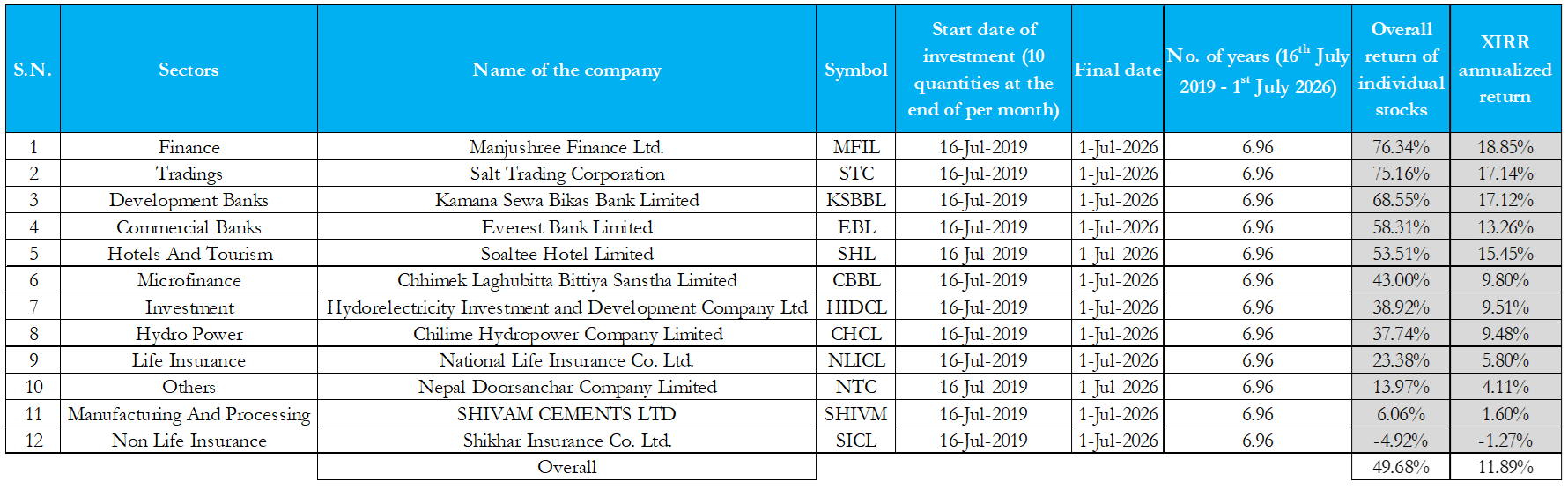
Table 2: Overall return of the portfolios of 4 blue-chip stocks and their annualized return.


The long-term performance data reveals highly insightful patterns. From Table 1, out of all twelve stocks, only a single equity, Shikhar Insurance Company Limited (SICL), recorded a negative annualized return of -1.27%. This specific underperformance was largely due to the Gen Z protest, which significantly impacted the entire non-life insurance sector. Other companies that delivered relatively low returns include NLICL with an annualized return of 5.80%, NTC at 4.11%, and SHIVM at 1.60%. Aside from these, all other remaining stocks in the portfolio delivered robust results, achieving an annualized return of approximately 10% or higher, bringing the overall annualized return of this multi-sector portfolio to 11.89%.
It is vital to recognize that the capital was deployed mechanically at the end of each month, completely ignoring whether the market was at an expensive peak or buried in a bearish trough. For instance, after 5th March 2019, the NEPSE index entered a massive bull run, eventually climbing to an all-time high of 3227.11 on 19th August 2021. If the investor had used basic technical analysis to spot support and resistance levels-buying more at lower prices and partially selling near the all-time high-the returns across these stocks would have nearly doubled.
If a completely passive monthly investment can generate a strong overall return of 11.89%, then careful timing and strategic asset allocation could easily elevate an investor's annualized return above 20%. A 20% return significantly outperforms standard Systematic Investment Plans (SIPs) and compulsory savings accounts.
While everyday retail investors might find it difficult to monitor twelve different stocks, they can easily select a focused group of 3 to 4 high-quality stocks and invest in them consistently, either quarterly or when share prices drop into clear technical support zones. From Table 2, portfolios A, B, C, and D have generated annualized returns of 16.89%, 17.20%, 16.81%, and 11.74%, respectively. Portfolio D has the lowest return of 11.74%. This straightforward approach can realistically target an annualized return exceeding 30% over the long haul if bought by seeing technical support & resistance and regular investment in the support zone. It's metric powerful enough to beat professional fund managers and traditional SIP products.
Essential Steps for Investment Success
Becoming a successful value investor requires deep personal discipline; simply buying a fundamentally strong stock and holding it indefinitely without rules is not enough. Based on my three years of experience in investment banking and rigorous market analysis, here are the essential steps every market participant must follow to succeed.
- Selection of Fundamental Stocks
The primary criteria for choosing equities must always be anchored in robust financial metrics, including favorable P/E ratios, P/B ratios, consistent revenue growth, and a strong history of dividend payouts. However, looking at the numbers alone is insufficient; investors must also evaluate the historical track record and corporate integrity of the company's promoters to safeguard capital.
- Diversification of Stocks
Investment capital must be distributed across entirely different sectors to mitigate market risks. At the same time, investors must avoid over-diversification, which dilutes overall returns and makes a portfolio difficult to monitor. Maintaining a focused portfolio of 3 to 4 high-quality stocks from distinct sectors is ideal for easy tracking and management, contrasting sharply with many Nepalese retail investors who hold an unmanageable number of different stocks.
- Supply of Stocks
This is a critical market factor that many Nepalese investors frequently overlook. Basic economic principles dictate that share prices are heavily driven by supply and demand dynamics. A company may possess stellar fundamentals, but if its total outstanding share volume (the market float) is massive, its upward price appreciation will likely be capped. Therefore, superior long-term wealth is best achieved by targeting companies that pair great fundamentals with a relatively low public float. Consider the case of SHIVM; its shares began trading on NEPSE on 24th March 2019 and soared up to NPR 1910 per share. However, as its founder lock-in expiration date approached on 5th March 2022, a massive wave of supply hit the market, causing the price to fall sharply and damaging the long-term return in our portfolio calculation. So, in the table, too, the SHIVM has a low return, and dumping it would have prevented that low return. Investors must avoid stocks where market supply is already overwhelming or expected to explode in the future.
- Regular Investment
Another frequent mistake made by investors in Nepal is deploying capital in massive, one-off lump sums. True long-term investing thrives on a systematic approach. Allocating a fixed, modest amount of money every month over an extended horizon naturally lowers your average cost per share across market cycles, utilizing the mathematical power of compounding to position your portfolio for substantial growth when the next market rally takes off.
- No Exit Strategy When Fundamentals Deteriorate
A major pitfall is blindly holding onto a company even when its underlying financial health begins to decay. A company with a prestigious history will not automatically maintain its financial soundness forever. Within the Nepalese commercial banking sector, when NIC Asia Bank's (NICA) fundamentals began to show clear signs of strain over consecutive fiscal years, many investors adamantly refused to exit because they clung to its past glory. Similarly, Nepal Telecom (NTC) has shown consistent signs of structural financial deterioration over multiple years, serving as an important reminder that long-term value investors must be willing to cut ties when a company's core financial strength permanently weakens. So, in the table, too, the NTC has a low return, and dumping it would have prevented that low return.
- Timing of the Investment
While identifying long-term value forms your financial foundation, maximizing your ultimate profitability is heavily dictated by the timing of entry. Excellent companies should be aggressively accumulated during periods of deep market correction. While stock prices naturally fluctuate, most retail investors mistakenly buy shares during times of peak market euphoria when prices are highest. Instead, equities should be acquired around major technical support zones or after deep market selloffs. Historically, Nepal's capital market has experienced four major bull and bear cycles, with the NEPSE index correcting by anywhere from 40% to 70% during its bear phases; masterful market timing requires entering the market during these deep corrections rather than chasing rapid rallies.
- Lack of an Appropriate Exit Strategy
When the NEPSE index runs into major long-term technical resistance, a short-term market correction usually follows. Even dedicated long-term value investors should capitalize on these trading cycles. Selling a partial fraction of your holdings allows you to lock in profits and repurchase those same shares at lower price points. For instance, an investor could sell 500 out of 1,000 shares of a company at a major resistance level of Rs. 800, and then re-enter the position at a support level of Rs. 750. This exit trading strategy is absolutely crucial during major bull markets. Given that Nepal's four historic bear cycles have repeatedly wiped out 40% to 70% of NEPSE's entire value, knowing when to take short-term profits off the table and wait patiently for a correction is a vital wealth-maximizing skill that most Nepalese investors sorely lack.
Finally, short-term trading isn’t inherently bad-it can generate quick profits-but it requires patience, discipline, and years of practice. Before risking real capital, you should do paper trading (dummy practice) for multiple years. Once you achieve a consistent 70% accuracy rate, you can transition to live trading with a small amount of money. The mechanics of trading, understanding technical indicators, and setting profit or loss targets are easy to grasp. The real challenge is discipline and patience. Human emotions like fear and greed constantly derail investors. Ultimately, the hardest part of trading isn't knowing when to trade, but when not to trade; in fact, successful traders spend about 80% of their time staying idle. If you lack emotional control to wait and stick to your strategy, trading won't be the fastest way to make easy money-it will be the fastest way to lose money.

Article By: Dipendra Pandey, Former merchant banker

