


Before and After Constitution 2072: An Evaluation of Nepal’s Budgetary Trends


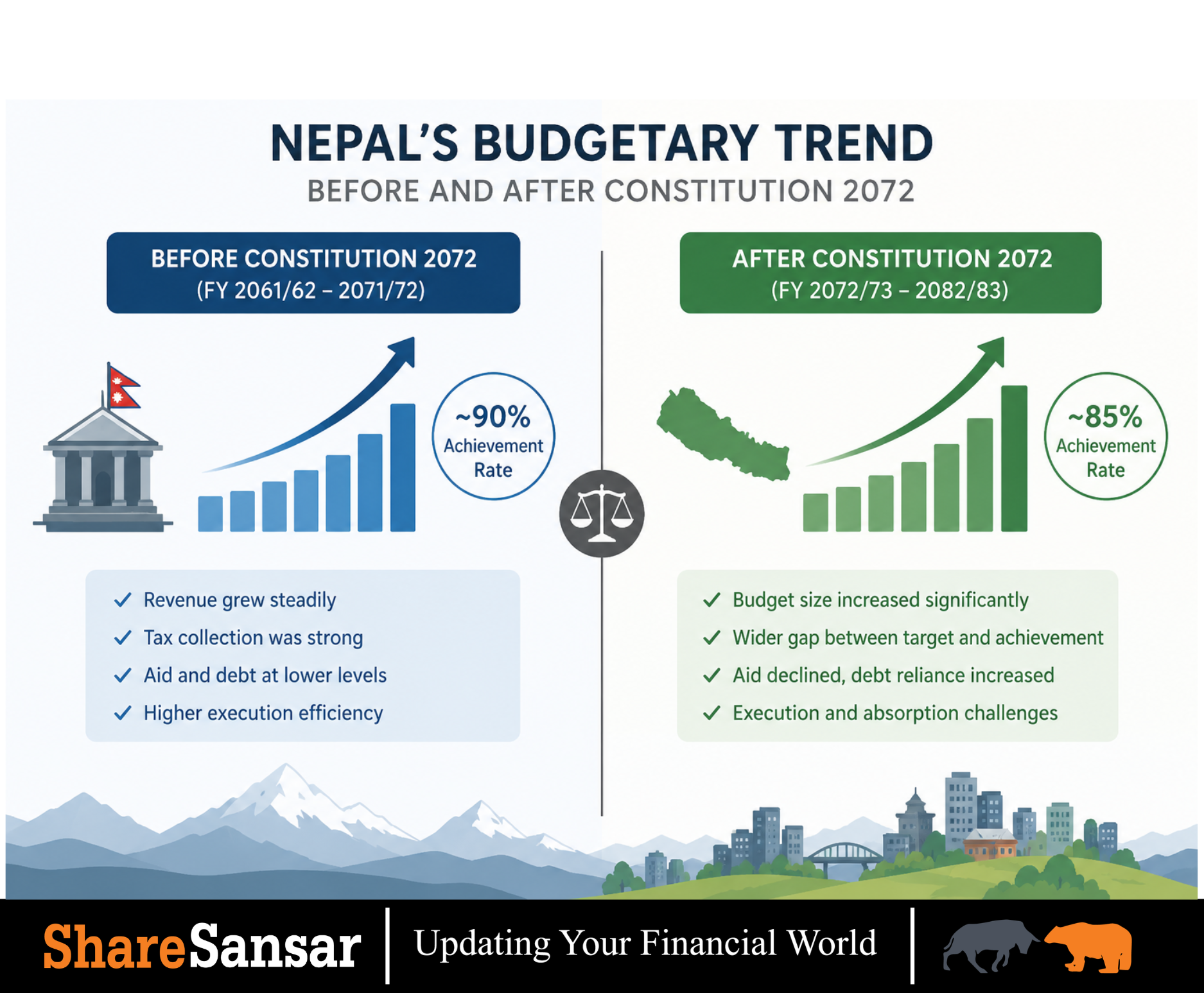
Nepal’s fiscal history over the last two decades reveals a persistent structural pattern: governments consistently present ambitious budgets, yet actual mobilization of resources falls materially short of projections. A quantitative review of fiscal data from FY 2061/62 to FY 2082/83 demonstrates that Nepal’s budgeting process has been characterized more by optimistic fiscal signaling than by empirical realism.
Total Revenue
Before Constitution 2072
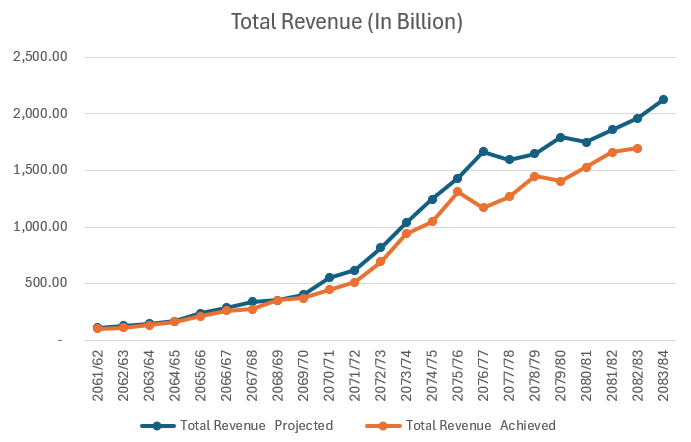
Based on the data, Nepal’s budgetary structure appeared relatively stable before the promulgation of the Constitution 2072. Nepal achieved around 90% of its projected revenue collection from FY 2061/62 to FY 2071/72.
Two major historical events reshaped Nepal’s fiscal structure during this period: the promulgation of the Constitution 2072 and the devastating earthquake of 2015 (2072 B.S.). During the first decade of the study, projected total revenue increased from NPR 111.69 billion to NPR 617.10 billion, representing a 4.53-fold increase over ten years.
On the other hand, actual revenue collection increased from NPR 100.37 billion to NPR 510.96 billion during the same period, reflecting a 4.09-fold increase.
After Constitution 2072
Following the earthquake and the implementation of federalism under the Constitution 2072, the Government of Nepal significantly increased budget size to support reconstruction and expanded administrative responsibilities. However, structural inefficiencies became more visible.
From FY 2072/73 to FY 2082/83, Nepal achieved only around 85% of its projected revenue collection on average. This indicates a widening gap between projected and actual revenue mobilization.
During the second decade of the study, projected total revenue increased from NPR 817.74 billion in FY 2072/73 to NPR 1,964.11 billion in FY 2082/83, representing a 1.40-fold increase.
Meanwhile, actual revenue collection increased from NPR 692.17 billion to NPR 1,696.33 billion (including federal and provincial revenues), reflecting a 1.45-fold increase.
Overall, Nepal achieved around 87% of its projected total revenue collection over the last two decades.
Tax Revenue
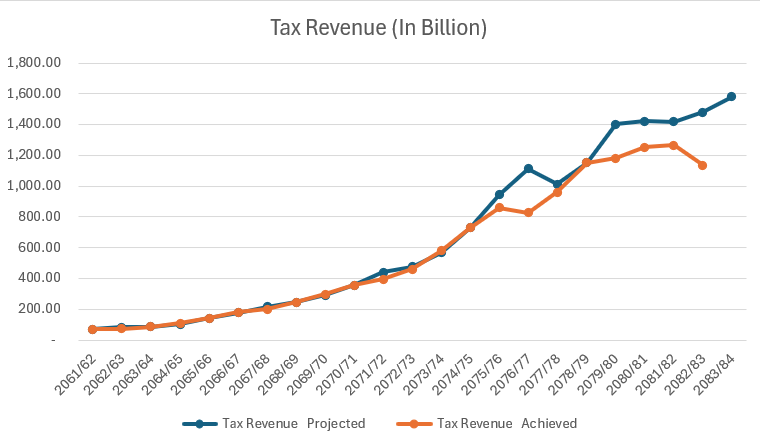
Tax revenue remains one of the major sources of funding for the Government of Nepal (GoN). Nepal’s tax revenue trend shows a gradually widening gap between projection and realization.
Projected tax revenue for FY 2061/62 stood at NPR 70.32 billion and increased to NPR 441.44 billion by FY 2071/72, representing a 5.28-fold increase over ten years.
In terms of actual collection, the government collected NPR 71.32 billion in FY 2061/62, which increased to NPR 393.51 billion by FY 2071/72, reflecting a 4.50-fold increase.
The average achievement rate of tax collection during this period stood at 98%, suggesting that government projections and execution were relatively practical and realistic before federal restructuring.
Projected tax revenue for FY 2072/73 stood at NPR 475.01 billion. Over the following decade, projected tax revenue increased to NPR 1,580.32 billion (including federal and provincial levels), representing a 2.33-fold increase.
However, actual tax revenue collection increased from NPR 460.43 billion to only NPR 1,135.23 billion, reflecting a 1.47-fold increase.
The average achievement rate for tax revenue stood at 91% during the post-Constitution period. Overall, the average tax revenue achievement ratio remained around 95% from FY 2061/62 to FY 2082/83.
AID
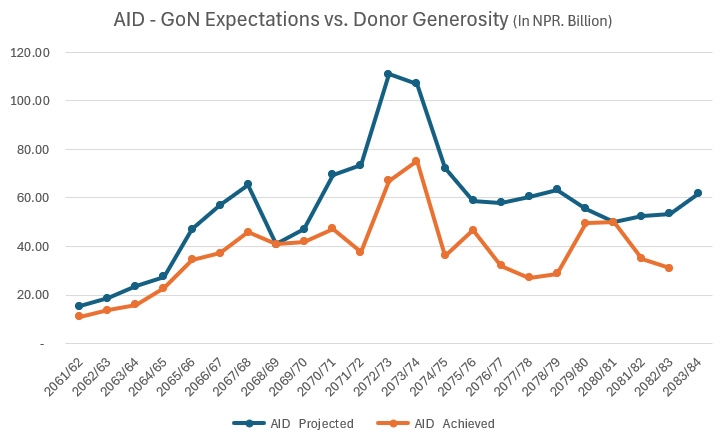
The Government of Nepal has historically considered foreign aid as an important source of financing for development activities. However, Nepal’s aid trend reveals a growing gap between government expectations and actual donor support.
Projected aid for FY 2061/62 stood at NPR 15.35 billion and increased to NPR 73.39 billion by FY 2071/72, representing a 3.78-fold increase.
In reality, actual aid received increased from NPR 11.17 billion to NPR 37.73 billion during the same period, representing only a 2.38-fold increase.
The average aid realization ratio stood at 74%, indicating that government expectations were consistently more optimistic than actual donor commitments.
This trend also suggests that development partners may have become increasingly cautious regarding Nepal’s institutional capacity, governance efficiency, and project implementation effectiveness.
Projected aid for FY 2072/73 reached NPR 110.93 billion, reflecting the government’s high expectations for post-earthquake reconstruction support.
However, over the following decade, projected aid declined to NPR 53.45 billion, nearly halving in size. Similarly, actual aid received declined from NPR 67.08 billion to NPR 31 billion during the same period.
The average aid realization ratio after Constitution 2072 stood at only 65%. Overall, Nepal’s average aid achievement ratio remained around 70% from FY 2061/62 to FY 2082/83.
Debt Financing
Debt financing has become one of the major sources used to finance Nepal’s fiscal deficit.
Overall, the Government of Nepal allocated around 19% of total projected budget financing through debt (foreign and domestic combined) from FY 2061/62 to FY 2071/72. In practice, actual debt financing represented around 17% of the implemented budget during the same period.
From FY 2072/73 to FY 2082/83, the average projected debt portion increased significantly to 29% of the proposed budget, while actual implementation stood at around 27%.
The Government of Nepal classifies debt into two categories:
- Foreign Debt
- Domestic Debt
Foreign Loan
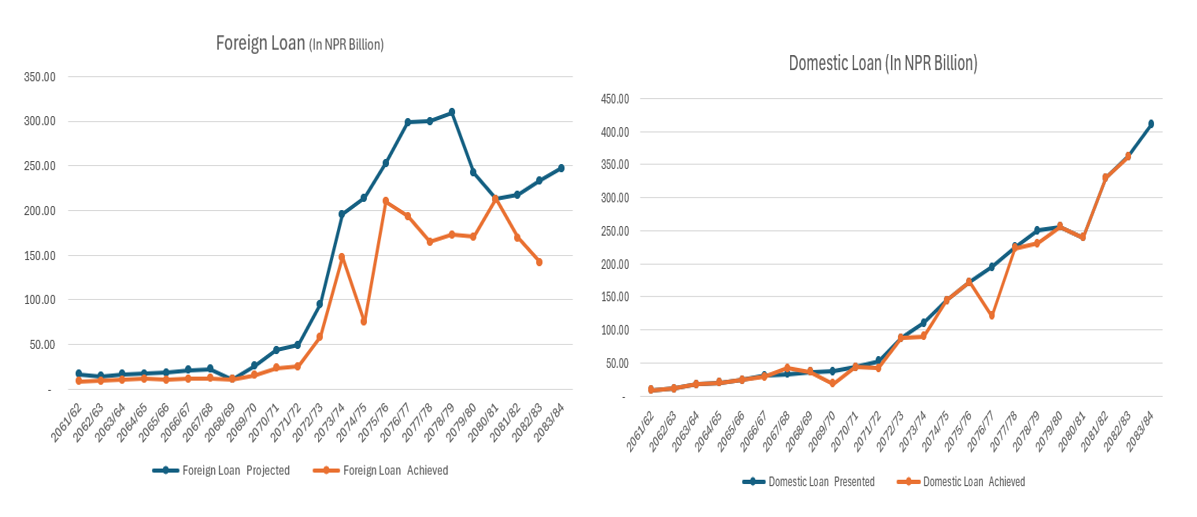
Nepal planned to mobilize NPR 16.96 billion in foreign loans in FY 2061/62, representing around 15% of the proposed budget. However, actual foreign borrowing represented only 9% of the implemented budget.
Before Constitution 2072, Nepal intended to finance approximately 9% of its proposed budget through foreign borrowing on average. In reality, actual foreign borrowing accounted for only around 6% of the implemented budget.
After Constitution 2072, the government significantly increased the projected share of foreign borrowing to around 15% of the proposed budget on average. However, actual foreign borrowing accounted for only around 12% of implemented expenditure.
Since FY 2076/77, the share of foreign borrowing in the implemented budget has shown a declining trend.
Domestic Loan
Nepal planned to mobilize NPR 9.06 billion in domestic borrowing in FY 2061/62, representing around 8% of the proposed budget. In reality, domestic borrowing represented around 9% of the implemented budget.
Before Constitution 2072, Nepal maintained domestic borrowing at around 10% of the proposed budget on average. Actual domestic borrowing accounted for around 11% of implemented expenditure.
After Constitution 2072, the government increased the projected domestic borrowing share to around 14% of the proposed budget. In practice, domestic borrowing accounted for around 15% of implemented expenditure.
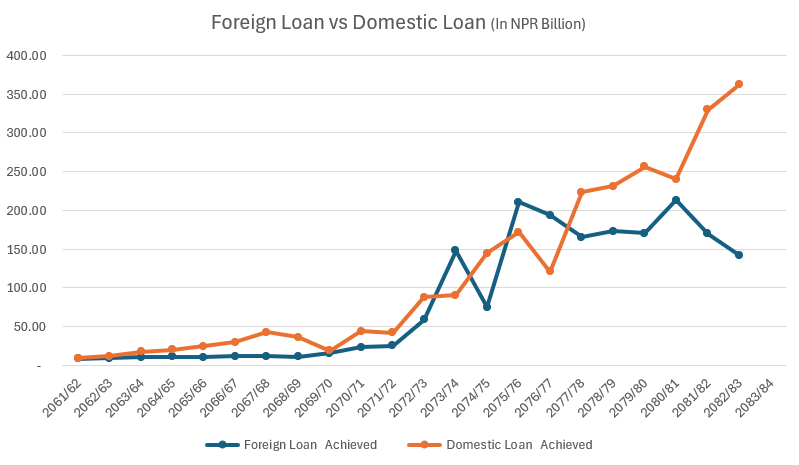
Since FY 2072/73, the share of domestic borrowing in actual implemented budgets has steadily increased.
Conclusion
For FY 2083/84, Finance Minister Dr. Swarnim Wagle has projected total resources of NPR 2,124.34 billion. The key question remains: will Nepal establish a new benchmark in revenue realization, or will the historical implementation gap persist?
Assumptions for Government Achievement
- If the government fails to address the structural inefficiencies that emerged after Constitution 2072, Nepal may achieve only around 85% of the projected budget.
- If the government successfully reforms structural and administrative weaknesses, achievement rates could improve toward the pre-Constitution average of around 90%.
- The government could outperform expectations, if it effectively utilizes its parliamentary strength to implement major policy reforms, improve governance efficiency, and accelerate the half completed multidimensionally impactful projects such as hydropower (i.e. with WIP 50% and above of physical and financial), irrigation (i.e. Sunkoshi Marine Diversion, Bheri Babai) , airports (i.e. Bhairahawa, Pokhara and other domestic) , road networks (i.e. Kathmandu Tarai Fast Track), information technology infrastructure, and industrial development. Strong collaboration with the private sector will also be essential.
The government should prioritize strengthening tax collection efficiency and broadening the tax base.
At the same time, Nepal should gradually reduce excessive dependence on foreign aid and debt financing.
Debt Concerns
The government has become increasingly reliant on debt to finance fiscal gaps. On average, around 24% of the proposed budget has been financed through debt, while actual implementation remained around 22%.
One alarming trend is the rapid growth of domestic borrowing. The average growth rate of domestic loans mobilized by the government stood at approximately 26% during the study period from FY 2061/62 to FY 2082/83.
Although Nepal currently has sufficient liquidity in the banking system, excessive government borrowing could eventually create competition for financial resources between the government and the private sector. This may increase the cost of funds for businesses and reduce private sector investment capacity in the future.
Ultimately, Nepal’s fiscal challenge is no longer only about revenue generation. The deeper issue lies in implementation efficiency, institutional capacity, and realistic fiscal planning.

